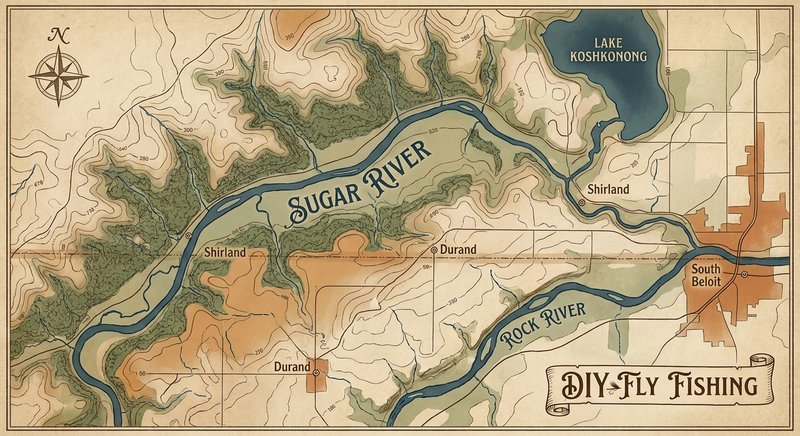
Sugar River
Fly fishing in Illinois · Intermediate · Best seasons: Spring, Fall
Target Species
Northern Pike, Smallmouth Bass, Bass, Pike
About This Water
A sandy-bottomed river meandering through forest preserves, ideal for chasing northern pike on large streamers.
Fishing Recommendations
The Sugar River in Northern Illinois (Winnebago County) is one of the region's hidden gems. Flowing south from Wisconsin to join the Pecatonica River, it is a low-gradient, meandering stream characterized by sandy bottoms, heavy woody debris, and surprising water clarity for a prairie river.
Here is your guide to mastering the Sugar River for Northern Pike and Smallmouth Bass.
🎣 Location Overview
The Sugar River is a "wild" feeling river tucked away in a state dominated by agriculture. What makes it special is its riparian corridor; much of the Illinois stretch flows through the Sugar River Alder Forest and various Forest Preserves, meaning you aren't staring at backyards or cornfields.
The water is stained but generally carries a "tea" color rather than mud. It is characterized by deep outside bends, massive log jams, and expansive sandbars. Because it is relatively shallow and slow, it is highly approachable for both wade anglers (during low water) and kayak/canoe anglers.
🐟 Target Species & Behavior
Smallmouth Bass
The "bronzebacks" here are hardy and opportunistic.
- Behavior: They hold tight to wood. In the Sugar, if you aren't bumping your fly against a sunken log, you aren't in the strike zone.
- Feeding: They focus on crawfish and emerald shiners. During the summer, they will look up for terrestrial insects (grasshoppers) and frogs.
Northern Pike
The Sugar is one of the few places in Illinois where you can consistently target river pike on a fly rod.
- Behavior: These are ambush predators. They sit in the "slack water" or eddies created by large fallen trees and in the deep, slow pools.
- Feeding: They are cannibalistic and highly aggressive toward large caloric payoffs—suckers, chubs, and smaller bass.
📅 Best Times to Fish
Spring (Late March – May)
- The Window: This is prime Pike season. As the water warms into the 40s and 50s, pike become active pre- and post-spawn.
- Conditions: Look for stable water levels. If the river is "blown out" from spring rains, wait 3-4 days for the visibility to return to at least 18 inches.
Fall (September – Early November)
- The Window: This is the best time for Smallmouth Bass. As water temperatures drop, bass feed heavily to prepare for winter.
- Conditions: Low, clear water is common in the fall. This is the time for stealthy approaches and "match the hatch" baitfish patterns.
Time of Day
- Pike: 10:00 AM to 2:00 PM. Pike are sight hunters and often wait for the sun to overhead to illuminate the water.
- Smallmouth: Low light—early morning and the hour before sunset.
🪰 Recommended Flies & Techniques
For Northern Pike
- Flies: 6–8 inch streamers. Barry’s Pike Fly, Gamechangers (in white/chartreuse), and Dahlberg Divers.
- Technique: Use a 8-weight or 9-weight rod with a floating line and a sink tip or an intermediate sink line. You must use a wire tippet (15-20lb multi-strand) to prevent bite-offs.
- Presentation: Cast tight to wood, let the fly sink for 2 seconds, and use "erratic" strips with long pauses.
For Smallmouth Bass
- Flies: Clouser Minnows (Chartreuse/White), Murdich Minnows, and Near Nuff Craws. For topwater, use Boogle Bug Poppers.
- Technique: A 6-weight rod is perfect. Use a 7.5ft 1X or 2X fluorocarbon leader.
- Presentation: "Swim" the fly through the current seams. If fishing crawfish patterns, let them bounce along the sandy bottom near rock transitions.
💡 Pro Tips & Local Knowledge
- The "Wood" Factor: If you see a massive downed tree in a deep bend, spend 20 minutes picking it apart. Start at the downstream end and work your way up. Pike often sit in the "quiet" water right behind the thickest trunk.
- Paddle vs. Wade: While you can wade near the Forest Preserve access points, the Sugar is best fished from a kayak or canoe. This allows you to reach the "unpressured" wood in the middle of stretches that wade-anglers can't get to.
- The Color Palette: Because of the tea-colored water, Black and Blue streamers often outperform natural colors on overcast days. On sunny days, go with White and Silver to catch the light.
- Short Casts: Accuracy is more important than distance. You rarely need to cast more than 30-40 feet; focus on "placing" the fly in the pockets between branches.
⚠️ Important Information
Access Information
The best access points are managed by the Winnebago County Forest Preserve District:
- Sugar River Alder Forest Preserve: Great for bank access and wading.
- Sugar River Forest Preserve (Shirland, IL): Offers a boat launch and excellent water for both pike and bass.
- Colored Sands Forest Preserve: Beautiful scenery and good wading opportunities during low water.
Regulations
- License: An Illinois Fishing License is required.
- Limits: Check current Illinois DNR "Site Specific" regulations for Winnebago County, as size and creel limits for Smallmouth and Pike can change seasonally to protect the fishery.
- Safety: The Sugar River has many "strainers" (fallen trees). If paddling, be extremely cautious of the current pushing your boat into logs. Always wear a PFD.
Special Considerations
The Sugar River is an environmentally sensitive area. It contains several endangered species of mussels and plants. Clean, Drain, and Dry your gear to prevent the spread of invasive species between this river and the nearby Rock or Pecatonica rivers.
Bug Hatches & Matching Flies
| Hatch | Type | Peak months | Time of day | Hook sizes | Matching flies |
|---|---|---|---|---|---|
| Chironomids Chironomidae | midge | March, April, November | All day | #18-24 | Zebra Midge #18-22, Griffith's Gnat #20-24 |
| Blue Winged Olive Baetis spp. | mayfly | April, October | Afternoon | #18-22 | RS2 #20-22, BWO Parachute #18-20 |
| Hendrickson Ephemerella subvaria | mayfly | April, May | Afternoon | #12-14 | Hendrickson Dark #12-14, Pheasant Tail Nymph #12-16 |
| Grannom Caddis Brachycentrus | caddis | May | Morning/Evening | #14-16 | Elk Hair Caddis #14-16, Peacock Caddis Larva #14-16 |
| Light Cahill Stenonema ithaca | mayfly | June, July | Evening | #12-14 | Light Cahill #12-14, Gold Ribbed Hare's Ear #12-14 |
| Hex Hexagenia limbata | mayfly | June, July | Dusk/Night | #6-10 | Hex Hagen #6-8, Hex Nymph #6-10 |
| Spotted Sedge Hydropsyche | caddis | June, July, August | Evening | #14-18 | Sparkle Pupa #16-18, X-Caddis #14-18 |
| Trico Tricorythodes | mayfly | August, September | Morning | #20-24 | Trico Spinner #22-24, Sunken Trico #22-24 |
| White Miller Ephoron leukon | mayfly | August | Evening/Dusk | #12-14 | White Wulff #12-14, Snowshoe Emerger #14 |
| Terrestrials Formicidae/Gryllidae | terrestrial | July, August, September | Mid-day/Afternoon | #10-16 | Dave's Hopper #10-12, Black Foam Ant #14-18 |