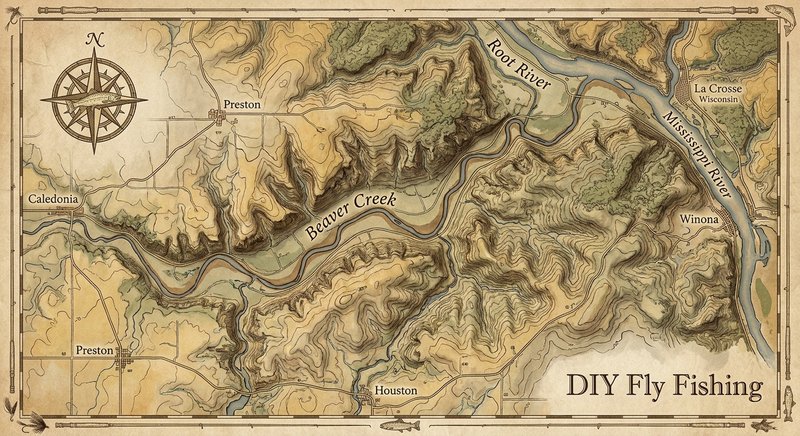
Beaver Creek
Fly fishing in Minnesota · Advanced · Best seasons: Spring, Winter
Target Species
Brown Trout
About This Water
Located within Beaver Creek Valley State Park, this crystal clear stream offers technical sight-fishing for spooky brown trout.
Fishing Recommendations
🎣 Location Overview
Beaver Creek, located within the Beaver Creek Valley State Park and extending into Houston County, is one of Southeast Minnesota’s most iconic "Driftless Area" spring creeks. What makes this water special is its consistent, cold-water flow provided by Big Spring, which pumps out roughly 5,000 gallons per minute at a constant 48°F.
The water is characterized by its extreme clarity and classic spring creek features: deep undercut banks, lush beds of watercress, and gravel runs. Anglers love it because it offers a "big mountain" feel in a intimate limestone valley, providing some of the most technical and rewarding sight-fishing opportunities in the Midwest.
🐟 Target Species & Behavior
Primary Species: Wild Brown Trout (with occasional stocked Rainbows in the State Park section).
- Behavior: These are wild, wary fish. Because the water is gin-clear, the trout are highly sensitive to shadows and overhead movement.
- Holding Patterns: Browns here hold tight to the undercut banks and beneath the "overhangs" of the tall grass. During hatches, they move into the tailouts of pools and the "pockets" within the watercress.
- Feeding: They are highly opportunistic but selective on size. Their diet consists heavily of scuds (freshwater shrimp), sowbugs, midges, and the prolific Blue-Winged Olive (BWO) hatches.
📅 Best Times to Fish
Optimal Seasons
- Spring (March - May): This is the "Golden Era" on Beaver Creek. As the snow melts, the BWO hatches begin, and the fish become aggressive after the lean winter months.
- Winter (January - February): Because it is spring-fed, the water rarely freezes. On sunny winter afternoons, you can find midges hatching and trout rising in 30-degree weather.
Best Times of Day
- Spring: 11:00 AM to 4:00 PM. This aligns with the warmest part of the day when insects are most active.
- Winter: 12:00 PM to 3:00 PM. Look for "midge windows" when the sun hits the water.
Prime Conditions
Overcast, drizzly days are arguably the best. The low light masks your presence and encourages the heavy BWO hatches that the Driftless is famous for.
🪰 Recommended Flies & Techniques
Top Fly Patterns
- Nymphs: Pink Squirrel (size 14-18), Gold-Ribbed Hare's Ear (16-20), Zebra Midge (18-22), and Scuds (gray or olive, 14-18).
- Dry Flies: Parachute Adams (18-22), BWO Sparkle Dun (18-22), Griffith’s Gnat (20-24).
- Streamers: Black or Olive Woolly Buggers (size 8-10) for high-water conditions.
Effective Techniques
- European Nymphing / Tight-Line: Very effective in the deeper runs within the State Park.
- Dry-Dropper: Use a buoyant foam hopper or large Parachute Adams with a small Zebra Midge or Scud dropped 18 inches below. This is the go-to for covering watercress edges.
- Sight Fishing: On clear days, stay back from the bank, use polarized glasses, and spot a specific fish before casting.
Presentation Tips
Keep it light. Use 6X or 7X fluorocarbon tippet. The fish have plenty of time to inspect your fly in the slow, clear pools. A downstream drift with a reach cast can often fool the larger, more cautious Browns.
💡 Pro Tips & Local Knowledge
- The "Beaver Creek Stealth": Do not walk right up to the bank. Stay 5-10 feet back and kneel. If you can see the fish, they have likely already seen you.
- Fish the "Rough" Water: Most anglers flock to the slow, deep pools. Expert guides know that the larger Browns often move into the shallow, bubbly riffles to feed because they feel more concealed by the surface turbulence.
- The State Park Boundary: The fishing is excellent inside the State Park, but if you want less pressure, head to the Beaver Creek Wildlife Management Area (WMA) sections located downstream or upstream of the park boundaries.
- Check the Gauge: If the nearby Root River is blown out and muddy, Beaver Creek often remains fishable due to its spring-fed nature, though it may have a slight "milky" tint.
⚠️ Important Information
- Access: Beaver Creek Valley State Park requires a vehicle permit. There are well-maintained trails along the stream.
- Regulations:
- Much of this area is under Catch and Release only or specific slot limits depending on the exact stretch.
- Barbless hooks are highly recommended (and required in some special regulation areas of the Driftless).
- A Minnesota Trout Stamp is required in addition to your fishing license.
- Special Considerations: Watch out for wild parsnip in the summer (can cause skin burns). In the spring and winter, be mindful of "Redds" (trout spawning beds)—do not walk on patches of bright, clean gravel.
Bug Hatches & Matching Flies
| Hatch | Type | Peak months | Time of day | Hook sizes | Matching flies |
|---|---|---|---|---|---|
| Midges Chironomidae | midge | January, February, March, December | Late Morning/Afternoon | #18-24 | Zebra Midge #18-22, Griffith's Gnat #20-24, Morgan's Midge #20-22 |
| Blue Winged Olive Baetis | mayfly | April, May, September, October | Midday | #18-22 | RS2 #20-22, Parachute Adams #18-22, Pheasant Tail Nymph #18-20 |
| Cranefly Tipulidae | other | May, June, July, August | Morning/Evening | #10-14 | Crane Fly Larva #10-12, Killer Bug #12-14 |
| Sulphur/Pale Morning Dun Ephemerella invaria | mayfly | May, June | Late Afternoon/Evening | #14-18 | Sulphur Parachute #16-18, Frenchie #14-16, Sparkle Dun #16-18 |
| Grannom Caddis Brachycentrus | caddis | April, May | Morning/Afternoon | #14-16 | Elk Hair Caddis #14-16, Holy Grail Caddis #14-16 |
| Light Cahill Stenacron canadense | mayfly | June, July | Evening | #12-14 | Light Cahill #12-14, Cream Usual #12-14 |
| Scud Gammarus | crustacean | March, April, May, September | All Day | #12-18 | Ray Charles #14-18, Pink Scud #12-16 |
| Trico Tricorythodes | mayfly | July, August, September | Early Morning | #20-24 | Trico Spinner #20-24, Trico Parachute #22-24 |
| Terrestrials (Hoppers/Ants/Beetles) Formicidae/Carabidae | terrestrial | July, August, September | Afternoon | #10-18 | Fat Albert #10-14, Black Foam Ant #16-18, Cinnamon Ant #14-16 |
| Cinnamon Caddis Hydropsyche | caddis | June, July, August | Evening | #14-18 | Iris Caddis #16-18, Caddis Larva #14-16 |