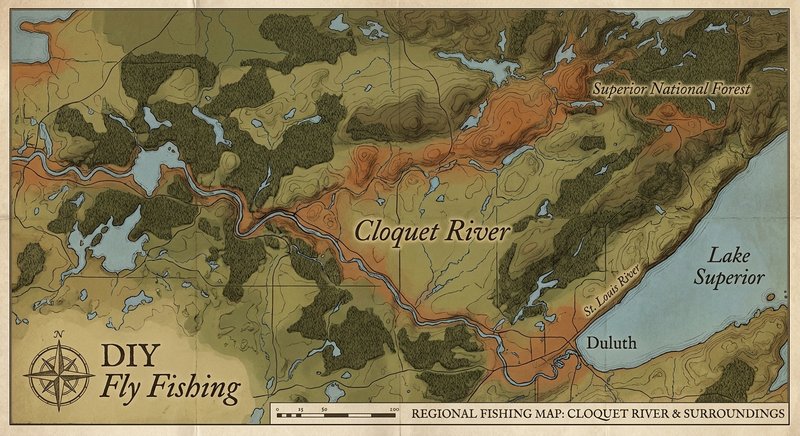
Cloquet River
Fly fishing in Minnesota · Intermediate · Best seasons: Summer
Target Species
Smallmouth Bass
About This Water
A boulder-strewn river that provides a wilderness feel and excellent topwater action for aggressive smallmouth bass.
Fishing Recommendations
The Cloquet River is one of Northern Minnesota’s true hidden gems. Located just north of Duluth, it offers a "wild" experience without the long haul into the Boundary Waters. It is a classic boreal river characterized by dark, tannin-stained water, granite boulders, and a mix of lazy bends and rocky riffles.
🎣 Location Overview
The Cloquet is a tributary of the St. Louis River. What makes it special is its transition: the upper reaches are narrow and forest-choked, while the middle and lower sections (below Island Lake) offer world-class Smallmouth Bass habitat.
Anglers love it because it feels remote. You are fishing through a corridor of white pine, balsam fir, and birch. The water is "tea-colored" due to the surrounding peatlands, which affects visibility and fly selection. It is a shallow river, making it ideal for wading in some spots, but it is best explored via canoe or a small raft.
🐟 Target Species & Behavior
Smallmouth Bass
The "Bronzebacks" here are aggressive and hard-fighting. In the Cloquet, they favor rock-to-sand transitions and the downstream side of large boulders. Because the water is dark, they rely heavily on their lateral line and silhouette detection.
- Feed on: Crayfish (primary), emerald shiners, leeches, and dragonflies.
Walleye
While often thought of as a gear-fisherman's fish, the Cloquet's Walleyes are very susceptible to the fly, especially in the evening. They hold in deeper "black holes" during the day and move into the tail-outs of riffles to feed at dusk.
- Feed on: Fathead minnows, leeches, and mayfly nymphs during hatches.
📅 Best Times to Fish
Optimal Seasons: Summer (June – August)
This is the prime window. Smallmouth activity peaks when the water temperature hits the 65°F–75°F range.
- June: Post-spawn aggression. Fish are shallow and hungry.
- July/August: Peak topwater action.
Best Times of Day
- Smallmouth: 10:00 AM to 4:00 PM for subsurface streamers; 6:00 PM to dark for topwater.
- Walleye: The "Magic Hour" (30 minutes before and after sunset). In tannin water, Walleyes will also feed during overcast, "gloomy" days.
Prime Conditions
Low to moderate flow is ideal. If the river is blown out from heavy rain, the dark water becomes "coffee with cream," and fishing becomes nearly impossible until it settles.
🪰 Recommended Flies & Techniques
Top Fly Patterns
- Murdich Minnow (Silver/White or Gold): The flash is essential in dark water.
- Clouser Minnow (Orange/Brown or Chartreuse/White): Mimics crayfish and shiners. Use lead eyes to get down in the current.
- Gamechanger (Small 3-inch version): Excellent for enticing larger Smallmouth.
- BoogleBug or Umpqua FeatherBullet: High-floating poppers for evening topwater.
- Woolly Bugger (Black or Olive): The ultimate Walleye fly when swung through deep runs.
Techniques & Presentation
- The "Crayfish Hop": Use a sink-tip line and bounce a heavy streamer along the bottom. The Smallmouth will often pick it up on the pause.
- The Swing: For Walleye, cast 45 degrees downstream and let the fly swing into the deeper holes.
- Popper Chugging: Don't just twitch the popper; make it "bloop" loudly. The vibration helps fish find the fly in the dark water.
💡 Pro Tips & Local Knowledge
- The "Boulder Garden" Strategy: If you see a cluster of rocks in the middle of the river, fish the front of the rocks first, then the soft "seam" behind them. The biggest bass often sit right in front of the rock to get first dibs on drifting food.
- Think Orange: In tannin-stained water, fluorescent orange and gold are the highest visibility colors. Adding a few strands of orange flash to your flies can double your hook-up rate here.
- Stealth Wading: The river is quiet. If you are wading, move slowly. The crunch of gravel under your wading boots can spook fish in the shallower runs.
- Recommended Stretch: The section from Fredenberg (Island Lake Dam) down to the St. Louis River confluence is prime. The stretch near Independence, MN, offers great public access and classic Smallmouth water.
⚠️ Important Information
Access
- Canoe/Kayak: There are several DNR-maintained carry-in sites. The river is generally Class I-II, but be prepared for some "boulder hopping" during low water.
- Wading: Public road crossings and DNR landings provide entry, but much of the bank is private. Stay in the water to remain legal.
Regulations
- A standard Minnesota Fishing License is required.
- Special Note: Check current MN DNR "Special Regulations" for the Cloquet. Often, there are specific length limits for Walleye and Smallmouth to ensure the trophy quality of the river remains intact. Catch and release is highly encouraged for the larger "breeder" bass.
Safety
- Mosquitoes/Ticks: This is Northern Minnesota. Bring heavy-duty repellent (DEET or Picaridin) and wear long sleeves.
- Cell Service: Spotty at best. Download offline maps (like OnX or Google Maps) before heading out.
Bug Hatches & Matching Flies
| Hatch | Type | Peak months | Time of day | Hook sizes | Matching flies |
|---|---|---|---|---|---|
| Early Brown Stonefly Strophopteryx fasciata | stonefly | March, April | Afternoon | #12-16 | Early Brown Stone #14-16, Prince Nymph #12-14 |
| Hendrickson Ephemerella subvaria | mayfly | May | Afternoon | #12-14 | Red Quill #12-14, Pheasant Tail #12-14 |
| Sulphur / Pale Evening Dun Ephemerella invaria/rotunda | mayfly | May, June | Evening | #14-18 | Sulphur Parachute #14-18, Hare's Ear #14-16 |
| Cinnamon Caddis Hydropsyche spp. | caddis | June, July | Evening/Dusk | #14-18 | Elk Hair Caddis (Tan) #14-16, LaFontaine's Deep Pupa #16 |
| Brown Drake Ephemera simulans | mayfly | June | Late Evening | #8-12 | Brown Drake Spinner #10-12, Gold Ribbed Hare's Ear #8-10 |
| White Mayfly / White Miller Ephoron leukon | mayfly | August | Night/Dusk | #12-14 | White Wulff #12-14, White Sparkle Dun #14 |
| Trico Tricorythodes spp. | mayfly | July, August, September | Early Morning | #20-24 | Trico Spinner #22-24, Zebra Midge #20-22 |
| Giant Orange Sedge Pycnopsyche spp. | caddis | September, October | Evening | #8-10 | Orange Stimulator #8-10, October Caddis Pupa #8-10 |