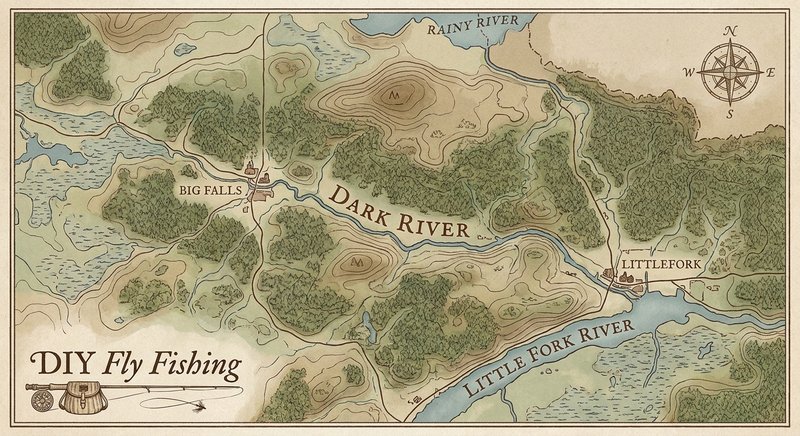
Dark River
Fly fishing in Minnesota · Intermediate · Best seasons: Summer
Target Species
Brook Trout
About This Water
A remote Iron Range gem that offers solitude and a healthy population of native brook trout in a wilderness setting.
Fishing Recommendations
The Dark River, located in the heart of the Superior National Forest north of Virginia, Minnesota, is one of the Midwest’s hidden gems for wild Brook Trout. While Minnesota is famous for its lakes, its "Arrowhead" region holds intimate, tannin-stained rivers that offer a true wilderness experience.
Here is your professional guide to fishing the Dark River.
🎣 Location Overview
The Dark River is a quintessential boreal stream. It is characterized by its tannin-stained "root beer" water, which is a result of the surrounding peatlands and coniferous forests.
What makes it special is its isolation and rugged beauty. Unlike the manicured spring creeks of SE Minnesota’s Driftless Area, the Dark River is wild, brushy, and boulder-strewn. It features a classic mix of riffles, deep undercut banks, and slow-moving pools. Anglers love it because it offers high numbers of wild Brookies in a setting where you are more likely to see a moose or a wolf than another fisherman.
🐟 Target Species & Behavior
Species: Wild Brook Trout (Salvelinus fontinalis).
Behavior:
- Holdings: These fish are opportunistic but wary. Look for them in the "seams" where fast water meets slow water, under overhanging alder branches, and behind large granite boulders.
- Feeding: Because the Dark River is a relatively low-nutrient environment, the trout are not usually "picky" eaters, but they are "cautious" eaters. They rely heavily on terrestrial insects falling from the dense canopy and aquatic insects like caddis and stoneflies.
- Size: Most fish will be in the 6–10 inch range, but 12–14 inch "trophy" Brookies are present for the angler who can navigate the deep, woody debris.
📅 Best Times to Fish
Season: Summer (June – August)
- June: Prime time. The water levels have stabilized after the spring thaw, and the first major hatches (Mayflies) occur.
- July & August: The "Terrestrial Window." This is the best time for dry fly fishing. As the water warms slightly, trout move into the faster, oxygenated riffles.
Best Time of Day
- Early Morning: Best for streamer fishing or large nymphs before the sun hits the water.
- Late Evening: The "Golden Hour." The tannin water holds heat, and evening caddis hatches can trigger a feeding frenzy.
Conditions
- Cloudy days are your best friend. The dark water and overhead cover make Brookies feel bold. On bright, sunny days, stick to the heavily shaded "tunnels" of the river.
🪰 Recommended Flies & Techniques
Top Fly Patterns
- Dry Flies:
- Royal Wulff (Size 14-16): High visibility in dark water.
- Elk Hair Caddis (Tan or Olive, Size 14-18).
- Parachute Adams (Size 16).
- Terrestrials:
- Chernobyl Ant or Foam Beetles (Size 12-14). Brookies love a big meal that floats.
- Nymphs:
- Bead-head Pheasant Tail (Size 16-18).
- Gold-ribbed Hare’s Ear (Size 14).
- Streamers:
- Black or Olive Woolly Bugger (Size 8-10). Essential for pulling bigger fish out of deep log jams.
Techniques & Presentation
- The "Dap and Drop": The banks are extremely brushy. Often, you won't have room for a backcast. Use a short line to "dap" your fly under overhanging alders.
- Dry-Dropper: A very effective Summer rig. Hang a small Pheasant Tail nymph 18 inches below a foam beetle.
- Upstream Stealth: Always fish moving upstream. Because the water is dark, Brookies rely heavily on their lateral lines; if you wade clumsily, they will spook long before you see them.
💡 Pro Tips & Local Knowledge
- Focus on the "Dark River Trout Area": Look for the stretches managed by the DNR north of Dark Lake. The area near the Sturgeon River State Forest boundary offers some of the most consistent gradients.
- The "Log Jam" Theory: If a spot looks impossible to cast into because of fallen timber, that is exactly where the biggest Brookie is. Use a heavy 4x or 5x tippet so you can horse the fish out before they wrap you around a branch.
- Bug Protection: This is Northern Minnesota. In June and July, the mosquitoes and black flies are relentless. Wear long sleeves and bring high-quality repellent—it is the difference between a 1-hour trip and a 5-hour trip.
- Water Temps: If the summer is exceptionally hot, bring a thermometer. If the water hits 68°F (20°C), stop fishing to protect the Brookies, as they are highly sensitive to heat stress.
⚠️ Important Information
Access
- Access is primarily via forest service roads and bridge crossings.
- Warning: The ground can be "muskeg" (boggy). Be careful where you step near the banks, as you can easily sink to your waist in soft peat.
Regulations
- A Minnesota fishing license with a Trout Stamp is mandatory.
- Check the current MN DNR Trout Regulations, as many streams in the Northeast have specific harvest limits or are catch-and-release only for certain stretches.
Gear Recommendations
- Rod: 2wt to 4wt, 7’ to 8’ length. A shorter rod is better for the tight canopy.
- Waders: Breathable chest waders are recommended, not just for the water, but as protection against brush and ticks.
- Safety: This is bear country. While black bears are generally shy, making noise and carrying bear spray is a wise precaution for solo anglers.
Bug Hatches & Matching Flies
| Hatch | Type | Peak months | Time of day | Hook sizes | Matching flies |
|---|---|---|---|---|---|
| Blue Winged Olive Baetis | mayfly | April, May, September, October | Midday | #18-22 | RS2 #20-22, Parachute Adams #18-20, Pheasant Tail #18-22 |
| Hendrickson Ephemerella invaria | mayfly | May | Afternoon | #12-14 | Hendrickson Sparkle Dun #12-14, Red Quill #14, Hare's Ear Nymph #12-14 |
| Sulphur Ephemerella dorothea | mayfly | June, July | Evening | #14-18 | Sulphur Parachute #16-18, CDC Sulphur Emerger #16-18, Pheasant Tail #16 |
| Light Cahill Stenacron canadense | mayfly | June, July | Evening | #12-16 | Light Cahill #12-16, Gold Ribbed Hare's Ear #14 |
| Spotted Sedge Hydropsyche | caddis | May, June, July, August | Evening | #14-18 | Elk Hair Caddis #14-18, LaFontaine's Deep Sparkle Pupa #16, Peacock Caddis #16 |
| Giant Stonefly Pteronarcys dorsata | stonefly | May, June | Night/Early Morning | #4-8 | Kaufmann's Stone #6-8, Stimulator (Orange) #8-10, Pat's Rubber Legs #6-10 |
| Trico Tricorythodes | mayfly | July, August, September | Morning | #20-24 | Trico Spinner #22-24, Sunken Trico Spinner #22, Zebra Midge #20-22 |
| Grasshoppers Orthoptera | terrestrial | August, September | Midday | #8-12 | Dave's Hopper #10-12, Parachute Hopper #8-12, Chernobyl Ant #10 |
| Zebra Midge Chironomidae | midge | March, April, October, November | All Day | #18-24 | Zebra Midge #18-22, Griffith's Gnat #20-24, Top Secret Midge #20-22 |