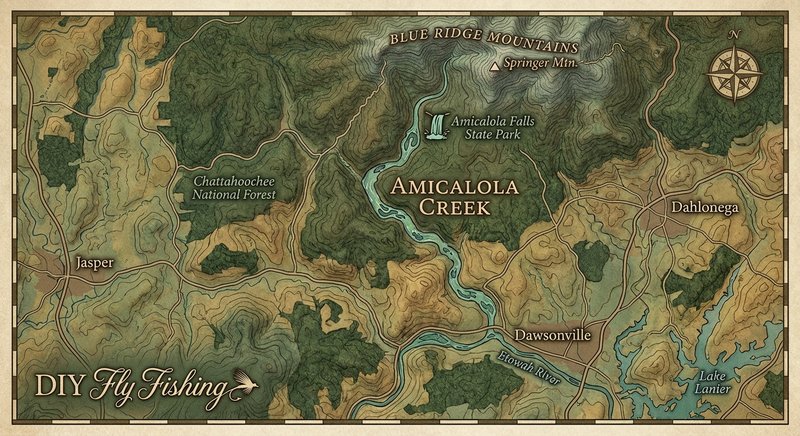
Amicalola Creek
Fly fishing in Georgia · Intermediate · Best seasons: Spring, Fall
Target Species
Rainbow Trout, Brown Trout, Brook Trout
About This Water
Amicalola Creek is a pristine mountain stream known for its wild trout population and scenic beauty near Amicalola Falls State Park.
Fishing Recommendations
Fly Fishing Guide: Amicalola Creek, Georgia
Amicalola Creek is one of Georgia’s most cherished trout destinations. Located in the foothills of the Blue Ridge Mountains near Dawsonville, it offers a unique blend of rugged scenery and accessible fishing. While it is famous for the nearby Amicalola Falls, for the angler, the draw is the Delayed Harvest (DH) section, which provides some of the most consistent trout fishing in the Southeast.
🎣 Location Overview
Amicalola Creek is a medium-sized freestone stream. What makes it special is the diversity of its terrain. It transitions from a steep, high-gradient mountain stream near the falls to a classic pool-and-riffle river in the lower sections.
The Delayed Harvest section (from Steel Bridge Road downstream to Hwy 53) is the primary draw. Because it is managed with special regulations, it maintains a high density of fish that are often larger than your average Georgia mountain trout. The water is generally tea-colored after rain but runs clear under normal conditions, with a bottom consisting of river rock, sand, and large granite boulders.
🐟 Target Species & Behavior
- Rainbow Trout: These are the most abundant species, especially in the DH section. They are aggressive and often hold in the faster "heads" of pools and riffles.
- Brown Trout: Known for being more elusive, the Browns tend to hold near woody debris, undercut banks, or at the very tail-outs of deep pools.
- Brook Trout: While less common in the lower DH section, you may find "stocker" brookies or wild specimens in the higher altitude tributaries.
- Behavior: During the DH season (Nov 1 – May 14), these fish are frequently stocked. Initially, they are "dumb" and will strike bright, flashy patterns. As the season progresses, they become highly pressured and "educated," requiring more technical presentations and smaller flies.
📅 Best Times to Fish
- Best Seasons:
- Spring (March – Early May): This is the "Golden Era" on the Amicalola. Water temperatures rise into the 50s, sparking major insect hatches (Quill Gordons, March Browns, and Caddis).
- Fall/Winter (November – February): This is the peak of the Delayed Harvest season. While the air is cold, the fishing is productive because of the high fish density.
- Best Times of Day: In late spring, early morning and late evening are best. In the dead of winter, wait until the sun hits the water (11:00 AM – 3:00 PM) to trigger insect activity and increase the fish's metabolic rate.
- Conditions: Look for "green" water—roughly 24 to 48 hours after a rain. Crystal clear water makes the fish spooky, while "chocolate milk" mud makes fishing nearly impossible.
🪰 Recommended Flies & Techniques
Top Fly Patterns
- Nymphs:
- Attractors: Sexy Walt’s Worm, Rainbow Warrior (Size 14-16), Squirmy Wormy (Red/Pink).
- Natural: Pheasant Tail Nymph (16-18), Hare's Ear, and Zebra Midges (20-22) for picky fish.
- Dry Flies:
- Elk Hair Caddis (Tan or Olive, 14-16).
- Parachute Adams (14-18) – the gold standard for searching.
- Stimulators (Orange or Yellow) – great for the faster pocket water.
- Streamers:
- Woolly Bugger (Black or Olive, 8-12).
- White Zonkers – highly effective for aggressive rainbows right after a stock.
Techniques
- Tight-Line/Euro Nymphing: This is the most effective way to fish the Amicalola. Because the bottom is uneven, getting your flies deep without the drag of a bobber is key.
- Dry-Dropper: Excellent for the late spring. Use a buoyant Stimulator as your "indicator" and hang a small Pheasant Tail 18 inches below it.
- The "Swing": If the water is slightly high, swinging a soft hackle or a small streamer through the tail of a pool can trigger aggressive strikes.
💡 Pro Tips & Local Knowledge
- The "Hike-In" Advantage: Most anglers congregate near the Steel Bridge or the parking lots off Hwy 53. If you are willing to hike 20–30 minutes into the middle of the DH section (the "gorge" area), you will find significantly less pressured fish and a more "wild" experience.
- Watch the Temperature: Once water temperatures hit 70°F (usually by June), stop fishing for trout. They become highly stressed and often won't survive the catch-and-release process. Switch to targeting the creek's excellent Redeye Bass during the summer.
- Small & Thin: By February, these fish have seen a thousand Y2Ks and Mops. Switch to very thin-profile nymphs (Perdigons) and 6X fluorocarbon tippet to fool the veterans.
⚠️ Important Information
- Regulations:
- Delayed Harvest (Nov 1 – May 14): Catch and release only. Single-hook, artificial lures only. No bait, no treble hooks.
- General Season (May 15 – Oct 31): Traditional mountain trout regulations apply (check GA DNR for harvest limits).
- Permits: You must have a Georgia Fishing License PLUS a Trout Supplement. These can be purchased online via the Go Outdoors Georgia website/app.
- Access:
- Steel Bridge Road: Provides access to the upper end of the DH.
- Hwy 53: Provides access to the lower end.
- Caution: The rocks in Amicalola are notoriously slippery. Felt-soled boots or studs are highly recommended.
- Wading Safety: Be cautious after heavy rains; the Amicalola drainage is large, and the creek can rise rapidly and become dangerous to wade.
Bug Hatches & Matching Flies
| Hatch | Type | Peak months | Time of day | Hook sizes | Matching flies |
|---|---|---|---|---|---|
| Blue Winged Olive Baetis species | mayfly | January, February, March, October, November | Midday | #18-22 | Parachute Adams #18-22, RS2 #20-22, Pheasant Tail #18-20 |
| Quill Gordon Epeorus pleuralis | mayfly | March | Midday | #12-14 | Quill Gordon Dry #12-14, Quill Gordon Wet #12-14, Hare's Ear Nymph #12-14 |
| March Brown Maccaffertium vicarium | mayfly | March, April | Afternoon | #10-14 | American March Brown #10-12, Gold Ribbed Hare's Ear #10-12 |
| Hendrickson Ephemerella subvaria | mayfly | April | Afternoon | #12-14 | Hendrickson Dry #12-14, Red Quill #12-14 |
| Cinnamon Caddis Hydropsyche species | caddis | May, June, September | Late Afternoon/Evening | #14-18 | Elk Hair Caddis (Tan) #14-16, Holy Grail Caddis #14-18, Pupa #16 |
| Giant Black Stonefly Pteronarcys dorsata | stonefly | April, May | Morning/All Day | #4-8 | Pat's Rubber Legs #6-10, Kaufmann's Stone #4-8 |
| Yellow Sally Isoperla species | stonefly | May, June, July | Late Afternoon | #14-16 | Yellow Sally Dry #14-16, Little Yellow Sloan #14-16 |
| Light Cahill Stenacron candadense | mayfly | June, July | Evening | #12-14 | Light Cahill Dry #12-14, Cream Usual #14 |
| Midges Chironomidae | midge | December, January, February | All Day | #20-26 | Zebra Midge #18-22, Griffith's Gnat #20-24, Top Secret Midge #20-22 |
| Terrestrials (Ants/Beetles) Formicidae/Coleoptera | terrestrial | July, August, September | Afternoon | #12-16 | Chernobyl Ant #10-14, Black Foam Beetle #14-16, Cinnamon Ant #16 |