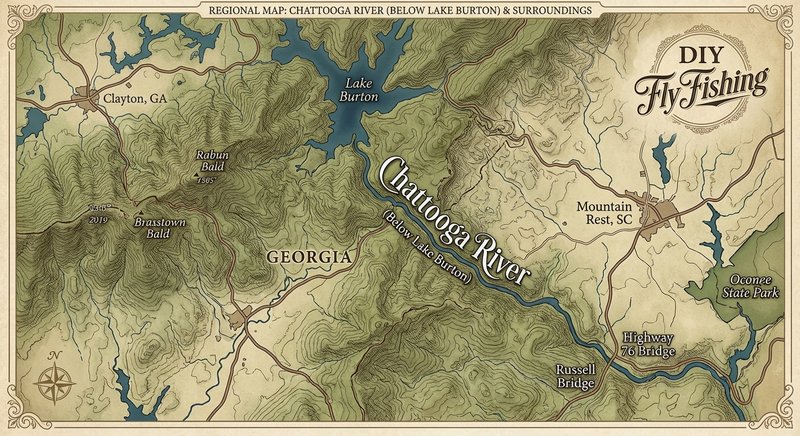
Chattooga River (Below Lake Burton)
Fly fishing in Georgia · Intermediate · Best seasons: Spring, Fall
Target Species
Rainbow Trout, Brown Trout, Brook Trout
About This Water
This section of the Chattooga offers excellent trout fishing in a beautiful, remote setting, with wild and stocked fish available.
Fishing Recommendations
The Chattooga River, specifically the section below Lake Burton (often referred to as the "Tallulah River" stretch or the headwaters area depending on local parlance, but focusing on the Chattooga’s GA/SC border sections), is one of the crown jewels of Southeastern fly fishing. It is a federally designated Wild and Scenic River, offering a wilderness experience that is rare in the Eastern United States.
🎣 Location Overview
The Chattooga is a free-flowing river (once you get past the immediate influence of the headwater impoundments) characterized by its rugged beauty, massive boulders, and deep, emerald-green pools. What makes it special is the diversity of water: you will find everything from technical pocket water and crashing falls to long, glassy glides.
Anglers love it because it offers a true "backcountry" feel. The river is divided into sections; the upper reaches near the North Carolina/Georgia line offer classic mountain trout water, while the lower sections transition into world-class smallmouth habitat. For trout, the focus remains on the Upper Chattooga (Section 0 and 1) and the Delayed Harvest (DH) section.
🐟 Target Species & Behavior
- Rainbow Trout: These are the most prevalent, especially in the DH section. They tend to hold in faster riffles and at the "heads" of pools where oxygen levels are highest.
- Brown Trout: The Chattooga is famous for its wild, "buttery" Browns. These fish are predatory and wary. They hold in "frog water" near undercut banks, under large boulders, or in the deep tailouts of pools during low light.
- Brook Trout: Found primarily in the high-altitude tributaries and the very uppermost reaches. They are opportunistic but small, requiring stealth and delicate presentations.
Feeding Behavior: In the spring, fish are aggressive and look for major hatches (Quill Gordons, March Browns). In the fall, they transition to caloric density—looking for streamers, large terrestrials, and egg patterns.
📅 Best Times to Fish
- Spring (March – May): This is the prime window. Water temperatures rise into the 50s, triggering massive insect activity. The Quill Gordon and Hendrickson hatches in late March are legendary.
- Fall (October – November): The "Delayed Harvest" season begins (Nov 1st), providing high catch rates. Additionally, wild Browns become aggressive as they prepare for the spawn.
- Best Time of Day: During Spring, 10:00 AM to 4:00 PM is best as the water warms. In the heat of early Fall, stick to the "Golden Hours" (dawn and dusk).
🪰 Recommended Flies & Techniques
Top Fly Patterns
- Nymphs: Prince Nymph (#12-16), Pheasant Tail (#14-18), Pat’s Rubber Legs (Black/Brown #8-12), and Sexy Walt’s Worm.
- Dry Flies: Parachute Adams (#14-18), Yellow Stimulator (#12-16) for Stonefly imitations, and Elk Hair Caddis (#14-16).
- Streamers: Woolly Bugger (Olive or Black #6-10) and the Gamechanger (for big Browns).
Techniques & Presentation
- High-Stick Nymphing: Because of the large boulders and complex currents, "high-sticking" or Euro-nymphing is incredibly effective to avoid drag.
- Dry-Dropper: A favorite for the Chattooga. Use a buoyant Stimulator as your indicator and hang a weighted Pheasant Tail 18-24 inches below it.
- The "Swing": On the large pools, swinging a wet fly or small streamer through the tailout can trigger aggressive strikes from Browns.
💡 Pro Tips & Local Knowledge
- The "Burrells Ford" Strategy: This is the most popular access point. To find better fishing, hike at least 1-2 miles upstream or downstream from the bridge to escape the "crowd" and find unpressured wild fish.
- Watch the Gauge: The Chattooga is rain-dependent. If the USGS gauge at Highway 76 is over 2.5 feet, wading can become dangerous. The "sweet spot" for wading is 1.8 to 2.2 feet.
- Stealth is Key: The water is often crystal clear. Wear earthy tones (camo/olive), keep a low profile, and try not to splash when wading. If you see a fish, it has likely already seen you.
⚠️ Important Information
- Access: Key access points include Burrells Ford Road, Highway 28 Bridge, and Bull Pen Road. Much of the river requires hiking in via Forest Service trails.
- Regulations:
- Georgia/South Carolina Reciprocity: You can fish the main stem of the Chattooga with either a GA or SC fishing license.
- Delayed Harvest (DH): From Nov 1 to May 14, the section from GA Hwy. 28 upstream to the mouth of Reed Creek is Catch and Release only, Single Hook Artificial Lures only.
- Safety: This is a rugged area with no cell service. Watch out for "widowmakers" (falling limbs) and be mindful of black bears and copperheads. Always tell someone your "float plan" before heading into the gorge.
Bug Hatches & Matching Flies
| Hatch | Type | Peak months | Time of day | Hook sizes | Matching flies |
|---|---|---|---|---|---|
| Blue Winged Olive Baetis | mayfly | February, March, October, November | Afternoon | #18-22 | RS2 #20-22, Parachute BWO #18-20, WD-40 #20-22 |
| Quill Gordon Epeorus confusus | mayfly | March, April | Midday | #12-14 | Quill Gordon Dry #12-14, Iron Blue Dun #12-14, Hare's Ear Nymph #12-14 |
| March Brown Maccaffertium vicarium | mayfly | April, May | Afternoon | #10-14 | March Brown Dry #12-14, Gold Ribbed Hare's Ear #10-12, March Brown Wet Fly #12 |
| Hendrickson Ephemerella subvaria | mayfly | April | Afternoon | #12-14 | Red Quill #14, Hendrickson Emerger #14, Pheasant Tail Nymph #12-14 |
| Yellow Sally Isoperla | stonefly | May, June, July | Late Afternoon/Evening | #14-16 | Yellow Sally Dry #14-16, Little Yellow Stone Nymph #14-16, Yellow Stimulator #14-16 |
| Golden Stonefly Acroneuria | stonefly | May, June | Evening/Night | #6-10 | Pat's Rubber Legs #6-10, Golden Stimulator #8-10, Kaufmann's Stone #8-12 |
| Tan Caddis Hydropsyche | caddis | April, May, September | Morning/Evening | #14-18 | Elk Hair Caddis #14-16, Holy Grail #16, Pupa-style Caddis #14-18 |
| Giant Black Stonefly Pteronarcys dorsata | stonefly | April, May | Afternoon/Evening | #4-8 | Black Rubber Legs #4-8, Girdle Bug #6-8, Black Stimulator #8 |
| Light Cahill Stenacron / Stenonema | mayfly | June, July | Evening | #12-16 | Light Cahill Dry #14-16, Cream Variant #12-14, Hare's Ear (Light) #14-16 |
| Terrestrials Formicidae / Gryllidae | terrestrial | July, August, September | Midday | #10-16 | Chernobyl Ant #10-12, Black Foam Beetle #14-16, Cinnamon Ant #16 |