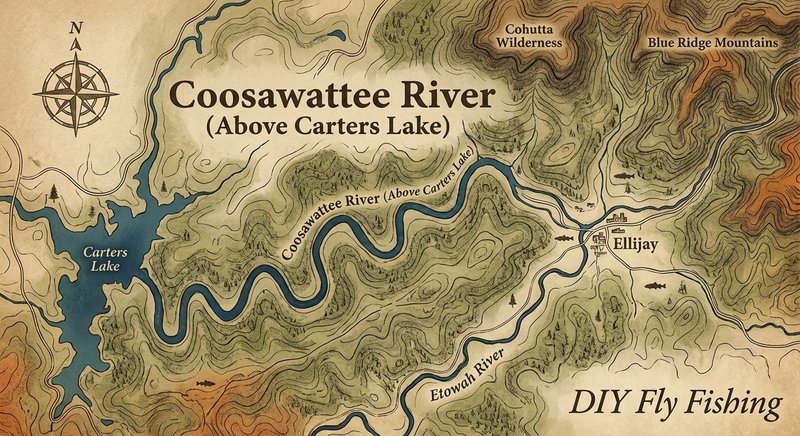
Coosawattee River (Above Carters Lake)
Fly fishing in Georgia · Intermediate · Best seasons: Spring, Fall, Winter
Target Species
Rainbow Trout, Brown Trout
About This Water
This section of the Coosawattee River offers clear water and trout fishing opportunities, especially in the cooler months.
Fishing Recommendations
The Coosawattee River, specifically the section above Carters Lake in Gilmer County, is one of North Georgia’s most underrated trout fisheries. While it doesn't get the same national press as the Toccoa or the Chattahoochee, it offers a rugged, scenic, and rewarding experience for anglers looking for a mix of stocked numbers and the chance at a wild-born holdover.
🎣 Location Overview
The upper Coosawattee is formed by the confluence of the Ellijay and Cartecay Rivers. This is a medium-sized river characterized by classic freestone features: deep pools, pocket water, and expansive gravel riffles.
What makes it special is the transition. It feels more "wild" than many roadside streams. The river is heavily influenced by the surrounding Appalachian foothills, offering cool water temperatures (though it can warm up in late summer). Anglers love it because it offers a "big water" feel compared to the tight rhododendron-choked creeks nearby, allowing for longer casts and more diverse tactical approaches.
🐟 Target Species & Behavior
- Rainbow Trout: These make up the bulk of the population. They are aggressive and tend to hold in faster water, particularly in the "heads" of pools where oxygen levels are high.
- Brown Trout: The "ghosts" of the Coosawattee. While fewer in number, the Browns here grow large by feeding on sculpins and smaller trout. They hold in deep undercut banks and behind large submerged boulders.
- Behavior: During the spring, fish are active throughout the day. In the winter, they move to the slower, deeper "guts" of the pools to conserve energy. Because this river can get stained after rain, the fish are often less "leader shy" than those in clearer mountain creeks.
📅 Best Times to Fish
- Optimal Seasons:
- Spring (March – May): This is the "Golden Era." Water temperatures hit the 50-55°F sweet spot, and insect activity peaks.
- Fall (October – November): Great for Brown Trout activity as they prepare for the spawn. The foliage is world-class.
- Winter (December – February): Excellent for nymphing. The river stays relatively stable, and crowds are non-existent.
- Best Times of Day: In Spring/Fall, 10:00 AM to 4:00 PM is prime. In the heat of early summer, focus on the "first light" window.
- Prime Conditions: Look for a "falling and clearing" river. A day or two after a rain when the water has a slight "tannin" or "tea" color is the best time to catch large, aggressive fish.
🪰 Recommended Flies & Techniques
Top Fly Patterns
- Nymphs:
- Pat’s Rubber Leg Stonefly (Sizes 8-12) – The "bread and butter" of the Coosawattee.
- Pheasant Tail Nymph (Sizes 14-18) – Flashy versions work well in stained water.
- Squirmy Worms / Egg Patterns – Essential after a rain or during stocking months.
- Dry Flies:
- Parachute Adams (Sizes 14-18) – The universal hatch matcher.
- Elk Hair Caddis (Sizes 12-16) – Great for the riffles.
- Chernobyl Ant (Sizes 8-10) – Used as a "hopper-dropper" lead fly in late summer/early fall.
- Streamers:
- Woolly Bugger (Olive or Black, Sizes 6-10).
- Gamechanger – For those hunting the trophy Browns near Carters Lake.
Techniques & Presentation
- High-Stick Nymphing: Because of the rocky bottom, a standard indicator rig can get snagged. Tight-line or "high-stick" nymphing through the pocket water is often more productive.
- The Swing: If you see fish rising but can't match the hatch, swing a small soft-hackle wet fly through the tail-outs of pools.
- Streamer Stripping: Don't be afraid to throw heavy sink-tips into the deep wood-filled bends.
💡 Pro Tips & Local Knowledge
- The "Confluence" Factor: The area where the Ellijay and Cartecay meet is a high-traffic zone for fish. Focus your energy here if you are new to the river.
- Wood is Good: Unlike many GA trout streams that are mostly rock, the Coosawattee has significant "blow-downs" (fallen trees). These are prime holding spots for the biggest Brown Trout in the river.
- The "Carters Lake Run": In the late winter and early spring, some fish may move up from the reservoir into the river. Use larger, flashier streamers during this window.
- Stealth: Even though the river is larger, the water is often clear. Wear earthy tones and avoid wading through the middle of a pool; fish the edges first.
⚠️ Important Information
- Access: Much of the Coosawattee flows through private land (especially within the Coosawattee River Resort).
- Public Access: Focus on the Easy Street Recreation Area and the DNR-managed areas near the Ellijay/Cartecay confluence.
- Kayaking: This is a popular "float-and-fish" river. Launching a kayak or raft allows you to reach water that walk-in anglers never see.
- Regulations:
- A Georgia Fishing License and a Trout Supplement are required.
- Check current DNR regulations as certain sections may have specific gear restrictions or seasonal closures.
- Safety: The river bottom is notoriously slick. Wading boots with studs and a wading staff are highly recommended. The current can be deceptively strong after a heavy rain.
Bug Hatches & Matching Flies
| Hatch | Type | Peak months | Time of day | Hook sizes | Matching flies |
|---|---|---|---|---|---|
| Blue Winged Olive Baetis | mayfly | February, March, October, November | Late Morning/Early Afternoon | #18-22 | Parachute Adams #18-22, RS2 #20-22, Pheasant Tail #18-20 |
| Hendrickson Ephemerella subvaria | mayfly | March, April | Afternoon | #12-14 | Red Quill #12-14, Hendrickson Emerger #12-14, Gold Ribbed Hare's Ear #12-14 |
| March Brown Maccaffertium vicarium | mayfly | April, May | Afternoon | #10-14 | March Brown Western #12-14, Hare's Ear Nymph #10-12 |
| Sulphur Ephemerella invaria/dorothea | mayfly | May, June | Evening | #14-18 | Sparkle Dun #16-18, Sulphur CDC Emerger #16-18, Pheasant Tail #16-18 |
| Caddis (Cinnamon & Tan) Hydropsyche / Cheumatopsyche | caddis | April, May, September | Morning/Evening | #14-18 | Elk Hair Caddis #14-18, Holy Grail #14-16, Pupa Larva #16 |
| Golden Stonefly Acroneuria | stonefly | June, July | Morning/Evening | #8-12 | Stimulator (Orange/Yellow) #8-12, Pat's Rubber Legs #8-12 |
| Light Cahill Stenacron interpunctatum | mayfly | June, July | Late Evening | #12-16 | Light Cahill #12-16, Cahill Wet Fly #14 |
| Terrestrials Formicidae / Gryllidae | terrestrial | July, August, September | All Day | #10-16 | Chernobyl Ant #10-12, Black Foam Beetle #14-16, Cinnamon Ant #16-18 |
| Midges Chironomidae | midge | December, January, February | Anytime | #20-24 | Zebra Midge #20-22, Griffith's Gnat #20-24, Morgan's Midge #22 |
| Giant Black Stonefly Pteronarcys dorsata | stonefly | March, April | Night/Early Morning | #4-8 | Black Kaufmann Stone #6-8, Girdle Bug #6-10 |