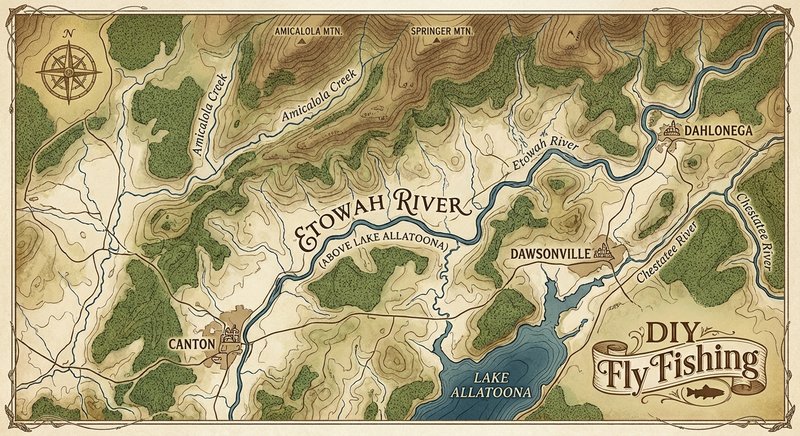
Etowah River (Above Lake Allatoona)
Fly fishing in Georgia · Intermediate · Best seasons: Spring, Fall
Target Species
Rainbow Trout, Brown Trout, Brook Trout
About This Water
The upper Etowah River offers beautiful scenery and the opportunity to catch wild trout and stocked trout.
Fishing Recommendations
🎣 Location Overview
The Upper Etowah River, specifically the section flowing through the Dawson Forest Wildlife Management Area (WMA), is one of Georgia’s most scenic and underrated trout fisheries. While the lower Etowah is famous for bass and striper, the headwaters above Lake Allatoona offer a classic Appalachian freestone experience.
What makes this water special is its transition from a high-gradient mountain stream to a broader, ledge-filled river. Anglers love it because it offers a sense of wilderness and "big water" feel that is often lacking in the smaller, rhododendron-choked creeks typical of North Georgia. The river is characterized by long, deep pools, dramatic rock ledges, and cobblestone riffles.
🐟 Target Species & Behavior
- Rainbow Trout: These are the primary residents. In the upper reaches (above Hwy 136), they are mostly wild and opportunistic. In the delayed harvest or stocked sections, they are more aggressive but can become "educated" quickly.
- Brown Trout: The Etowah holds some surprisingly large, wary Brown Trout. They hold in the deepest undercut banks and beneath the heavy ledge shelves. They are piscivorous (fish-eaters) once they hit the 12-inch mark.
- Brook Trout: Found only in the extreme headwaters and high-altitude tributaries. They are small, vibrant, and highly spookable, requiring a stealthy approach and light tackle.
Feeding Behavior: These fish are keyed into aquatic insects (Caddis and Stoneflies) but also rely heavily on terrestrial insects in the summer and sculpins/crayfish year-round.
📅 Best Times to Fish
- Spring (March – May): The Prime Window. This coincides with the major insect hatches (Quill Gordons and March Browns). Water temperatures are rising into the 50s, making fish metabolism peak.
- Fall (October – November): Excellent for Brown Trout as they prepare for the spawn. The cooling water temperatures trigger a secondary feeding frenzy.
- Time of Day: During Spring, mid-morning to late afternoon is best as the sun warms the water. In the early Fall, dawn and dusk are the "magic hours" for streamer fishing.
- Conditions: Look for "stained" water—about 2-3 days after a rain. Crystal clear water makes these fish very skittish, while slightly murky water gives you the cover to use heavier tippet.
🪰 Recommended Flies & Techniques
Top Fly Patterns
- Nymphs: Pheasant Tail (size 14-18), Prince Nymph (size 12-16), and the Pat’s Rubber Legs (Black/Brown) to imitate the large Golden Stoneflies found in the Etowah.
- Dry Flies: Parachute Adams (year-round), Elk Hair Caddis (Spring), and Stimulators (orange or yellow) for the pocket water.
- Streamers: Woolly Buggers (Olive or Black) and Sculpzilla. The Etowah has a high sculpin population.
Techniques
- Tight-Line Nymphing: Given the many ledges and varying depths, "Euro" or tight-line nymphing is incredibly effective for keeping your fly in the "zone" behind underwater rocks.
- Swing the Streamer: In the larger pools of the Dawson Forest, casting a streamer quartering downstream and swinging it through the tailouts is a great way to find aggressive Browns.
- The "Dry-Dropper": A high-floating Stimulator with a small Pheasant Tail dropped 18 inches below is the standard "searching" rig for the Etowah.
💡 Pro Tips & Local Knowledge
- The "Ledge" Rule: The Etowah is famous for its lateral rock ledges. Fish do not just sit behind these; they often sit underneath the overhangs. If your fly isn't ticking the rock, you aren't deep enough.
- Stealth is Key: In the upper sections, the water is exceptionally clear. Wear earthy tones (camo or tan) and avoid "lining" the fish with your fly line. Long leaders (9ft+) are a must.
- Dawson Forest Reach: Focus on the "Wildhorse" section of the Dawson Forest. It requires a bit of a hike, which thins out the crowds and leaves the fish less pressured.
- The "Bigger Fly" Theory: Because the Etowah is a larger river system than nearby Smith Creek or the Chattahoochee headwaters, don't be afraid to use larger #10 or #8 nymphs.
⚠️ Important Information
- Access: Main access points include Hwy 136 (limited parking) and the Dawson Forest WMA (check for gate closures during hunting season). A $5-10 daily land use fee or a valid hunting/fishing license is required for WMA access.
- Regulations: Parts of the Etowah and its tributaries are "General Regulation" (standard bait/creel limits), while others have specific season dates. Always check the current Georgia DNR Fishing Regulations.
- Safety: The rocks in the Etowah are notoriously slippery. Studded wading boots and a wading staff are highly recommended.
- Land Ownership: While the riverbed is public in the WMA, much of the upper Etowah flows through private land. Be respectful and stay within the banks unless you are certain of public access.
Bug Hatches & Matching Flies
| Hatch | Type | Peak months | Time of day | Hook sizes | Matching flies |
|---|---|---|---|---|---|
| Blue Winged Olive Baetis | mayfly | February, March, October, November | Midday | #18-22 | RS2 #20-22, Parachute Adams #18-22, Pheasant Tail #18-20 |
| Grannom Caddis Brachycentrus | caddis | April | Late Morning/Afternoon | #14-16 | Elk Hair Caddis #14-16, LaFontaine's Deep Sparkle Pupa #14-16, Holy Grail #14-16 |
| March Brown Maccaffertium vicarium | mayfly | March, April | Afternoon | #10-14 | March Brown Wet Fly #12-14, Gold Ribbed Hare's Ear #10-14, American March Brown #12-14 |
| Light Cahill Stenonema | mayfly | May, June | Evening | #12-16 | Light Cahill #12-16, Light Cahill Nymph #14-16 |
| Golden Stonefly Acronesuria | stonefly | May, June, July | Morning/Evening | #6-10 | Pats Rubber Legs #6-10, Stimulator (Yellow) #8-12 |
| Zebra Midge Chironomidae | midge | January, February, December | All Day | #18-24 | Zebra Midge #18-22, Griffith's Gnat #20-24, Mercury Midge #20-22 |
| Eastern Pale Evening Dun Ephemerella dorothea | mayfly | June, July | Evening | #16-18 | Sulfur Parachute #16-18, Sulfur Emerger #16-18 |
| Japanese Beetle / Grasshopper Various | terrestrial | July, August, September | All Day | #8-14 | Dave's Hopper #8-12, Joan Wulff’s Beetle #12-14, Chernobyl Ant #8-10 |