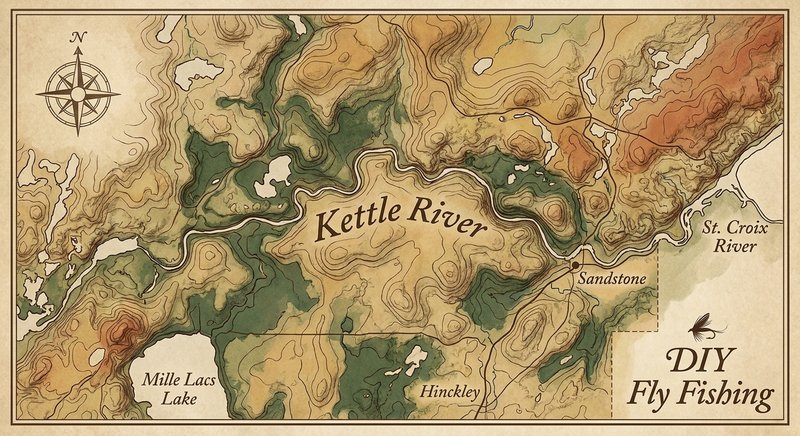
Kettle River
Fly fishing in Minnesota · Intermediate · Best seasons: Summer, Fall
Target Species
Smallmouth Bass, Northern Pike
About This Water
A wild and scenic river within Banning State Park offering technical pocket water for smallmouth and occasional northern pike.
Fishing Recommendations
The Kettle River is one of Minnesota’s premier "wild and scenic" rivers. Located in the east-central part of the state, it is famous for its dark, tea-colored (tannic) water and its dramatic sandstone cliffs. For the fly angler, it offers a rugged, drift-boat or kayak-style experience that feels much more remote than it actually is.
🎣 Location Overview
The Kettle River is a classic "pool and drop" river. It flows through the Banning State Park area down to its confluence with the St. Croix. What makes it special is the tannic water—stained dark by cedar swamps upstream—which creates high-contrast visibility.
The river is characterized by massive sandstone boulders, swift runs, and deep, oxygenated pools. Anglers love it because it feels like a mountain river transported to the Midwest. The structure is incredible; every turn of the river offers a new ledge, boulder garden, or undercut bank to pick apart.
🐟 Target Species & Behavior
Smallmouth Bass (The Main Attraction)
- Behavior: These are aggressive, "river-hardened" fish. Because of the current, they are leaner and stronger than lake smallmouth.
- Holding Water: They favor the "seams" where fast water meets slow water, and they love the slack water behind the massive boulders (locally called "boulder hopping").
- Feeding: They key in on crayfish, emerald shiners, and during mid-summer, large terrestrial insects like grasshoppers and dragonflies.
Northern Pike
- Behavior: The Kettle holds "river pike" which are notoriously explosive. They are ambush predators.
- Holding Water: Look for "slack water" sloughs, the mouths of feeder creeks, or deep woody debris (fallen logs).
- Feeding: They are opportunistic, eating anything from suckers and chubs to ducklings and large frogs.
📅 Best Times to Fish
- Optimal Months: June through September is the prime window.
- Early Summer (June): High water can be a challenge, but this is when the biggest Pike are active.
- Late Summer (July/August): The best time for topwater Smallmouth.
- Fall (September/October): As the water cools, fish feed aggressively to bulk up for winter.
- Best Time of Day:
- Low Light: The "Magic Hour" (last two hours of daylight) is unbeatable for topwater action.
- Mid-Day: If it’s overcast, the bite stays consistent. On bright days, look for the deep shadows cast by the sandstone cliffs.
🪰 Recommended Flies & Techniques
Top Fly Patterns
- For Smallmouth:
- Topwater: Murdich Minnow (white/silver), BoogleBug Poppers (yellow or olive), and Umpqua’s Swimming Frog.
- Sub-surface: Clouser Minnow (Chartreuse/White), Gamechangers, and Near Nuff Crawfish (Brown/Orange).
- For Northern Pike:
- Streamers: Barry’s Pike Fly, Pike Bunnies (Red/White), and large EP Fibers streamers (8-10 inches).
Techniques & Presentation
- The "Bang the Bank" Method: Cast your fly within inches of the sandstone walls or logs. Smallmouth often strike the second the fly hits the water.
- The Swing: In faster riffles, swing a weighted streamer through the tail-out, much like you would for steelhead.
- The Pause: When fishing topwater poppers, give the fly a loud pop, then let it sit for 5-10 seconds. The "tannic" water means fish often track the sound before they see the profile.
💡 Pro Tips & Local Knowledge
- Focus on Banning State Park to Highway 48: This stretch offers some of the best habitat. However, be extremely careful—the "Hell’s Gate" section in Banning is Class II-IV whitewater and is not for drift boats or casual kayakers.
- The "Dark Water" Strategy: Because the water is tea-colored, use high-contrast colors. Black and orange or chartreuse and white show up better than natural "clear water" patterns.
- Heavy Tippet: Don't go light. Use 10lb to 12lb fluorocarbon for bass. The rocks are abrasive, and the fish aren't leader-shy in the stained water. For Pike, use a wire bite tippet or 40lb fluorocarbon.
⚠️ Important Information
- Access: Key access points include Banning State Park, Robinson Park (Sandstone, MN), and the Highway 48 bridge.
- Water Levels: This river is "flashy." It rises and falls quickly after rain. Check the USGS gauge at Sandstone. If it’s over 1,000 cfs, wading is dangerous and fishing is tough. 300-600 cfs is the "sweet spot" for most anglers.
- Regulations: Minnesota DNR fishing licenses are required. Note that there are specific "Catch and Release" or size limit regulations for Smallmouth in certain stretches to preserve the trophy quality—always check the current MN Fishing Regulations booklet.
- Safety: The Kettle has a very slippery sandstone bottom. Cleated wading boots and a wading staff are mandatory if you plan on getting out of the boat.
Bug Hatches & Matching Flies
| Hatch | Type | Peak months | Time of day | Hook sizes | Matching flies |
|---|---|---|---|---|---|
| Blue Winged Olive Baetis | mayfly | April, October | Afternoon | #18-22 | RS2 #20-22, Parachute Adams #18-20, Pheasant Tail #18-22 |
| Hendrickson Ephemerella subvaria | mayfly | May | Afternoon | #12-14 | Red Quill #12-14, Hendrickson Nymph #12-14, Hare's Ear #14 |
| March Brown Maccaffertium vicarium | mayfly | May, June | Midday | #10-14 | March Brown Dry #10-12, Gold Ribbed Hare's Ear #10-12 |
| Sulphurs Ephemerella invaria/dorothea | mayfly | June | Evening | #14-18 | Sulphur Parachute #16-18, Sparkle Dun #14-16 |
| Light Cahill Stenacron interpunctatum | mayfly | June, July | Late Evening | #12-14 | Light Cahill #12-14, Cream Variant #14 |
| Grannom Caddis Brachycentrus | caddis | May | All Day | #14-16 | Elk Hair Caddis #14-16, Peacock Caddis Larva #14-16, Holy Grail #14-16 |
| Giant Salmonfly Pteronarcys dorsata | stonefly | June | All Day | #4-8 | Kaufmann's Stone #4-8, Chubby Chernobyl #6-10 |
| Trico Tricorythodes | mayfly | July, August, September | Early Morning | #20-24 | Trico Spinner #22-24, Zebra Midge #20-22 |
| White Miller Ephoron leukon | mayfly | August | Night/Evening | #12-14 | White Wulff #12-14, Ephoron Emerger #12-14 |
| Giant Dark Stonefly Acroneuria | stonefly | May, June | Afternoon | #6-10 | Golden Stone #8-10, Pat's Rubber Legs #6-10 |