Rum River
Fly fishing in Minnesota · Beginner · Best seasons: Summer, Fall
Target Species
Smallmouth Bass, Northern Pike
About This Water
A designated Wild and Scenic River that offers exceptional wading and floating for aggressive smallmouth bass and northern pike.
Fishing Recommendations
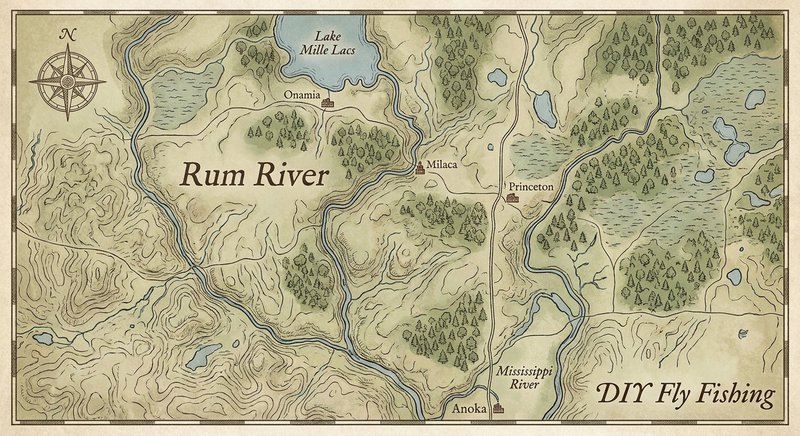
The Rum River is one of Minnesota’s premier "Wild and Scenic" rivers. Flowing out of Mille Lacs Lake and eventually joining the Mississippi at Anoka, it offers a classic upper-midwest river experience. It is a tea-colored, low-gradient fishery that feels much more remote than it actually is, despite its proximity to the Twin Cities.
🎣 Location Overview
What makes the Rum River special is its diversity of water types. The upper sections (near Milaca and Princeton) are narrower with more riffles and rocky gardens, while the lower sections (near St. Francis and Anoka) become deeper and more sluggish.
The water is stained with tannins (dark brown), which affects visibility but makes the fish less "spooky" than in crystal-clear streams. Anglers love the Rum because it is one of the best "wadeable" smallmouth rivers in the state during low water, yet it is also perfectly suited for a drift boat or a canoe/kayak.
🐟 Target Species & Behavior
- Smallmouth Bass: The "Bronze Backs" are the stars here. They are aggressive and hard-fighting. They hold in the "seams" between fast and slow water, behind boulders, and along undercut banks. They feed heavily on crayfish, hellgrammites, and baitfish like shiners and dace.
- Northern Pike: The Rum holds a surprising number of pike, especially in the slower, weedier reaches. They are ambush predators that sit in the slack water or near downed timber. They will opportunistically smash a bass fly, but targeting them requires larger, flashy streamers.
📅 Best Times to Fish
- Summer (June – August): This is prime time for topwater action. As the water warms, the metabolism of the smallmouth skyrockets.
- Condition: Look for stable, low-water levels. High water after a heavy rain makes the Rum muddy and difficult to fish.
- Fall (September – October): This is the window for the biggest fish of the year. As temperatures drop, smallmouth school up in deeper wintering holes and feed aggressively to bulk up.
- Time of Day: In mid-summer, the "Golden Hour" (first and last two hours of light) is unbeatable for topwater. On overcast days, the bite can stay hot all day long.
🪰 Recommended Flies & Techniques
The Rum is a "big fly" river. Because of the stained water, profiles that push water or have high contrast are essential.
Top Patterns:
- Topwater: Boogle Bugs (Poppers) in yellow or black, Murdich Minnows (fished high), and Umpqua’s Swimming Frog.
- Sub-surface: Clouser Minnows (Chartreuse/White or Olive/White), Meat Whistles, and Crayfish patterns like the Near Nuff Crayfish.
- Pike Specific: Large Double Bunnies or Pike Bunnies in red/white or firetiger.
Techniques:
- The "Splatt" Presentation: Don't be delicate. For Smallmouth, "slapping" a popper near a log often acts as a dinner bell. Let the rings dissipate before your first twitch.
- The "Swing and Strip": Cast 45 degrees downstream across a riffle, let the fly swing into the soft water, and then use erratic strips to mimic a wounded baitfish.
- Nymphing: If the topwater bite is slow, use a heavy rubber-legged stonefly nymph under a large indicator through the deeper runs.
💡 Pro Tips & Local Knowledge
- Focus on the Rocks: The stretch between Milaca and Princeton is arguably the best for fly anglers because of the high concentration of boulders and "pocket water" where smallies love to hide.
- The "Mid-River" Lie: Most amateurs only fish the banks. On the Rum, large Smallmouth often sit in the middle of the river behind submerged "deadheads" (sunken logs) or in the deep troughs between weed beds.
- Color Palette: In the stained water of the Rum, Black and Blue or Chartreuse often outperform natural colors. On very bright days, go with Copper or Gold flash.
- Portage Awareness: If you are floating, be aware of the dams at Milaca, Cambridge, and St. Francis. Always scout your take-outs beforehand.
⚠️ Important Information
- Access: There are numerous DNR carry-in sites and several public parks (like Rum River Central Regional Park). Use the Minnesota DNR Recreation Compass online to find specific access points.
- Regulations: The Rum has specific "Special Regulations" for Smallmouth Bass in certain stretches (Catch and Release only zones). Always check the current MN DNR Fishing Regulations booklet before heading out, as these can change annually.
- Safety: The bottom can be slippery and "mucky" in the lower sections. Felt-soled wading boots and a wading staff are highly recommended if you aren't in a boat.
- Permit: A standard Minnesota Fishing License is required. No special trout stamp is needed for the Rum.
Bug Hatches & Matching Flies
| Hatch | Type | Peak months | Time of day | Hook sizes | Matching flies |
|---|---|---|---|---|---|
| Midges Chironomidae | midge | March, April, October, November | Late Morning/Afternoon | #18-24 | Zebra Midge #18-22, Griffith's Gnat #20-24 |
| Blue Winged Olive Baetis | mayfly | April, May, September, October | Afternoon | #18-22 | RS2 #20-22, BWO Parachute #18-20 |
| Hendrickson Ephemerella subvaria | mayfly | May | Afternoon | #12-14 | Red Quill #14, Pheasant Tail Nymph #12-14 |
| Grannom Caddis Brachycentrus | caddis | May | Late Morning/Afternoon | #14-16 | LaFontaine's Deep Sparkle Pupa #14-16, Peacock Elk Hair Caddis #14-16 |
| Light Cahill Stenonema | mayfly | June, July | Evening | #12-16 | Light Cahill #14-16, Gold Ribbed Hare's Ear #14-16 |
| Hexagenia (Hex) Hexagenia limbata | mayfly | June, July | Dusk/Night | #4-8 | Hexagenia Spinner #6-8, Improved Hex Nymph #6-8 |
| White Miller Ephoron leukon | mayfly | August | Evening/Night | #12-14 | White Wulff #12, Snowshoe Emerger #14 |
| Terrestrials (Hoppers/Ants) Orthoptera/Formicidae | terrestrial | July, August, September | Mid-day/Afternoon | #8-18 | Dave's Hopper #8-12, Black Foam Ant #16-18 |
| Isonychia Isonychia bicolor | mayfly | July, August, September | Afternoon/Evening | #10-12 | Prince Nymph #10-12, Iso Parachute #10-12 |
| Autumn Splendor (Caddis) Pycnopsyche | caddis | September, October | Late Afternoon | #8-12 | October Caddis #8-10, Orange Stimulator #10-12 |