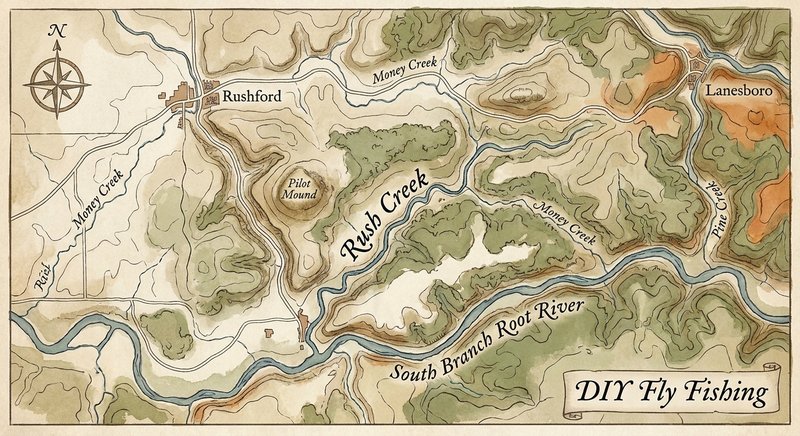
Rush Creek
Fly fishing in Minnesota · Intermediate · Best seasons: Spring, Summer, Fall
Target Species
Brown Trout
About This Water
A classic Driftless Area spring creek with excellent hatches and winding bends that hold surprisingly large brown trout.
Fishing Recommendations
🎣 Rush Creek, Minnesota: A Driftless Gem
Rush Creek, located in Winona County near the town of Rushford, is one of the premier "big water" spring creeks in Minnesota’s Driftless Area. Unlike the tiny, brush-choked trickles found elsewhere in the region, Rush Creek offers a more expansive feel with diverse water types, including deep limestone pools, long riffles, and classic undercut banks.
What makes Rush special is its productivity. Fed by numerous cold-water springs, it maintains stable temperatures that support incredible biomass. It is a "bug factory," boasting some of the best hatches in the Midwest. Anglers love it because it offers the rare opportunity to catch truly large, wild Brown Trout on dry flies in a scenic valley setting.
🐟 Target Species & Behavior
Primary Species: Wild Brown Trout (with occasional Brook Trout in the upper reaches).
- Behavior: Rush Creek Browns are notorious for being "pool-dwellers" during the bright hours of the day. They are highly structure-oriented. Look for them tucked tightly against limestone ledges, under fallen timber, or beneath the deep "cut banks" carved by high water.
- Feeding: They are opportunistic but sophisticated. In the spring, they focus on midges and Blue Winged Olives. By mid-summer, they become "terrestrial hunters," keying in on grasshoppers and beetles falling from the lush bankside grasses.
- The Big Guys: The trophy Browns (18"+) in Rush are often nocturnal or crepuscular. If you want a monster, you have to hunt the transition zones where deep pools meet shallow riffles during low-light hours.
📅 Best Times to Fish
Spring (April - May)
- The Window: This is prime time for the Grannom Caddis and Hendrickson hatches.
- Conditions: Water levels can be high from snowmelt, but the limestone influence keeps it clear faster than freestone rivers.
- Time of Day: 11:00 AM – 4:00 PM. The water needs to warm slightly to trigger insect activity.
Summer (June - August)
- The Window: The heat of summer brings the Trico hatch (early morning) and legendary terrestrial fishing.
- Conditions: Focus on the "Trout Run" section or areas with heavy spring influence to find cooler water.
- Time of Day: "The Midnight or the Morning." Be on the water at dawn for Tricos, or fish the "Hex" hatch at dusk. midday is for hoppers.
Fall (September - October)
- The Window: Pre-spawn aggression makes this streamer season.
- Conditions: Crisp mornings and low, clear water.
- Time of Day: All day. Overcast days are gold for BWO hatches and streamer stripping.
🪰 Recommended Flies & Techniques
Dry Flies
- Tricos (Size 20-24): A must-have for summer mornings.
- Pink Squirrel (Size 14-16): Though technically a nymph, it's the legendary Driftless fly.
- Hi-Vis Beetle or Dave’s Hopper (Size 8-12): For "pounding the banks" in August.
- Light Cahill (Size 14-16): Great for evening rises in early summer.
Nymphing
- Technique: Use a Euro-nymphing rig or a very small "strike putty" indicator. The water is clear; bulky plastic bobbers will spook fish.
- Flies: Zebra Midges (Black/Silver), Pheasant Tails (Flashback), and Scud patterns (Olive/Gray).
Streamers
- Technique: The "Pound and Paint." Cast a streamer tight to an undercut bank, strip it twice aggressively, and let it flutter.
- Flies: Woolly Buggers (Black or Olive), Sculpzilla, or Sparkle Minnows.
💡 Pro Tips & Local Knowledge
- The "Stealth" Factor: Because Rush Creek is wider than most, anglers often get careless. The fish are wary. Wear earthy tones (olive/tan), avoid "lining" the fish, and always approach a pool from downstream.
- Focus on the "Upper" vs "Lower": The Lower Rush (near the Root River confluence) holds the biggest fish but gets warmer in July. The Upper Rush (near Enterprise) is colder, more intimate, and better for technical nymphing during heatwaves.
- The "Scud" Secret: If the hatches are thin, fish a size 16 gray scud deep. The limestone chemistry of Rush Creek produces massive amounts of freshwater shrimp (scuds), and the trout eat them year-round like candy.
- Cattle Impact: You will likely encounter cattle in some sections. While they can muddy the water locally, they also keep the grass short, making for easier backcasts. Fish right behind the cows—they often kick up nymphs as they cross!
⚠️ Important Information
- Access: Much of Rush Creek flows through private land, but Minnesota has an excellent Angling Easement program. Look for the green "Cowl" signs or use the MN DNR Recreation Compass online to find public access points.
- Regulations: Most of Rush Creek falls under general trout regulations, but always check the current MN DNR Trout Handbook, as some tributaries or specific stretches may have "Catch and Release only" or barbless hook requirements.
- Gear: A 8'6" or 9' 4-weight rod is the "Goldilocks" setup for this water. 5x or 6x fluorocarbon tippet is essential due to the water clarity.
- Wading: The bottom can be slippery limestone and "muck." Felt soles (where legal) or studded rubber boots are highly recommended. Always be mindful of the "Driftless Mud"—some holes are deeper than they look!
Bug Hatches & Matching Flies
| Hatch | Type | Peak months | Time of day | Hook sizes | Matching flies |
|---|---|---|---|---|---|
| Blue Winged Olive Baetis | mayfly | April, October | Afternoon | #18-22 | RS2 #18-22, Parachute Adams #18-22 |
| Winter Midge Chironomidae | midge | February, March | Late Morning/Afternoon | #20-24 | Zebra Midge #18-22, Griffith's Gnat #20-22 |
| Hendrickson Ephemerella subvaria | mayfly | May | Afternoon | #12-14 | Hendrickson Sparkle Dun #12-14, Pheasant Tail #12-14 |
| Grannom Caddis Brachycentrus | caddis | May | Morning/Afternoon | #14-16 | Elk Hair Caddis #14-16, Deep Sparkle Pupa #14-16 |
| Sulfur / Pale Morning Dun Ephemerella invaria/dorothea | mayfly | June | Evening | #14-18 | Sulfur Parachute #14-18, Sulfur Emerger #16-18 |
| Light Cahill Stenacron/Stenonema | mayfly | June, July | Evening | #12-14 | Light Cahill #12-14 |
| Terrestrials (Hopper/Ant/Beetle) Orthoptera/Formicidae/Coleoptera | terrestrial | July, August, September | All Day | #10-18 | Dave's Hopper #10-14, Black Foam Ant #16-18 |
| Trico Tricorythodes | mayfly | July, August | Early Morning | #20-24 | Trico Spinner #20-24, Sunken Trico #22-24 |
| Crane Fly Tipulidae | midge | August, September | Afternoon/Evening | #10-14 | Daddy Long Legs #10-12, Crane Fly Larva #10-12 |
| Scud Gammarus | midge | March, April, May, October | All Day | #14-18 | Ray Charles #14-18, Pink Scud #14-16 |