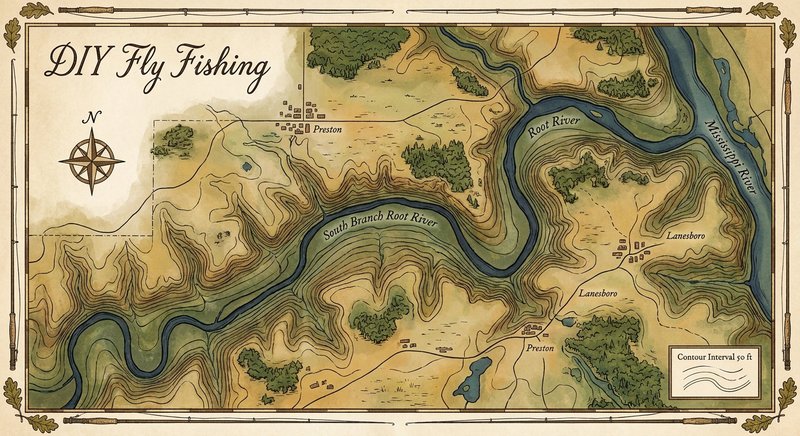
South Branch Root River
Fly fishing in Minnesota · Intermediate · Best seasons: Spring, Summer, Fall
Target Species
Brown Trout, Rainbow Trout
About This Water
Features dramatic limestone bluffs and deep pools that hold trophy-sized brown trout, especially productive during the caddis hatches.
Fishing Recommendations
The South Branch of the Root River is the crown jewel of Minnesota’s "Driftless Area." Unlike the rest of the Midwest, this region was bypassed by the last glaciation, leaving behind a rugged landscape of limestone bluffs, deep valleys, and cold, spring-fed streams. The South Branch is famous for its diversity, offering everything from intimate meadow fishing to dramatic canyon stretches.
🎣 Location Overview
The South Branch is characterized by its limestone spring-influenced water, which remains cold enough for trout year-round. It features classic "pool-run-riffle" structures, but what makes it unique is its size; it is one of the larger systems in Southeast Minnesota, allowing for a variety of fishing styles including swinging streamers and long-distance dry fly presentations.
The river runs through the heart of Preston and Lanesboro. You’ll find high limestone cut-banks, deep sediment-bottomed pools, and fast, rocky riffles. It is a "fertile" river, meaning it is bug-dense, supporting high fish counts per mile.
🐟 Target Species & Behavior
- Brown Trout: The dominant species. Most are wild, buttery-gold, and incredibly wary. They hold tight to "overhead cover"—think undercut banks, fallen timber, and the dark shadows beneath limestone ledges. Large "trophy" browns (18"+) are nocturnal or low-light hunters.
- Rainbow Trout: Found primarily in the stretches managed with fingerling stocking. They tend to hold in faster, oxygenated water at the "heads" of pools and in heavy riffles. They are generally more opportunistic than the browns.
- Feeding Behavior: These fish are opportunistic but selective during hatches. They key in on scuds (freshwater shrimp) and sowbugs year-round due to the limestone geology.
📅 Best Times to Fish
- Spring (Late March – May): This is the window for the legendary Blue Winged Olive (BWO) and Grannom Caddis hatches. The water is cool, and the fish are hungry after winter.
- Summer (June – August): The time for Terrestrials. Look for midday action with grasshoppers, beetles, and ants along the tall grass banks. Morning and late evening are best for Trico hatches.
- Fall (September – October): Pre-spawn Brown Trout become aggressive. This is the best time to throw large streamers. The colors of the Driftless bluffs during this time are world-class.
- Prime Window: Low light is your friend. The 90 minutes before sunset often produce the best "rise" of the day.
🪰 Recommended Flies & Techniques
Top Fly Patterns
- Nymphs: Pink Squirrel (a local legend), Gold-Ribbed Hare’s Ear (#14-18), Flashback Pheasant Tail, and Zebra Midges (#18-22).
- Dry Flies: Parachute Adams, Elk Hair Caddis (Tan/Olive), Hippie Stomper (Terrestrial), and the Trico Spinner.
- Streamers: Black or Olive Woolly Buggers, Sparkle Minnows, and Sculpin patterns.
Effective Techniques
- The "Driftless Dropper": Use a buoyant dry fly (like a Hippo Stomper) and hang a weighted nymph (like a Pink Squirrel) 18-24 inches below it. This covers two water columns and acts as a strike indicator.
- Tight-Line Nymphing: In the deeper runs near Preston, "Euro" or tight-line nymphing is incredibly effective to get flies down through the current seams.
- Streamer Stripping: Cast streamers quartering downstream toward undercut banks. Use an erratic "strip-strip-pause" retrieve.
💡 Pro Tips & Local Knowledge
- The Pink Squirrel: If you only carry one fly, make it this one. Created by local legend John Bethke, the pink dubbing and silver bead are irresistible to Root River trout.
- Stealth is Mandatory: The water can be crystal clear. Avoid "lining" the fish (casting your fly line directly over their heads). Approach pools from downstream and stay low—crouching or even kneeling is often necessary.
- Forestville/Mystery Cave State Park: This is a "must-fish" stretch. The water coming out of the cave system is consistently cold, providing a refuge for trout during the hottest weeks of July.
- Watch the Gauge: The South Branch can get muddy after a heavy rain due to agricultural runoff. Check the USGS gauge at Lanesboro; if it's spiking rapidly, head to the smaller tributaries like Wisel Creek.
⚠️ Important Information
- Regulations: Much of the South Branch is under Catch and Release only or specific slot limits. Always check the current MN DNR Trout Regulations.
- Permits: You need a Minnesota Fishing License PLUS a Trout Stamp.
- Access: Minnesota has excellent "Angler Easements." Look for the green and white "Fishing Path" signs. Respect private property—stay within the high-water marks when walking through farmland.
- Gear: A 9-foot, 4-weight or 5-weight rod is the perfect "all-around" tool for this river. Use 5X or 6X fluorocarbon tippet for nymphs to combat the clear water and spooky fish.
Bug Hatches & Matching Flies
| Hatch | Type | Peak months | Time of day | Hook sizes | Matching flies |
|---|---|---|---|---|---|
| Blue Winged Olive Baetis spp. | mayfly | April, May, September, October | Afternoon | #18-22 | RS2 #18-22, BWO Sparkle Dun #18-20, Pheasant Tail #18-20 |
| Grannom Caddis Brachycentrus occidentalis | caddis | April, May | Mid-day to Evening | #14-16 | Peacock Caddis #14-16, LaFontaine's Deep Sparkle Pupa #14-16, Elk Hair Caddis #14-16 |
| Hendrickson Ephemerella subvaria | mayfly | May | Afternoon | #12-14 | Red Quill #12-14, Hendrickson Nymph #12-14, Parachute Hendrickson #12-14 |
| Sulphur / Pale Evening Dun Ephemerella invaria/dorothea | mayfly | May, June | Evening | #14-18 | Sulphur Parachute #16-18, Sulphur Emerger #16-18, Pheasant Tail #16-18 |
| Light Cahill Stenacron canadense | mayfly | June, July | Evening | #12-14 | Light Cahill #12-14, Gold Ribbed Hare's Ear #12-14 |
| Trico Tricorythodes spp. | mayfly | July, August, September | Morning | #20-24 | Trico Spinner #20-24, Trico Parachute #22-24 |
| Hopper / Terrestrials Orthoptera | terrestrial | July, August, September | Late Morning to Afternoon | #8-12 | Dave's Hopper #10-12, Fat Albert #8-10, Morrish Hopper #10-12 |
| Zebra Midge Chironomidae | midge | January, February, March, December | All Day | #18-22 | Zebra Midge #18-22, Griffith's Gnat #18-22 |
| Scud Gammarus | crustacean | April, May, June, July | All Day | #14-18 | Ray Charles #14-16, Pink Scud #14-18 |
| Giant Michigan Mayfly Hexagenia limbata | mayfly | June, July | Dusk / Night | #6-10 | Hexagenia Spinner #6-8, Hex Nymph #6-10 |