Straight River
Fly fishing in Minnesota · Intermediate · Best seasons: Summer, Fall
Target Species
Brown Trout
About This Water
A rare northern Minnesota brown trout stream with heavy silt bottoms and excellent hexagenia limbata hatches in early summer.
Fishing Recommendations
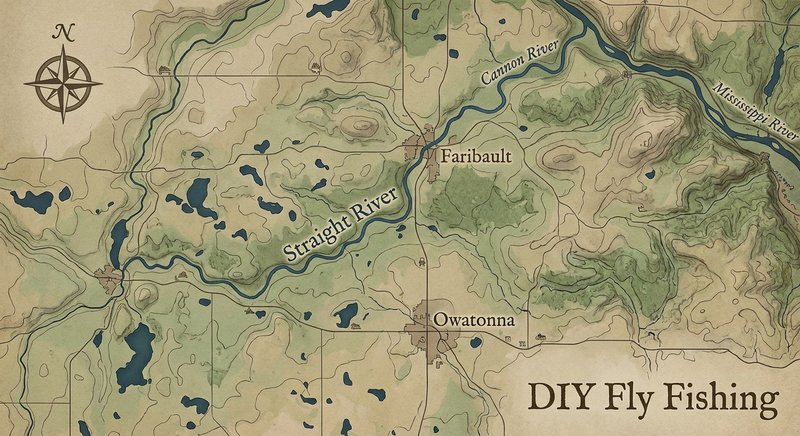
The Straight River in Southeast Minnesota is a true diamond in the rough. Located near Faribault, it is one of the few cold-water trout streams in the state that isn't located in the "Driftless" bluff country. This is a low-gradient, winding river that feels more like a classic Pennsylvania spring creek or a Michigan meadow stream than a typical Minnesota mountain-style creek.
🎣 Location Overview
What makes the Straight River special is its resilience and its size. Unlike the tiny, brush-choked creeks often found in the Midwest, the Straight offers more "elbow room" and significant depth. It flows through a glacial valley characterized by sandy bottoms interspersed with limestone rubble and deep, undercut banks.
Anglers love it because it produces trophy-class Brown Trout in a region dominated by smaller fish. The water stays cool thanks to significant groundwater input, but the river is susceptible to turbidity after heavy rains due to the surrounding agricultural land. When it’s "on," it’s one of the best big-fish rivers in the Upper Midwest.
🐟 Target Species & Behavior
The Brown Trout is the king of the Straight River. While there are some rainbows (mostly escapees or historical remnants), the wild and holdover Browns are the main attraction.
- Behavior: These fish are notorious "bank huggers." Because the river has many deep, silty sections, the trout congregate around structure: fallen timber, root wads, and deep undercut banks.
- Feeding: Straight River Browns are highly piscivorous (fish-eaters). Once they hit 14 inches, they transition from insects to crayfish and baitfish. However, they are also famous for "looking up" during the massive Hexagenia (Giant Mayfly) hatches in late June.
📅 Best Times to Fish
Optimal Seasons
- Summer (June - July): This is the peak for insect activity. The Hexagenia limbata hatch (usually mid-June to early July) brings the largest fish in the river to the surface at dusk.
- Fall (September - October): As temperatures drop, Browns become aggressive ahead of the spawn. This is the prime window for streamer fishing. The colors of the valley are spectacular during this time.
Best Times of Day
- Summer: Early morning (dawn to 10 AM) or late evening (8 PM to dark). Mid-day can be slow unless there is significant cloud cover.
- Fall: Mid-day becomes more productive as the water warms slightly.
Prime Conditions
- The "Green Fade": The best fishing occurs when the river is dropping and clearing after a rain. When the water has 1–2 feet of visibility and a "trout green" tint, the big fish lose their wariness.
🪰 Recommended Flies & Techniques
Dry Flies (The Evening Rise)
- Hexagenia Patterns (Size 4-8): Large, yellow-bodied extended body drakes.
- Trico Spinners (Size 20-24): For the patient angler on August mornings.
- Terrestrials: Fat Albert (Size 8), foam crickets, and Dave’s Hopper. The meadow sections are prime for hopper-dropper rigs.
Nymphing (The Bread & Butter)
- Crayfish Patterns: Small, weighted crayfish imitations (Size 8-10) bounced along the bottom.
- Scuds and Sowbugs: The river is rich in crustaceans. Grey or olive (Size 14-18).
- Pheasant Tail / Prince Nymphs: Classic searchers for the riffle sections.
Streamers (For the Trophies)
- Black or Olive Wooly Buggers: A staple.
- Sex Dungeon or Sparkle Minnows: Use these in the deep holes near wood debris.
- Technique: "Pounding the banks." Cast tight to the wood, give two or three aggressive strips, and move on.
💡 Pro Tips & Local Knowledge
- Focus on the "Bends": The Straight is a meandering river. The most productive water is almost always the outside bend where the current has carved out a deep hole under the bank.
- Stealth is Mandatory: Despite the "Straight" name, the river is very "swirly." Large Browns are sensitive to vibrations on the bank. Walk softly and stay low.
- The "River Bend" Stretch: The area near River Bend Nature Center offers excellent access and diverse water, ranging from shallow riffles to deep, slow-moving pools.
- Wading Caution: The bottom can be deceptive. You may transition from firm gravel to "muck" that will trap a boot in seconds. Use a wading staff.
⚠️ Important Information
Access
- Faribault to Owatonna: Most fishing occurs between these two cities.
- Public Access: Look for DNR easements and bridge crossings. The River Bend Nature Center in Faribault provides some of the easiest public foot access.
Regulations
- MN DNR Trout Regulations: The Straight River falls under specific Southeast Minnesota regulations. Much of it is open for "Catch and Release" during the early spring, with a harvest season typically opening in mid-April.
- Barbless Hooks: While not always required by law, using barbless hooks is highly recommended to protect the wild Brown Trout population.
- License: A Minnesota Fishing License and a Trout Stamp are required.
Special Considerations
- Temperature Watch: In late July and August, monitor water temperatures. If the water hits 68°F (20°C), stop fishing to prevent lethal stress on the trout.
- Deadly Wood: This river has a lot of "sweepers" (fallen trees). Be careful when wading downstream; the current can push you into submerged logs quickly.
Bug Hatches & Matching Flies
| Hatch | Type | Peak months | Time of day | Hook sizes | Matching flies |
|---|---|---|---|---|---|
| Blue Winged Olive Baetis | mayfly | April, May, September, October | Late Morning/Afternoon | #18-22 | BWO Sparkle Dun #18-20, RS2 #20-22, Pheasant Tail #18-22 |
| Hendrickson Ephemerella subvaria | mayfly | May | Afternoon | #12-14 | Hendrickson Dark #12-14, Red Quill #12-14, Hare's Ear #12-14 |
| Sulphur Ephemerella invaria/dorothea | mayfly | June, July | Evening | #14-18 | Sulphur Parachute #16-18, CDC Sulphur Emerger #14-16, Pheasant Tail #16-18 |
| Grannom Caddis Brachycentrus | caddis | May | Morning/Afternoon | #14-16 | Elk Hair Caddis (Olive) #14-16, Deep Sparkle Pupa #14-16, Peacock Caddis #14-16 |
| Light Cahill Stenacron canadense | mayfly | June, July | Evening | #12-14 | Light Cahill #12-14, Gold Ribbed Hare's Ear #12-14 |
| Trico Tricorythodes | mayfly | July, August, September | Early Morning | #22-26 | Trico Spinner #22-24, Zebra Midge #22-24 |
| Cinnamon Caddis Hydropsyche | caddis | June, July, August | Evening | #14-18 | Caddis Vari-Pupa #14-16, Tan Elk Hair Caddis #14-18, Iris Caddis #16 |
| Terrestrials (Hoppers/Ants) Formicidae / Orthoptera | terrestrial | July, August, September | Afternoon | #10-16 | Dave's Hopper #10-12, Black Foam Ant #14-18, Chernobyl Ant #10-14 |