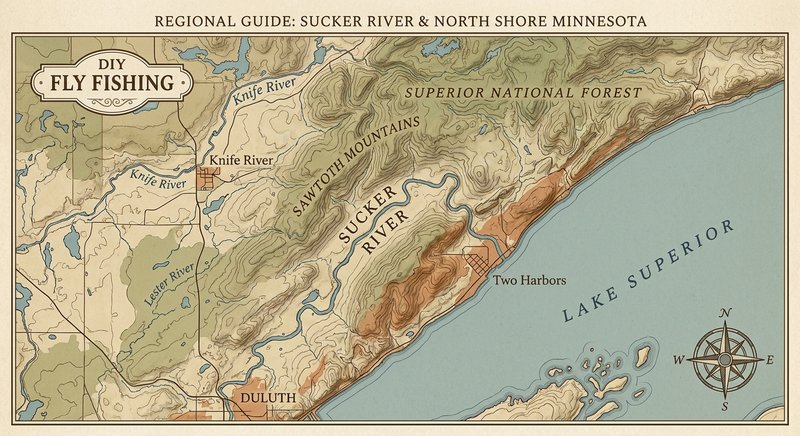
Sucker River
Fly fishing in Minnesota · Advanced · Best seasons: Spring, Fall
Target Species
Rainbow Trout, Brook Trout, Steelhead
About This Water
A high-gradient North Shore stream that is particularly productive during the spring coaster brook trout and steelhead runs.
Fishing Recommendations
🎣 Sucker River, Minnesota: Expert Guide
The Sucker River is one of the premier North Shore tributaries flowing into Lake Superior, located just northeast of Duluth. Unlike the high-gradient, bedrock-heavy rivers further north, the Sucker offers a classic "trout stream" feel with more gravel, manageable pocket water, and accessible pools. It is a dual-natured river: it hosts a resident population of small Brookies and serves as a vital corridor for migratory Lake Superior salmonids.
🐟 Target Species & Behavior
Kamloops & Steelhead (Rainbow Trout)
The "Kamloops" (hatchery-reared rainbows) and wild Steelhead are the main draw.
- Behavior: These are lake-run fish. They enter the river to spawn and then drop back to the lake. They are opportunistic but wary.
- Holding Water: Look for "slack water" next to fast currents, deep undercut banks, and the tail-outs of larger pools. During the spawn, they will move onto gravelly "runs," but please avoid fishing for actively spawning fish on redds.
Brook Trout
- Behavior: Resident Brookies are found further upstream, above the first major barriers/falls. They are generally small (6–10 inches) but exceptionally vibrant.
- Feeding: They are aggressive opportunistic feeders, focusing on terrestrial insects in the summer and small nymphs year-round.
📅 Best Times to Fish
Spring (Late March – May)
This is the prime window for lake-run Rainbows.
- Conditions: Success is dictated by water temperature. Once the water hits 40°F, fish become active.
- Window: Early morning provides the least pressure, but the bite often improves mid-day as the sun warms the water slightly.
Fall (September – November)
- Conditions: Fall brings the "Loopers" (Kamloops) back toward the river mouths and lower stretches.
- Brookies: Fall is also the Brook Trout spawning season; they are most active and colorful in September.
🪰 Recommended Flies & Techniques
The "North Shore" Rig (Nymphing)
Most success on the Sucker comes from high-stick nymphing or indicator nymphing.
- Glo-Bugs / Egg Patterns: Size 8-12 in Oregon Cheese, Pink, or Chartreuse.
- Stoneflies: Large, weighted black or golden stonefly nymphs (Size 6-10).
- Superior X-Mas Tree: A local flashy favorite for lake-run fish.
- Prince Nymphs / Pheasant Tails: Size 12-16 for resident Brookies.
Streamers
- Patterns: Black or Olive Woolly Buggers, or Muddler Minnows.
- Technique: "Swing" the fly through the tail-outs of pools. This trigger-response strike is often more aggressive than an egg-take.
Dry Flies (Summer/Early Fall)
- Patterns: Elk Hair Caddis, Royal Wulff, or Foam Ants/Beetles for Brookies.
- Technique: Short, accurate casts to pocket water behind boulders.
💡 Pro Tips & Local Knowledge
- The "Barrier" Rule: The Sucker has a designated fish barrier. Focus your efforts for migratory Rainbows below the barrier. For Brookies, hike well above the Highway 61 bridge and look for the canopy-covered sections.
- Watch the Flow: The Sucker is "flashy"—it rises and muddies quickly after rain. Check the USGS gauges or local reports. If the water is "chocolate milk," wait 24 hours for it to clear to a "tea" color.
- Stealth is Key: Because the Sucker is smaller than the nearby St. Louis or Knife rivers, the fish are easily spooked. Wear earthy tones and avoid splashing while wading.
- The Mouth: Don't ignore the "casting" at the mouth where the river enters Lake Superior. In late fall and early spring, fish stage here before moving up.
⚠️ Important Information
Regulations
- Trout Stamp: A Minnesota trout stamp is mandatory for fishing the Sucker River.
- Barbless Hooks: While not always mandated by law for all species, using barbless hooks is highly recommended for the catch-and-release of wild Steelhead.
- Special Regulations: The North Shore has specific "Below the Bridge" vs. "Above the Bridge" regulations. Always check the current MN DNR Fishing Regulations booklet, as seasons for Brookies and Rainbows differ.
Access
- The Highway 61 bridge offers the primary access point. There is a small parking area nearby.
- Old North Shore Rd also provides access points to the middle stretches of the river.
- Respect Private Property: Much of the upper Sucker runs through private land. Stick to the riverbed or public easements.
Safety
- Wading: The rocks are notoriously slippery (known as "North Shore snot"). Felt soles (where legal) or studded wading boots and a wading staff are highly recommended.
Bug Hatches & Matching Flies
| Hatch | Type | Peak months | Time of day | Hook sizes | Matching flies |
|---|---|---|---|---|---|
| Blue Winged Olive Baetis spp. | mayfly | April, May, September, October | Afternoon | #18-22 | RS2 #18-22, BWO Sparkle Dun #18-20 |
| Little Brown Stonefly Strophopteryx fasciata | stonefly | March, April | Late Morning/Afternoon | #14-16 | Early Brown Stone Nymph #14-16, Little Brown Stone #16 |
| Hendrickson Ephemerella invaria | mayfly | May | Afternoon | #12-14 | Hendrickson Dark #12-14, Pheasant Tail #12-16 |
| Mother's Day Caddis Brachycentrus occidentalis | caddis | May | All Day | #14-16 | LaFontaine's Deep Pupa #14-16, Elk Hair Caddis (Olive) #14-16 |
| Light Cahill Stenacron canadense | mayfly | June, July | Evening | #12-14 | Light Cahill #12-14, Gold Ribbed Hare's Ear #12-14 |
| Trico Tricorythodes spp. | mayfly | July, August | Morning | #20-24 | Trico Spinner #20-24, Zebra Midge #20-22 |
| Grasshoppers Orthoptera | terrestrial | August, September | Mid-day | #8-12 | Dave's Hopper #10-12, Morrish Hopper #8-12 |
| Zebra Midge Chironomidae | midge | March, April, November | All Day | #18-24 | Zebra Midge (Red/Black) #18-22, Griffith's Gnat #18-22 |