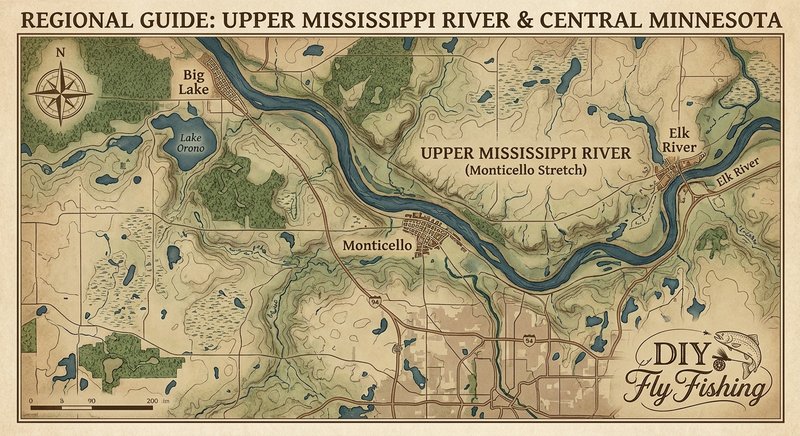
Upper Mississippi River (Monticello Stretch)
Fly fishing in Minnesota · Intermediate · Best seasons: Summer, Fall
Target Species
Smallmouth Bass, Muskellunge
About This Water
World-class smallmouth bass fishing in a tailwater-like environment influenced by the power plant, allowing for a longer active season.
Fishing Recommendations
As a guide who has spent years rowing the boulder-strewn reaches of the Upper Mississippi, I can tell you that the "Monticello Stretch" (typically defined as the water between St. Cloud and the Coon Rapids Dam) is one of the premier Smallmouth Bass fisheries in the Midwest. While the river flows through a major metropolitan area, this specific reach feels wild, scenic, and incredibly productive.
🎣 Location Overview
The Monticello stretch is characterized by a "Big River" feel but with the heart of a trout stream. It is a classic freestone-style environment with a bed of glacial till—meaning it is littered with granite boulders, cobble, and mid-river islands.
What makes this area special is the thermal influence. Because of the Nuclear Power Plant in Monticello, the water temperatures remain slightly elevated and the river rarely freezes solid in this section. This creates a longer growing season for both the fish and the forage (crayfish and baitfish), leading to "football-shaped" Smallmouth Bass that are famously aggressive.
🐟 Target Species & Behavior
Smallmouth Bass
The "Bronzebacks" here are the stars. They are incredibly muscular due to the constant current.
- Behavior: They are ambush predators. They hold in the "seams" where fast water meets slow water.
- Holding Water: Look for "slack water" behind large boulders, the heads of deep pools, and the "V" of current created by islands.
- Forage: The diet is 70% crayfish. The rest consists of emerald shiners, suckers, and seasonal hatches of giant Hexagenia mayflies.
Muskellunge (Muskie)
The "fish of ten thousand casts" lives here in surprisingly high densities.
- Behavior: They are the apex predators. On the Mississippi, they love wood. Look for fallen timber and deep outside bends.
- Holding Water: They often sit just downstream of a Smallmouth "honey hole," waiting for an easy meal.
- Forage: They target large suckers, redhorse, and—much to the chagrin of fly anglers—the very Smallmouth Bass you are targeting.
📅 Best Times to Fish
Summer (June – August)
- Conditions: Stable flows and clear water.
- Topwater Window: Early morning and late evening are prime for poppers.
- The "Hex" Hatch: Late June through July features massive mayfly hatches at dusk that bring even the biggest bass to the surface.
Fall (September – November)
- Conditions: Water temperatures drop, and fish move to deeper wintering holes.
- The Feeding Frenzy: This is the best time for trophy fish. Bass sense winter coming and gorge on high-protein baitfish.
- Muskie Peak: October is prime "Muskie Month" as they move into shallower flats to hunt before the winter doldrums.
🪰 Recommended Flies & Techniques
For Smallmouth Bass
- Topwater: Umpqua’s Swimming Frog or BoogleBugs in size 4. Use a "pop-and-pause" retrieve.
- Sub-Surface (Crayfish): Clouser Minnows (Olive/White or Orange/Brown) and Near Nuff Crayfish.
- The "Gamechanger": Small Chocklett’s Gamechangers in white or shiner patterns are deadly in the fall.
- Technique: "Swing" your streamers like you’re fishing for Steelhead. Cast 45 degrees downstream, let the current tension the line, and strip it back through the seams.
For Muskellunge
- Patterns: Double D’s, Bucktail Gamechangers, and Buffington’s Pole Dancer (for topwater).
- Colors: Black/Orange (classic Mississippi "dirty water" colors) or White/Chartreuse.
- Technique: Use a 10-12wt rod and a sinking tip. Always perform a "Figure-8" at the end of every single cast. Mississippi Muskies are notorious for following the fly right to the boat.
💡 Pro Tips & Local Knowledge
- The "Boulder Garden": The stretch immediately downstream of the Monticello power plant is a boulder garden. If you aren't bumping your fly off a rock, you aren't in the strike zone.
- Paddle/Float Strategy: This is best fished from a drift boat or a stable fishing kayak. While wading is possible near access points (like Ellison Park), the riverbed is incredibly slippery and "greasy." Studded wading boots are a must.
- Read the Bubbles: In the summer, look for "bubble lines." Bass will sit directly under these lines waiting for insects to be funneled to them.
- The Drag-Free Drift: When fishing crayfish patterns, try dead-drifting them under an indicator through deep slots. It feels like nymphing for trout but results in massive Smallmouth.
⚠️ Important Information
- Access: Key launch points include Ellison Park (Monticello), Montissippi County Park, and Otsego County Park.
- Regulations: The Mississippi River from the St. Cloud Dam to the mouth of the Crow River is a Catch and Release Only zone for Smallmouth Bass. This regulation is why the fishing is so world-class—treat these fish with respect.
- Safety: The river can rise rapidly after heavy rains. Check the USGS gauge at St. Cloud or Monticello before heading out. If the water is chocolate milk, the bite will be tough.
- Permit: A standard Minnesota fishing license is required. No special stamps are needed unless you plan on keeping trout from tributaries (not recommended in this stretch).
Guide’s Final Word: Bring a 7-weight rod for the bass, plenty of water, and your best polarized glasses. This river rewards those who look for the subtle changes in current. Tight lines!
Bug Hatches & Matching Flies
| Hatch | Type | Peak months | Time of day | Hook sizes | Matching flies |
|---|---|---|---|---|---|
| Midges Chironomidae | midge | March, April, October, November | Afternoon | #18-24 | Zebra Midge #18-22, Griffith's Gnat #20-24 |
| Blue Winged Olive Baetis spp. | mayfly | April, May, September, October | Late Morning/Afternoon | #18-22 | RS2 #20-22, Parachute Adams #18-22 |
| Grannom Caddis Brachycentrus occidentalis | caddis | April, May | Mid-day/Afternoon | #14-16 | Peacock Caddis #14-16, Deep Sparkle Pupa #14-16 |
| Hydropsyche Caddis Hydropsychidae | caddis | June, July, August | Late Afternoon/Evening | #12-16 | Elk Hair Caddis #14-16, LaFontaine Emerger #14-16 |
| Light Cahill Stenacron interpunctatum | mayfly | June, July | Evening | #12-14 | Light Cahill #12-14, Gold Ribbed Hare's Ear #12-14 |
| White Miller Ephoron leukon | mayfly | August | Late Evening/Dusk | #12-14 | White Wulff #12-14, Snowshoe Emerger #12-14 |
| Hexagenia Hexagenia limbata | mayfly | June, July | Dusk/Night | #6-10 | Hex Paradox #6-8, Hex Nymph #8-10 |
| Tricos Tricorythodes spp. | mayfly | July, August, September | Early Morning | #20-24 | Trico Spinner #22-24, Sunken Trico Spinner #22-24 |
| Giant Salmonfly Pteronarcys dorsata | stonefly | May, June | Afternoon/Evening | #4-8 | Pat's Rubber Legs #4-8, Chubby Chernobyl #6-10 |
| Damselflies Calopteryx spp. | other | June, July, August | All Day | #10-12 | Marabou Damsel #10-12, Adult Damsel #10-12 |