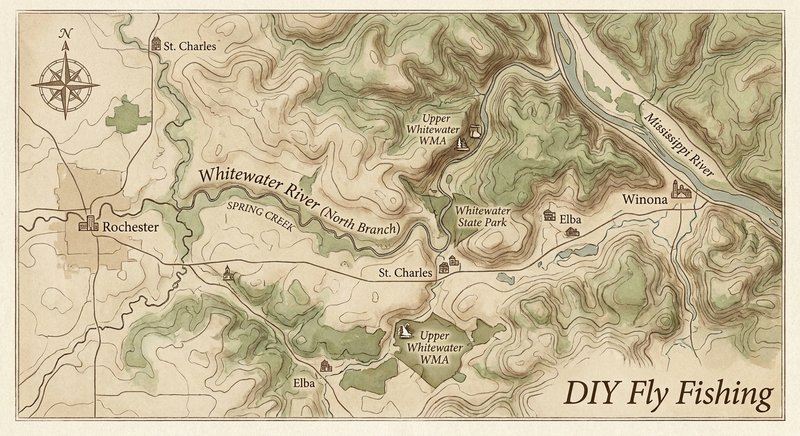
Whitewater River (North Branch)
Fly fishing in Minnesota · Beginner · Best seasons: Spring, Summer, Fall, Winter
Target Species
Brown Trout, Rainbow Trout
About This Water
Located within a state park, this stream offers accessible riffle-and-pool water perfect for dry fly enthusiasts.
Fishing Recommendations
The North Branch of the Whitewater River is a crown jewel of the Driftless Area in Southeast Minnesota. While the Main Branch gets more pressure, the North Branch offers a classic "spring creek" experience—crystal clear water, lush valley scenery, and a high density of wild trout.
Here is your guide to fishing the North Branch.
🎣 Location Overview
The North Branch is characterized by its limestone-influenced spring water, which remains a constant temperature year-round. This stretch is famous for its winding meanders, undercut banks, and deep pools. Unlike the muddier waters found elsewhere in the Midwest, the North Branch stays relatively clear except after heavy rains.
What makes it special is the diversity of water. You’ll find everything from fast-moving riffles to glass-calm "flats" where the trout are exceptionally spooky. It is nestled within the Whitewater Wildlife Management Area, providing a rugged, "wild" feel despite being an easy drive from Rochester or the Twin Cities.
🐟 Target Species & Behavior
- Brown Trout: The North Branch is primarily a wild Brown Trout fishery. These fish are wary and highly territorial. They hold tight to the undercut banks and under leaning timber.
- Rainbow Trout: The DNR does stock Rainbows in certain sections. They tend to congregate in the faster, oxygenated water at the "heads" of pools.
- Behavior: These fish are highly keyed into the bug life. During a hatch, they will move into the shallow tail-outs of pools. During the day, they tuck under banks. If you see a shadow dart away, you’ve likely been spotted—stealth is mandatory.
📅 Best Times to Fish
- Spring (April – May): Prime time. The Blue-Winged Olive (BWO) and Hendrickson hatches bring fish to the surface.
- Summer (June – August): Great for terrestrial fishing. The mornings and evenings are best to avoid the heat. Trico hatches in July and August provide world-class technical dry fly fishing at dawn.
- Fall (September – October): The Brown Trout become aggressive as they prepare to spawn. Streamer fishing is at its peak.
- Winter (January – March): The spring-fed nature keeps the water from freezing. Focus on the warmest part of the day (11 AM – 2 PM) using midges.
🪰 Recommended Flies & Techniques
Dry Flies
- Tricos (Size 20-24): Essential for summer mornings.
- BWO (Size 18-22): Perfect for overcast spring and fall days.
- Caddis (Elk Hair, Size 14-16): A reliable searching pattern.
- Terrestrials: Fat Albert, Dave’s Hopper, or Beetle patterns (Size 10-14) during late summer.
Nymphs
- Scuds (Pink or Orange, Size 14-18): This is a "crustacean" water. Scuds are a staple year-round.
- Pheasant Tail & Zebra Midge: Standard fare for the deeper runs.
- Prince Nymph: Effective in the faster riffles.
Streamers
- Woolly Bugger (Black or Olive): The gold standard for the North Branch.
- Muddler Minnow: Excellent when twitched near undercut banks.
Presentation Tips
- The Reach Cast: Essential for avoiding drag on the North Branch’s complex currents.
- Light Tackle: Use a 3-weight or 4-weight rod with a long leader (9-12 feet) and 5x or 6x fluorocarbon tippet.
💡 Pro Tips & Local Knowledge
- The "North Branch Shuffle": Avoid wading whenever possible. The silty bottom can send plumes of mud downstream that alert every fish in the pool to your presence. Fish from the bank or stay on the gravel bars.
- Focus on Elba: The stretch near the town of Elba is popular, but if you hike a mile upstream or downstream from the main bridges, the fishing pressure drops significantly.
- Cloudy Day Advantage: If the sky is overcast, the big Browns lose their inhibitions. This is the best time to throw larger streamers right against the banks.
- Observe First: Spend 5 minutes watching a pool before casting. In the Driftless, you can often "spot" fish before you ever wet a line.
⚠️ Important Information
- Access: Much of the North Branch runs through the Whitewater Wildlife Management Area (WMA). Public access is excellent, but be sure to respect private property boundaries where marked.
- Regulations: Minnesota has specific trout seasons. Generally, the catch-and-release season runs in the winter, with the full "harvest" season opening in mid-April. Always check the current MN DNR Driftless Area regulations, as some sections may have "Artificial Lure Only" or specific length limits.
- Permits: You must have a Minnesota Fishing License AND a Trout Stamp.
- Gear Note: Felt-soled wading boots are legal in MN, but be sure to clean them thoroughly to prevent the spread of invasive species like New Zealand Mudsnails.
Bug Hatches & Matching Flies
| Hatch | Type | Peak months | Time of day | Hook sizes | Matching flies |
|---|---|---|---|---|---|
| Blue Winged Olive Baetis spp. | mayfly | March, April, October, November | Late Morning/Afternoon | #18-22 | RS2 #18-22, Parachute BWO #18-22, Pheasant Tail #18-22 |
| Hendrickson Ephemerella subvaria | mayfly | April, May | Afternoon | #12-14 | Hendrickson Parachute #12-14, Red Quill #12-14, Hare's Ear #12-14 |
| Light Cahill Stenacron interpunctatum | mayfly | June, July | Evening | #12-16 | Light Cahill #12-16, Gold Ribbed Hare's Ear #14-16 |
| Trico Tricorythodes spp. | mayfly | July, August, September | Early Morning | #20-24 | Trico Spinner #20-24, Sunken Trico Spinner #22-24 |
| Grannom Caddis Brachycentrus occidentalis | caddis | April, May | Afternoon/Evening | #14-16 | Elk Hair Caddis #14-16, Peacock Caddis Pupa #14-16, Deep Sparkle Pupa #14-16 |
| Crane Fly Tipulidae | other | August, September | Late Afternoon/Evening | #10-14 | Daddy Long Legs #10-12, Crane Fly Larva #10-14 |
| Winter Midge Chironomidae | midge | January, February, March | Midday | #18-24 | Zebra Midge #18-22, Griffith's Gnat #20-24 |
| Terrestrials (Grasshoppers/Beetles) Orthoptera/Coleoptera | terrestrial | July, August, September | All Day | #8-16 | Dave's Hopper #8-12, Black Foam Beetle #14-16, Ant Acid #16-18 |
| Sulphur Ephemerella invaria | mayfly | May, June | Evening | #14-16 | Sulphur Parachute #14-16, Sparkle Dun #14-16 |
| Scud Gammarus lacustris | other | March, April, May, September | All Day | #14-18 | Pink Scud #14-18, Olive Scud #14-18 |