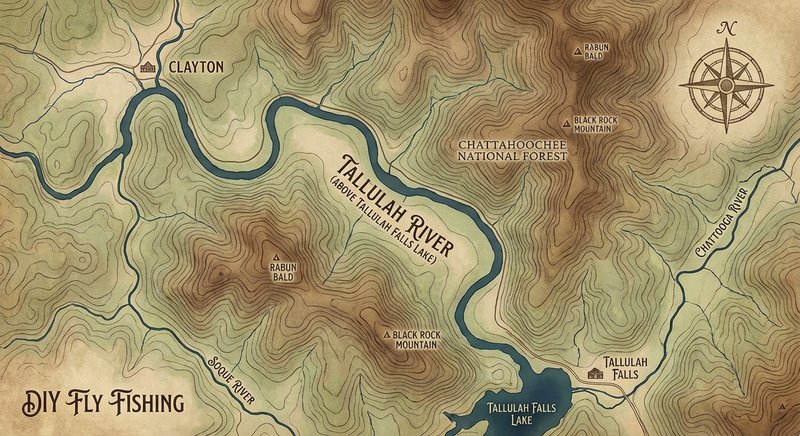
Tallulah River (Above Tallulah Falls Lake)
Fly fishing in Georgia · Intermediate · Best seasons: Spring, Fall
Target Species
Rainbow Trout, Brown Trout
About This Water
The Tallulah River above the lake provides a remote fishing experience. It is stocked with trout and surrounded by stunning scenery.
Fishing Recommendations
The Tallulah River, specifically the stretch flowing through the Blue Ridge Mountains into the Tallulah River Basin (above Lake Burton and Tallulah Falls), is one of Georgia’s most iconic trout destinations. While parts are heavily stocked, the upper reaches offer some of the most scenic and productive "mountain style" fishing in the Southeast.
🎣 Location Overview
The Tallulah River above the lake is a classic freestone mountain river. It is characterized by a high gradient, featuring a mix of deep, emerald-green pools, frantic pocket water, and long, glassy glides.
What makes it special is the dual personality of the river. The section running through the Rock Mountain and Coleman River areas feels like a rugged backcountry expedition, while the sections near the developed campgrounds offer easier access. It is a high-elevation river by Georgia standards, meaning the water stays cooler longer into the summer than lower-elevation streams like the Chattahoochee.
🐟 Target Species & Behavior
- Rainbow Trout: These are the primary residents. In the lower sections (near campgrounds), you will find plenty of stocked fish. However, as you move upstream toward the North Carolina line, you will encounter more stream-born, wild Rainbows. They are opportunistic and tend to hold in the "cushion" in front of boulders or in the fast riffles.
- Brown Trout: The "ghosts" of the Tallulah. Large, wild Browns lurk in the deep, undercut banks and the shadowy tail-outs of large pools. They are far more cautious and often require low-light conditions or large streamers to coax out.
- Feeding Habits: In the spring, they focus heavily on Blue Winged Olives and Caddis. In the summer and fall, terrestrials (ants/beetles) and stonefly nymphs are the primary calorie sources.
📅 Best Times to Fish
- Spring (March – May): This is the prime window. Rising water temperatures trigger massive insect hatches (Quill Gordons and March Browns).
- Fall (October – November): The Brown Trout move upstream to spawn, and the surrounding foliage makes for a stunning backdrop. The fish become aggressive again after the summer heat.
- Best Time of Day: During Spring/Fall, 10:00 AM to 4:00 PM is the sweet spot as the sun warms the water. In the heat of summer, stick to "Grey Light"—the hour before sunrise and after sunset.
🪰 Recommended Flies & Techniques
Top Fly Patterns
- Dry Flies: Yellow Stimulator (#12-16), Parachute Adams (#14-18), Elk Hair Caddis (Tan, #14-16), and the "Chernobyl Ant" for summer terrestrials.
- Nymphs: Prince Nymph (#14-16), Pheasant Tail (Bead Head, #16-18), and Pat’s Rubber Legs (Black or Coffee) for the deeper holes.
- Streamers: Woolly Bugger (Olive or Black, #8-10) for targeting large Browns in deep pools.
Techniques
- Dry-Dropper: This is the "bread and butter" of the Tallulah. Hang a small Pheasant Tail or Hare's Ear nymph 18-24 inches below a high-floating Stimulator.
- Tight-Line Nymphing: In the heavy pocket water and plunges, skip the indicator. High-sticking through the deep troughs will often yield fish that "indicator" anglers miss.
- Stealth: The water is exceptionally clear. Wear earthy tones and avoid "lining" the fish (casting your fly line directly over their heads).
💡 Pro Tips & Local Knowledge
- The "Upper" Upper: If you want wild fish and solitude, drive past the Tate City bridge and fish the headwaters near the North Carolina border. The fish are smaller but 100% wild and eager to rise to a dry fly.
- The Coleman River Confluence: Where the Coleman River enters the Tallulah is a legendary "honey hole." The mixing of water temperatures and currents often holds the largest fish in the system.
- Observe the "Soft Water": Many anglers fish only the deep pools. On the Tallulah, big fish often sit in surprisingly shallow "seams" right on the edge of the fast current. Don't wade through the shallows until you've flicked a fly into them.
⚠️ Important Information
- Access: Much of the river follows Tallulah River Road. There are numerous pull-offs and campgrounds (Sandy Bottom, River Bend, and Tate City). The further you drive (toward Tate City), the more "wild" the fishing becomes.
- Regulations:
- Georgia fishing regulations apply. You must have a Georgia Fishing License AND a Trout Supplement.
- Most of this section is "General Trout Water," allowing for various lures/baits, but check current GA DNR maps for specific "Artificial Only" tributary regulations (like the Coleman River).
- Safety: This is a mountain environment. Cell service is non-existent once you pass the Lake Burton area. Rocks are extremely slick; felt-soled boots or studs are highly recommended. Watch for sudden afternoon thunderstorms in the spring and summer.
Bug Hatches & Matching Flies
| Hatch | Type | Peak months | Time of day | Hook sizes | Matching flies |
|---|---|---|---|---|---|
| Blue Winged Olive Baetis | mayfly | February, March, October, November | Midday | #18-22 | Parachute Adams #18-22, Pheasant Tail #18-20, RS2 #20-22 |
| Quill Gordon Epeorus pleuralis | mayfly | March, April | Early Afternoon | #12-14 | Quill Gordon #12-14, Quill Gordon Nymph #12-14 |
| March Brown Maccaffertium vicarium | mayfly | April, May | Afternoon | #10-14 | March Brown Dry #12-14, Gold Ribbed Hare's Ear #10-12 |
| Little Yellow Stonefly (Yellow Sally) Isoperla | stonefly | May, June, July | Late Afternoon/Evening | #14-16 | Yellow Sally Dry #14-16, Iron Lotus #16 |
| Light Cahill Stenacron / Stenonema | mayfly | June, July | Evening | #12-16 | Light Cahill #14-16, Cream Variant #12-14 |
| Cinnamon Caddis Hydropsyche | caddis | May, June, September | Morning/Evening | #14-18 | Elk Hair Caddis (Tan) #14-18, Holy Grail #16-18 |
| Giant Black Stonefly Pteronarcys dorsata | stonefly | April, May | All Day (Nymphs) | #4-8 | Girdled Bugger #6-10, Pat's Rubber Leg #8-12 |
| Terrestrials (Ants/Beetles) Formicidae / Coleoptera | terrestrial | July, August, September | All Day | #12-18 | Chernobyl Ant #12-14, Black Foam Beetle #16-18, Cinnamon Ant #16-18 |
| Midges Chironomidae | midge | December, January, February | Midday | #20-24 | Zebra Midge #20-22, Griffith's Gnat #20-22 |
| Green Sedge Rhyacophila | caddis | May, June | Evening | #12-16 | Green Weenie #12-14, LaFontaine's Deep Sparkle Pupa #14-16 |