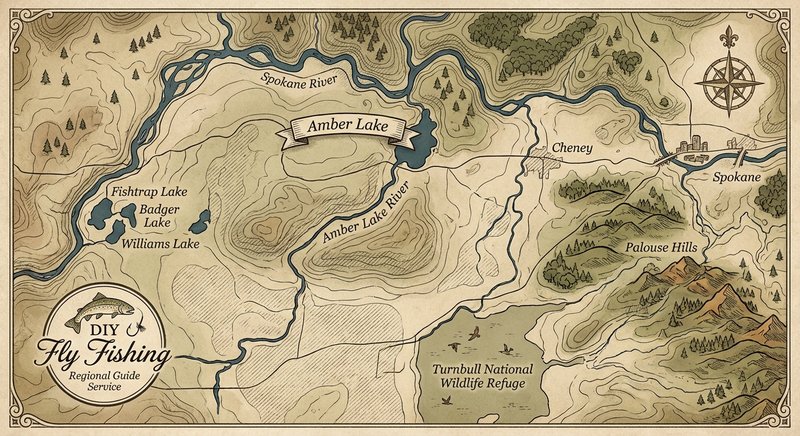
Amber Lake
Fly fishing in Washington · Intermediate · Best seasons: Spring, Fall
Target Species
Rainbow Trout, Brown Trout
About This Water
Eastern Washington quality trout lake with selective gear rules. Good spring and fall fishing.
Fishing Recommendations
Welcome to Amber Lake, one of the "crown jewels" of Eastern Washington’s fly fishing scene. Located roughly 30 miles southwest of Spokane in the Channeled Scablands, Amber Lake is managed as a "Quality Water" fishery. For a fly angler, this is a technical but highly rewarding destination known for producing thick, hard-fighting trout in a stunning, desert-like setting.
🎣 Location Overview
Amber Lake is a classic "Scabland" lake, carved out by the prehistoric Missoula Floods. It is characterized by dramatic basalt cliffs, crystal-clear water, and extensive weed beds. Unlike the muddy bottom lakes found elsewhere, Amber is nutrient-rich and oxygenated, supporting a massive biomass of aquatic insects.
What makes Amber special is its Selective Gear Rules and Catch and Release status. Because fish aren't being taken home in coolers, they have the opportunity to grow large and become "educated." It is a quiet, serene lake where internal combustion engines are prohibited, making it a sanctuary for float tubers and pontoon anglers.
🐟 Target Species & Behavior
- Rainbow Trout: These are the primary residents. They are known for being exceptionally girthy and energetic. Expect fish in the 16–20 inch range, with "trophy" specimens exceeding 24 inches. They cruise the weed edges and are notorious for aerial displays once hooked.
- Brown Trout: More elusive than the Rainbows, the Browns here are wary and often hold deeper or tighter to the basalt rock walls. They become particularly active during low-light hours and in the late fall when they prepare for their (unsuccessful) spawning runs.
Behavior: These fish are "grazers." They move along the drop-offs where the shallow "flats" meet the deep channels. Because the water is clear, they are very observant; if they see your boat or a heavy fly line landing over their heads, they will spook.
📅 Best Times to Fish
Amber Lake follows a classic "Ice-Out to Ice-In" cycle, but the shoulder seasons are undoubtedly the prime windows.
- Spring (March – June): This is the peak season. As soon as the ice thaws (usually March), the Chironomid (midge) hatches begin. April and May offer the most consistent action as water temperatures hit the "magic" 50–55°F mark.
- Fall (September – November): As water temperatures drop, the trout move out of the deep "summer holes" and back into the shallows to feed aggressively before winter. This is the best time to target the large Browns with streamers.
- Best Times of Day:
- Spring: Mid-morning to late afternoon (when the sun warms the water enough to trigger hatches).
- Fall: Early morning and the "golden hour" before sunset.
🪰 Recommended Flies & Techniques
1. Chironomid Fishing (The Gold Standard)
This is the most effective way to fish Amber.
- Patterns: Ice Cream Cone, Zebra Midge, or "Chanter" styles in sizes 12–18. Colors: Blood Red, Black with Silver Wire, and Olive/Copper.
- Technique: Use a long leader (15–20 feet) under a small strike indicator. Hang your fly 12–18 inches off the bottom. Patience is key—wait for the indicator to dive.
2. Scuds and Sowbugs
Amber Lake is crawling with Gammarus (scuds).
- Patterns: Olive or "Amber" colored scuds, sizes 14–16.
- Technique: Fish these on a weighted nymph rig or a slow-sink line along the edges of the weed beds. A "twitch-and-pause" retrieve mimics their natural swimming motion.
3. Callibaetis (Mayflies)
Late spring (May/June) brings the speckled-wing mayflies.
- Patterns: Parachute Adams (Dry), Hare’s Ear (Nymph), or a Cripple pattern.
- Technique: Look for rising fish in the afternoon. If no rises are visible, strip a small nymph on an intermediate sinking line through the top 3 feet of water.
4. Streamers (For the Big Browns)
- Patterns: Balanced Leeches (Black/Red or Olive), Woolly Buggers, or Zonkers.
- Technique: Use a type 3 or type 5 sinking line. Cast toward the basalt cliffs and strip back toward the middle of the lake with erratic movements.
💡 Pro Tips & Local Knowledge
- The "Basalt Shadow": On bright days, fish the shadows cast by the high basalt cliffs on the west side of the lake. Browns love the cover of the shade.
- Long Leaders are Mandatory: Because the water is so clear, a 9-foot leader is often too short. Move to a 12 or 15-foot fluorocarbon leader (4X or 5X) to avoid lining the fish.
- The "Wind Drift": Amber can get windy. Use a drogue (drift sock) on your pontoon or boat to slow your drift, allowing you to cover more water while keeping your flies at the proper depth.
- Check the Weeds: If you are catching weeds on every cast, you are too deep. If you aren't seeing any weeds, you might be too shallow. The "sweet spot" is usually right above the tips of the submerged vegetation.
⚠️ Important Information
- Access: There is one main WDFW boat launch on the north end of the lake. It has a vault toilet and a gravel ramp.
- Regulations:
- Selective Gear Rules: Single, barbless hooks only. No bait, no scented lures.
- Catch and Release ONLY: All trout must be released immediately.
- Motors: Internal combustion motors are prohibited. Electric trolling motors are allowed.
- Permits: A Washington State Fishing License and a Discover Pass (for parking at the WDFW site) are required.
- Winds: The Scablands are prone to sudden, high winds. Always wear a PFD, especially if you are in a float tube or kayak.
Amber Lake rewards the technical angler who pays attention to the details. Match the hatch, stay stealthy, and you'll find out why this lake is a legend among Northwest fly fishers. Tight lines!
Bug Hatches & Matching Flies
| Hatch | Type | Peak months | Time of day | Hook sizes | Matching flies |
|---|---|---|---|---|---|
| Chironomids Chironomidae | midge | April, May, September | All Day | #12-18 | Chromie #14-16, Ice Cream Cone #12-18, Chan's Chironomid Pupa #14-16 |
| Callibaetis Callibaetis | mayfly | June, July, September | Late Morning/Afternoon | #12-16 | Parachute Adams #14-16, Callibaetis Spinner #14-16, Hare's Ear Nymph #12-16 |
| Damselfly Enallagma/Coenagrion | terrestrial | June, July | Late Morning/Afternoon | #10-12 | Marabou Damsel #10-12, Adult Damsel #12, Balanced Damsel #10-12 |
| Scuds Gammarus | terrestrial | March, April, October, November | All Day | #12-16 | Ray Charles #14-16, Olive Scud #12-16, Orange Scud #14-16 |
| Traveling Sedge Hesperophylax | caddis | June, July | Evening | #8-12 | Mikulak Sedge #8-10, Goddard Caddis #10-12, Caddis Pupa #10-12 |
| Dragonfly Nymph Anisoptera | terrestrial | July, August | Afternoon | #4-10 | Carey Special #6-10, Gumdrop Dragon #8-10, Dragon Bugger #6-8 |
| Water Boatmen Corixidae | terrestrial | September, October | Afternoon | #14-16 | Water Boatman #14-16, Prince Nymph #14-16 |
| Terrestrial Ants Formicidae | terrestrial | August, September | Afternoon | #12-16 | Black Foam Ant #12-16, Cinnamon Ant #14-16 |