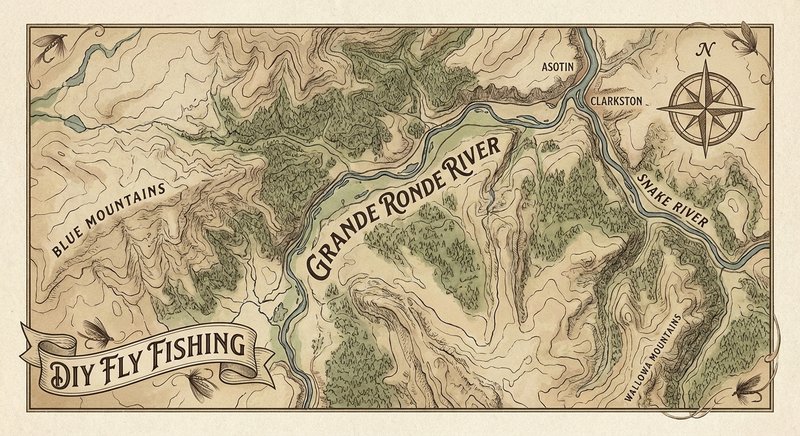
Grande Ronde River
Fly fishing in Washington · Intermediate · Best seasons: Summer, Fall
Target Species
Steelhead, Rainbow Trout
About This Water
Eastern Washington section with excellent summer steelhead. Remote canyon fishing near the Oregon border.
Fishing Recommendations
The Grande Ronde River, often referred to by locals simply as "The Ronde," is one of the most storied and scenic fly fishing destinations in the Pacific Northwest. Flowing through the deep basalt canyons of Southeast Washington, it offers a wilderness experience that feels a world away from the hustle of the I-5 corridor.
As your guide, here is a comprehensive breakdown of how to approach this majestic river.
🎣 Location Overview
The Grande Ronde is a "Classic" steelhead river. Its geology is defined by dramatic basalt cliffs, rolling golden hills, and a riverbed composed of perfect "softball to head-sized" cobble—ideal for wading and holding fish.
What makes the Ronde special is its gradient and character. Unlike the torrential, heavy flows of the coastal rivers, the Grande Ronde is relatively shallow and manageable. This makes it perhaps the best river in the world for swinging a fly on the surface or just below it. The scenery is breathtaking; it’s common to see bighorn sheep, mule deer, and golden eagles while you're working a run.
🐟 Target Species & Behavior
Steelhead (Summer-Run)
The stars of the show are the A-Run Summer Steelhead. These fish enter the Columbia, head up the Snake, and eventually turn into the Grande Ronde.
- Behavior: They are known for being exceptionally "grabby" and aggressive toward swung flies.
- Holding Water: They love "walking pace" water—about 3 to 4 feet deep with a consistent current. They often hold in the tailouts of long pools or in the "soft" water near the bank during high light.
Rainbow Trout (Redbands)
The river also hosts a healthy population of native interior Redband Trout.
- Behavior: These are hard-fighting, opportunistic feeders. During the summer, they are very focused on terrestrial insects (grasshoppers) and stoneflies.
- Holding Water: Look for them in faster riffles and behind large boulders where oxygen levels are higher.
📅 Best Times to Fish
Summer (July – Early September)
- Target: Primarily Rainbow Trout.
- Conditions: Water is warm, so focus on the early morning and late evening. This is prime "hopper-dropper" season.
Fall (Late September – November) — PEAK SEASON
- Target: Steelhead.
- Window: The "Magic Window" is usually October. This is when the water temperatures drop into the 45–55°F range—the sweet spot for steelhead activity.
- Time of Day: In the early fall, "shadow transitions" are key. When the sun first hits the water or when the canyon walls cast a shadow in the afternoon, the fish often move and become aggressive.
🪰 Recommended Flies & Techniques
For Steelhead (The Swing)
The Grande Ronde is "Spey Heaven." While you can nymph for them, swinging a fly is the soul of this river.
- Top Patterns:
- Surface: Pom Skater, Waller Walker (purple or black).
- Sub-surface: Green Butt Skunk, Blue Charm, Hobo Spey (purple/black), and the "Freight Train."
- Technique: Use a 6 or 7-weight Spey rod. Cast at a 45-degree angle, mend once to set the depth, and let the fly swing in a steady arc. Don't set the hook when you feel the pull; wait for the line to go tight!
For Rainbow Trout (Dries & Nymphs)
- Top Patterns:
- Dries: Chubby Chernobyl (Orange/Tan), Morrish Hopper, Stimulators.
- Nymphs: Pat’s Rubber Legs, Prince Nymph, Copper John.
- Technique: Focus on "pocket water." A heavy stonefly nymph with a smaller dropper 18 inches below is the standard "bread and butter" rig.
💡 Pro Tips & Local Knowledge
- The "Shade" Rule: Steelhead have no eyelids. On a bright, bluebird day in the canyon, the fish will often tuck tight against the basalt cliffs or into deeper shadows. If you find a run with a high cliff casting a shadow over the water, fish it thoroughly.
- Cover Water: Don't marry a hole. The Grande Ronde rewards the angler who moves. Take two steps between every cast. You are looking for the "player"—the aggressive fish that wants your fly.
- The "Boggan’s" Factor: Boggan’s Oasis is the legendary hub of the river. Stop in for a milkshake and the latest river report. The stretch from Boggan's to Rogersburg (the mouth) is the most popular for float trips.
- Watch the Temps: If the water hits 68°F in the summer, stop fishing for trout. They won't recover well. In the fall, if the water drops below 40°F, switch from a floating line to a sink tip (T-8 or T-11).
⚠️ Important Information
Access
- Roadside: Highway 129 and Shumaker Road provide decent bank access.
- Floating: This is the best way to see the river. Popular drifts include Minam to Troy (multi-day) or Boggan’s to Shumaker (day trip).
Regulations & Permits
- Steelhead: You must have a Washington fishing license with a Columbia River Salmon and Steelhead Endorsement.
- Barbless Hooks: Mandatory for all steelhead fishing in Washington.
- Wild vs. Hatchery: You must release all wild (unclipped adipose fin) steelhead immediately. Only hatchery fish (clipped fin) may be retained (check current emergency rules for harvest limits).
Safety
- Rattlesnakes: The canyon is prime rattlesnake habitat in the summer and early fall. Watch your step when hiking to the river.
- Cell Service: Virtually non-existent in the canyon. Download your maps for offline use or carry a satellite messenger (InReach/Zoleo).
Guide’s Final Word: The Grande Ronde isn't a river where you count fish; it's a river where you count memories. Slow down, enjoy the canyon, and wait for that "electric" pull on the swing. 🎣
Bug Hatches & Matching Flies
| Hatch | Type | Peak months | Time of day | Hook sizes | Matching flies |
|---|---|---|---|---|---|
| Salmonfly Pteronarcys californica | stonefly | May, June | All day | #4-8 | Chubby Chernobyl #6-8, Pat's Rubber Leg #4-8, Clark's Stone #6-8 |
| Golden Stonefly Hesperoperla pacifica | stonefly | June, July | Morning/Evening | #8-12 | Rogue Foam Stone #8-10, Kaufmanns Stone #8-12, Norm Wood Special #10 |
| Blue Winged Olive Baetis | mayfly | March, April, October, November | Afternoon | #18-22 | RS2 #20-22, Parachute Adams #18-22, Pheasant Tail #18-20 |
| Pale Morning Dun Ephemerella excrucians | mayfly | June, July | Late Morning/Afternoon | #14-18 | PMD Sparkle Dun #16-18, Split Case PMD #16-18, Quigley Cripple #14-16 |
| October Caddis Dicosmoecus atripes | caddis | September, October | Afternoon/Evening | #8-12 | Orange Stimulator #8-10, Morrish October Caddis #10-12, Peeking Caddis #8-12 |
| Skwala Stonefly Skwala americana | stonefly | March, April | Afternoon | #10-12 | Skwala Stone #10-12, 20 Incher Stone #10-12, Bullet Skwala #12 |
| Spotted Sedge Hydropsyche | caddis | July, August, September | Evening | #14-18 | Elk Hair Caddis #14-16, LaFontaine's Deep Sparkle Pupa #14-18, Holy Grail #16 |
| Grasshoppers Acrididae | terrestrial | August, September | Afternoon | #6-12 | Morrish Hopper #8-10, Dave's Hopper #10-12, Pantone Hopper #8 |
| Mother's Day Caddis Brachycentrus occidentalis | caddis | May | Mid-day | #14-16 | Peacock Caddis #14-16, Z-Wing Caddis #14-16, Soft Hackle Hare's Ear #14-16 |