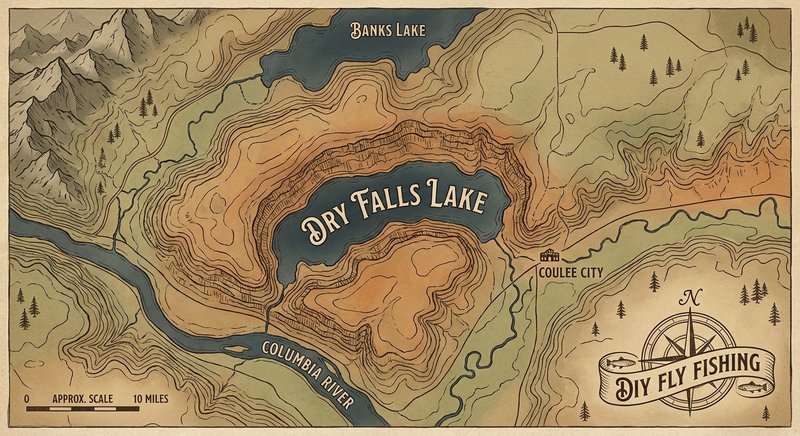
Dry Falls Lake
Fly fishing in Washington · Intermediate · Best seasons: Spring, Fall
Target Species
Rainbow Trout, Brown Trout
About This Water
Dramatic eastern Washington lake below ancient waterfall. Quality rainbow and brown trout fishing.
Fishing Recommendations
Welcome to one of the crown jewels of Washington State stillwater fly fishing. As your guide, I can tell you that Dry Falls Lake is a place of prehistoric beauty and exceptional trout growth. Located within the Sun Lakes-Dry Falls State Park, this lake sits at the foot of a massive, 400-foot-high basalt precipice—what was once the largest waterfall in the world during the Missoula Floods.
Here is your comprehensive guide to tackling Dry Falls.
🎣 Location Overview
Dry Falls Lake is a "Quality Water" fishery located in the Coulee Corridor of Central Washington. What makes it special is the sheer drama of the landscape and the productivity of the water.
The lake is highly alkaline and rich in calcium, which creates a massive biomass of insects and crustaceans. Because it is managed under Selective Gear Rules, the fish aren't just numerous; they are large, healthy, and "educated." The water is generally clear, though it can develop a tea-colored tint or algae bloom in late spring. It is a classic "coulee" lake, meaning it is surrounded by sheer basalt walls that offer some protection from the wind but can also create tricky swirling gusts.
🐟 Target Species & Behavior
- Rainbow Trout: These are the primary residents. They are typically stocked as fingerlings and grow rapidly on a diet of scuds and midges. Expect "hot" fish in the 16–22 inch range that fight significantly harder than your average hatchery trout.
- Brown Trout: Dry Falls is famous for its elusive, trophy-sized Browns. They tend to be more nocturnal and structure-oriented than the Rainbows. You will find them cruising the weed lines or tucked against the shaded basalt cliffs.
Behavior: These fish are sophisticated. They move from the deep central basins to the shallow "flats" and weed edges to feed. In the spring, they focus heavily on chironomid hatches; in the fall, they are looking to bulk up on baitfish and scuds for the winter.
📅 Best Times to Fish
Optimal Seasons
- Spring (Late March – June): This is the prime window. The chironomid hatches are legendary, and the trout are hungry after the winter.
- Fall (September – November): As the water cools, the "shallows" become active again. This is the best time to target the big Browns using streamers.
Best Times of Day
- Early Morning/Dusk: Essential for Brown trout and for fishing dry flies (Callibaetis or Caddis).
- Mid-Day: Actually very productive in the spring during the peak of a midge (chironomid) hatch when the sun warms the water surface.
Prime Windows
The Damselfly migration (usually late May to early June) is the highlight of the year. Watching 20-inch Rainbows cruise the surface like sharks is an experience you won't forget.
🪰 Recommended Flies & Techniques
Top Fly Patterns
- Chironomids: Sizes 12–18. Colors: "Ice Man," "Chromie," "Bloodworm" (red), and black with a silver bead.
- Scuds: Sizes 14–16. Olive, UV tan, or orange. These are the "bread and butter" of the lake.
- Damselflies: Size 10–12. Marabou nymphs in olive or bright green.
- Streamers: Size 4–8. Black or Olive Woolly Buggers, Balanced Leeches (bruised or black/red), and Zonkers to mimic small perch.
- Dry Flies: Size 14–16 Callibaetis Sparkle Duns or Parachute Adams for those quiet evenings.
Effective Techniques
- Chironomid Fishing (The "Indicator" Rig): Use a long leader (12–20 feet) under a slip-indicator. Suspend your fly 1–2 feet off the bottom in 10–15 feet of water.
- The "Slow Crawl": Use an intermediate sinking line with a scud or damselfly nymph. Use an agonizingly slow retrieve along the weed edges.
- Balanced Leeches: Fished under an indicator, these are deadly when there is a slight chop on the water to provide movement.
💡 Pro Tips & Local Knowledge
- The "Wall" Strategy: The steep basalt wall on the far side of the lake isn't just for scenery. The shade it provides keeps the water cooler, and the rock falls create underwater structures where big Browns hide.
- Watch the Wind: The wind can howl through the coulee. If it's too windy for an indicator, switch to a Type 3 or Type 5 sinking line and "troll" or strip streamers deep.
- Watercraft is Essential: While there is limited bank access near the boat launch, this is a boat/float tube lake. A pontoon boat or float tube is ideal because it allows you to stay quiet and maneuver into the small coves.
- The "Basalt Drop-off": Find the areas where the shallow flats (5–8 feet) suddenly drop into the deep basin (20+ feet). Fish often patrol these "edges" like a highway.
⚠️ Important Information
- Regulations: Dry Falls is a Selective Gear Rules lake. This means:
- Unscented artificial flies and lures only.
- Single-point barbless hooks are required.
- Internal combustion motors are prohibited (Electric motors only).
- Access: There is a well-maintained WDFW boat launch with a dock and a toilet. A Discover Pass is required for parking.
- Permits: You need a valid Washington State Freshwater Fishing License.
- Safety: The basalt cliffs are home to rattlesnakes in the warmer months. Be cautious if you decide to scramble along the shorelines.
Dry Falls Lake is a "thinking person's" fishery. It rewards patience, long leaders, and a keen eye for what is hatching. Tight lines!
Bug Hatches & Matching Flies
| Hatch | Type | Peak months | Time of day | Hook sizes | Matching flies |
|---|---|---|---|---|---|
| Chironomids Chironomidae | midge | April, May, October | All Day | #10-18 | Chromie #12-16, Ice Bud #14-18, Chan's Bomber #10-12 |
| Callibaetis Callibaetis ferrugineus | mayfly | May, June, September | Late Morning/Afternoon | #12-16 | Parachute Adams #14-16, Callibaetis Cripple #14-16, Hare's Ear Nymph #12-16 |
| Traveling Sedge Hesperophylax | caddis | June, July | Evening | #6-10 | Mikulak Sedge #8-10, Goddard Caddis #8-12, Carey Special #6-10 |
| Damselflies Enallagma | terrestrial | June, July | Morning/Afternoon | #10-12 | Marabou Damsel #10-12, Adult Damsel #10-12, Wiggle Tail Damsel #12 |
| Grasshoppers Melanoplus | terrestrial | July, August, September | Afternoon | #8-12 | Morrish Hopper #8-12, Dave's Hopper #10-12 |
| Blue-Winged Olive Baetis | mayfly | March, April, October | Afternoon | #16-20 | BWO Sparkle Dun #18-20, Pheasant Tail Nymph #16-20 |
| Black Ants Formicidae | terrestrial | August, September | All Day | #14-18 | Cinnamon Ant #16, Black Foam Ant #14-18 |
| Little Black Caddis Brachycentrus | caddis | April, May | Morning/Evening | #16-18 | Elk Hair Caddis #16-18, Z-Caddis #16-18 |