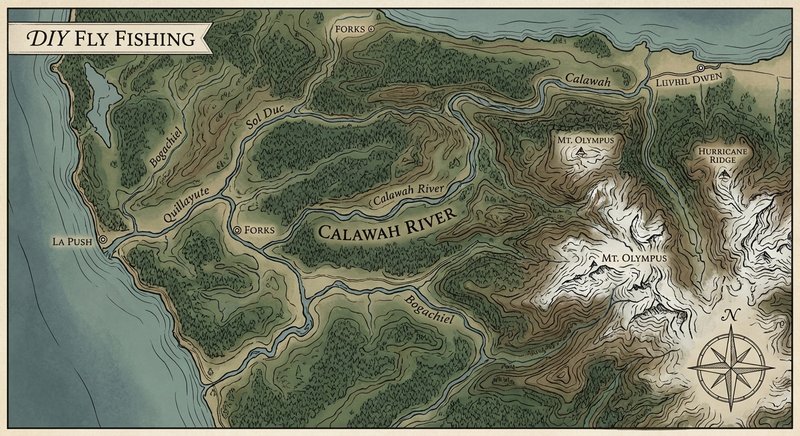
Calawah River
Fly fishing in Washington · Intermediate · Best seasons: Winter, Spring
Target Species
Steelhead
About This Water
Olympic Peninsula tributary with winter steelhead. Scenic fishing through temperate rainforest.
Fishing Recommendations
The Calawah River is often whispered about in hushed tones by Olympic Peninsula (OP) locals. While the nearby Hoh and Bogachiel get the lion's share of the fame, the Calawah—a major tributary of the Bogachiel—is the "gem" of the Forks area. It is a rugged, intimate, and moody river that offers some of the most technical and rewarding steelhead fishing in the Pacific Northwest.
🎣 Location Overview
The Calawah is divided into three distinct sections: the North Fork, the South Fork, and the Mainstem. It is characterized by its high gradient, boulder-strewn pocket water, and incredible clarity. Because much of its headwaters lie within the Olympic National Forest, it lacks the glacial silt of the Hoh, meaning it is often the first river to clear after a heavy storm and the last to blow out.
Anglers love the Calawah because it feels "smaller" than the big coastal rivers. It requires precise casting and a strategic approach. It is a "pocket water" river, where a steelhead might be behind a boulder the size of a Volkswagen or tucked into a slot no wider than a sidewalk.
🐟 Target Species & Behavior
Target Species: Winter Steelhead (Wild and Hatchery).
- Hatchery Runs: These fish arrive early (December–January). They are typically destined for the Bogachiel hatchery or the Calawah rearing ponds. They are aggressive and often school up in the lower river.
- Wild Steelhead: The stars of the show. These fish arrive in late January and peak in March and April. Calawah wild fish are legendary for their shoulders and fighting spirit, often using the river's heavy current and boulders to their advantage.
- Behavior: Unlike the "cruising" fish of larger rivers, Calawah steelhead are "holders." They find high-oxygen water behind structure. Because the water is often exceptionally clear, these fish can be "spooky." Stealth and long leaders are often necessary.
📅 Best Times to Fish
- Optimal Months: December through April.
- Hatchery Peak: Late December to mid-January.
- Wild Peak: February 15th through the end of March.
- Prime Conditions: The Calawah is "flashy." The best fishing occurs on the "drop and clear." When the river gauge is receding after a rain event and the water turns that "steelhead green" (3–5 feet of visibility), fishing is world-class.
- Time of Day: In the clear water of the Calawah, low-light conditions (dawn and dusk) are paramount. On bright, sunny days, fish move into deeper slots or under heavy cover.
🪰 Recommended Flies & Techniques
1. Swinging (Spey Casting)
This is the traditionalist's choice. Because the Calawah has many boulders, you need a fly that "dances" without snagging the bottom.
- Patterns:
- Intruders: Black/Blue (cloudy days), Pink/Orange (dirty water), or Olive/White (clear water).
- Hobo Speys: Great for low water; they have incredible movement with minimal weight.
- Prom Dress: A classic OP flashy fly for high-water visibility.
- Tips: Use T-11 or T-14 sink tips to get down quickly in the short, deep pockets.
2. Nymphing / Indicator Fishing
Often the most productive method on this river due to the "pocket-y" nature of the water.
- Patterns:
- Beads: 10mm or 12mm soft beads in "Mottled Roe" or "Orange Crush."
- Rubber-Legged Stones: Size 4–6 in black or brown.
- Glo-Bugs: Classic yarn eggs in peach or pink.
3. Presentation
In the Calawah's clear water, downsizing is a pro move. If the sun is out and the water is low, switch to smaller, unweighted flies and lighter tips to avoid spooking fish.
💡 Pro Tips & Local Knowledge
- The "North Fork" Strategy: If the mainstem is running high, the North Fork often remains fishable. It is much smaller and requires "trout-style" stalking.
- The Boulder Garden: Experienced Calawah guides look for "soft spots" in turbulent water. A steelhead doesn't need much room; look for the "seam" where fast water meets a slow eddy behind a rock.
- Walking the Dog: When swinging flies, use a "perched" cast. Instead of a long 45-degree swing, try to keep your fly in the "bucket" as long as possible by mending upstream aggressively.
- Stealth Matters: Don't stomp through the shallows. On the Calawah, fish will often hold in very shallow "tailouts" (the end of a pool). Fish the tailout before you wade into it.
⚠️ Important Information
- Access:
- The 110 Bridge: A popular launch and bank access point.
- Calawah Rearing Ponds: Good bank access for hatchery fish.
- Whitcomb-Dimmel Park: Offers access to the lower river.
- Regulations: Washington Department of Fish & Wildlife (WDFW) rules change frequently.
- Selective Gear Rules: Usually, single barbless hooks are required.
- Wild Fish: It is illegal to remove a wild steelhead from the water. Keep them wet!
- Check the Hotline: Always check the WDFW emergency closures, as the OP rivers can close on short notice due to low escapement numbers.
- Safety: The Calawah is a "technical" float. If you are rowing a drift boat or raft, be prepared for tight turns and boulder dodging. If you are an amateur rower, hire a guide or stick to bank fishing.
Bug Hatches & Matching Flies
| Hatch | Type | Peak months | Time of day | Hook sizes | Matching flies |
|---|---|---|---|---|---|
| March Brown Rhithrogena morrisoni | mayfly | March, April | Midday | #12-14 | Western March Brown #12-14, Hare's Ear Nymph #12-14, March Brown Emerger #14 |
| Blue Winged Olive Baetis | mayfly | March, April, September, October | Late Morning/Afternoon | #16-20 | RS2 #18-20, Parachute Adams #16-20, Pheasant Tail Nymph #16-20 |
| Golden Stonefly Calineuria californica | stonefly | June, July | Morning/Evening | #6-10 | Pat's Rubber Leg #6-10, Rogue River Stone #8-10, Golden Demon #8-10 |
| October Caddis Dicosmoecus atripes | caddis | September, October | All Day/Evening | #8-10 | Orange Stimulator #8-10, Pecka's October Caddis Jig #8-10, Morrish October Caddis Adult #8-10 |
| Green Sedge Rhyacophila | caddis | May, June, July, August | Afternoon/Evening | #12-16 | Green Weenie #12-14, LaFontaine's Deep Sparkle Pupa #14-16, Elk Hair Caddis (Green) #14-16 |
| Pale Morning Dun Ephemerella | mayfly | June, July, August | Late Morning | #14-18 | PMD Sparkle Dun #16-18, Split Case PMD #16-18, Quigley's PMD Hackle Stacker #14-16 |
| Skwala Stonefly Skwala americana | stonefly | February, March | Midday | #10-12 | Skwala Stone Dry #10-12, Twenty Incher #10-12, Little Olive Stone #12 |
| Salmonfly Pteronarcys californica | stonefly | May, June | Afternoon | #4-8 | Chubby Chernobyl (Orange) #6-8, Kaufmann's Stone #4-8, Clark's Stone #6-8 |