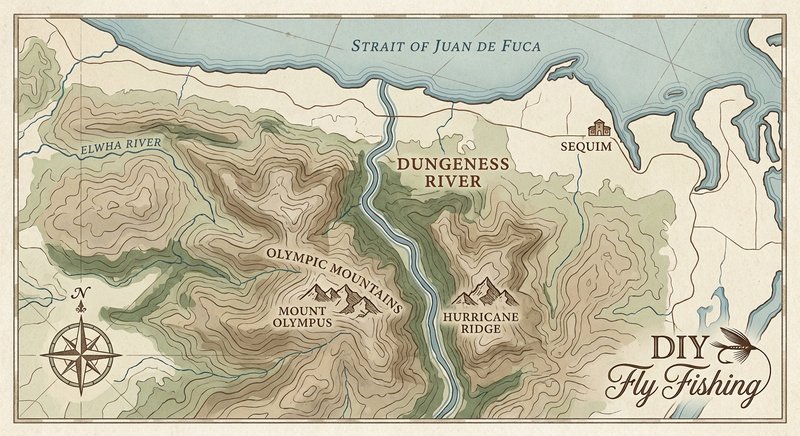
Dungeness River
Fly fishing in Washington · Intermediate · Best seasons: Winter, Fall
Target Species
Steelhead, Coho Salmon
About This Water
Olympic Peninsula river near Sequim. Wild steelhead and salmon in clear mountain water.
Fishing Recommendations
The Dungeness River, flowing from the rugged peaks of the Olympic Mountains into the Strait of Juan de Fuca, is one of the most unique and challenging rivers on the Olympic Peninsula (OP). Known for its incredibly steep gradient—dropping over 7,000 feet in just 28 miles—it is a fast-moving, "flashy" river that requires a technical approach and a keen eye for water reading.
Here is your comprehensive guide to fly fishing the Dungeness.
🎣 Location Overview
The Dungeness is often described as a "boutique" river compared to the massive glacial systems like the Hoh or the Quinault. It is characterized by its crystal-clear water (outside of flood stages), large cobblestones, and classic pool-riffle-run construction.
Anglers love the Dungeness because it offers a more intimate experience. You aren't usually dealing with the heavy jet boat traffic found on other rivers; instead, it's a walk-and-wade paradise. The scenery is spectacular, transitioning from alpine forests to the fertile Sequim valley. However, it is a temperamental river—because it is so steep, it rises and falls faster than almost any other drainage in Washington.
🐟 Target Species & Behavior
Winter Steelhead
- Behavior: These are the "ghosts" of the Dungeness. They enter the river with the first major rains of winter. Unlike the deep-holding fish of larger rivers, Dungeness Steelhead often hold in "pocket water" behind large boulders or in the walking-speed water of tailouts.
- Feeding: They aren't actively feeding, but they are highly territorial. They respond best to "swinging" flies that irritate them or high-drifting nymphs that look like a natural protein source.
Coho (Silver) Salmon
- Behavior: Coho enter the system in the fall. They are notorious for seeking out "frog water"—the slowest, quietest backwaters, sloughs, and eddies. They are aggressive but can be "put down" easily by clumsy wading or heavy lines.
- Feeding: In the river, they retain their predatory instinct. They react well to movement, flash, and sudden changes in fly speed.
📅 Best Times to Fish
- Coho Salmon: Late September through November. The "sweet spot" is usually mid-October after the first significant rain "unlocks" the river mouth, allowing fish to push past the lower flats.
- Winter Steelhead: January through March. February is traditionally the peak month for both hatchery returns and the arrival of the larger wild fish.
- Prime Conditions: Look for a dropping and clearing trend. If the river flow (checked via USGS gauges) is spiking, stay home. You want to hit it as the graph starts to angle downward and the water transitions from "chocolate milk" to "steelhead green" (about 2–3 feet of visibility).
🪰 Recommended Flies & Techniques
For Steelhead
- Technique: Spey Casting / Swinging. This is the soul of OP fishing. Use a 7 or 8-weight Spey rod with a Skagit head and a variety of sink tips (T-11 to T-14).
- Patterns:
- Intruders: Pink/Orange or Black/Blue.
- Bunny Leeches: The "Egg-Sucking Leech" is a classic here.
- Hoh Bo Spey: Highly effective in the Dungeness’s clear water.
For Coho
- Technique: Stripping or "Twitching." Use an 8-weight single-handed rod. Cast into soft water and use erratic, short strips to trigger a strike.
- Patterns:
- Flash Flies: Anything with purple, pink, or chartreuse UV flash.
- Christmas Trees: A local favorite.
- Rolie Polie / Polliwog: If the water is low and clear, fishing a surface popper (Polliwog) can result in explosive topwater takes.
💡 Pro Tips & Local Knowledge
- The "Three-Day Rule": Because the Dungeness is so steep, it "blows out" instantly. However, it also clears faster than any other river. If a storm hits on Monday, the Dungeness might be fishable by Thursday, while the Bogachiel might still be a mess.
- Focus on the Lower River: Much of the upper Dungeness is tightly canyoned or flows through private timberland. The most productive (and accessible) fly water is generally from the Railroad Bridge Park down to the mouth.
- The Grey Wolf Influence: The Grey Wolf River is the main tributary. If the Dungeness looks muddy, check if the mud is coming from the mainstem or the Grey Wolf; sometimes one is clear while the other is blown, providing a "mixing zone" of fishable water below the confluence.
- Stealth is Mandatory: Because the water is often exceptionally clear, Dungeness fish are spooky. Wear earthy tones, avoid splashing while wading, and try to keep a low profile on the bank.
⚠️ Important Information
- Regulations: Check the WDFW Sport Fishing Rules PAMPHLET and Emergency Rules daily. The Dungeness is a highly regulated conservation river. It often has "selective gear rules" (unweighted flies, single barbless hooks).
- Closures: The river is frequently subject to emergency closures to protect ESA-listed Chinook and Summer Chum. Never fish the Dungeness without checking the WDFW website first.
- Access:
- Railroad Bridge Park: Great walking access.
- Dungeness Hatchery: Good access for hatchery steelhead.
- Riverside Landing: Public access points provided by Clallam County.
- Safety: The "Dungeness cobblestones" are notoriously slippery and round. Use studded wading boots and a wading staff. This is not a river you want to take a swim in.
Guide’s Final Word: The Dungeness is a river for the thinking angler. It won't give up its prizes easily, but swinging a fly in that turquoise water with the Olympic Mountains as a backdrop is as good as fly fishing gets in the Pacific Northwest.
Bug Hatches & Matching Flies
| Hatch | Type | Peak months | Time of day | Hook sizes | Matching flies |
|---|---|---|---|---|---|
| March Brown Rhithrogena morrisoni | mayfly | March, April, May | Afternoon | #12-14 | Western March Brown #12-14, Hare's Ear Nymph #12-14, March Brown Emerger #14 |
| Blue Winged Olive Baetis | mayfly | March, April, September, October | Mid-day/Afternoon | #16-20 | BWO Parachute #16-20, RS2 #18-20, Pheasant Tail #16-20 |
| Golden Stonefly Calineuria californica | stonefly | June, July | Morning/Evening | #8-12 | Kaufmann's Stone #8-12, Chubby Chernobyl #10-12, Pat's Rubber Legs #8-12 |
| Mother's Day Caddis Brachycentrus | caddis | May | All day | #14-16 | Elk Hair Caddis (Olive) #14-16, Peacock Caddis #16, Deep Sparkle Pupa #14-16 |
| October Caddis Dicosmoecus gilvipes | caddis | September, October, November | Afternoon/Evening | #8-10 | Orange Stimulator #8-10, October Caddis Pupa #8-10, Morrish October Caddis #8-10 |
| Little Black Stonefly Capniidae | stonefly | February, March | Mid-day | #16-18 | Black Stimulator #16-18, Zebra Midge (Black) #18, Little Black Sloan #16-18 |
| Pale Morning Dun Ephemerella | mayfly | June, July, August | Morning/Early Afternoon | #16-18 | PMD Sparkle Dun #16-18, Pale Morning Dun Parachute #16-18, Military Mayfly #16-18 |
| Midges Chironomidae | midge | January, February, December | All day | #18-24 | Griffith's Gnat #18-22, Zebra Midge #18-24, Top Secret Midge #20-22 |
| Terrestrials (Ants/Beetles) Formicidae/Coleoptera | terrestrial | July, August, September | Afternoon | #12-16 | Cinnamon Ant #14-16, Black Foam Beetle #12-14, Fat Albert #12 |