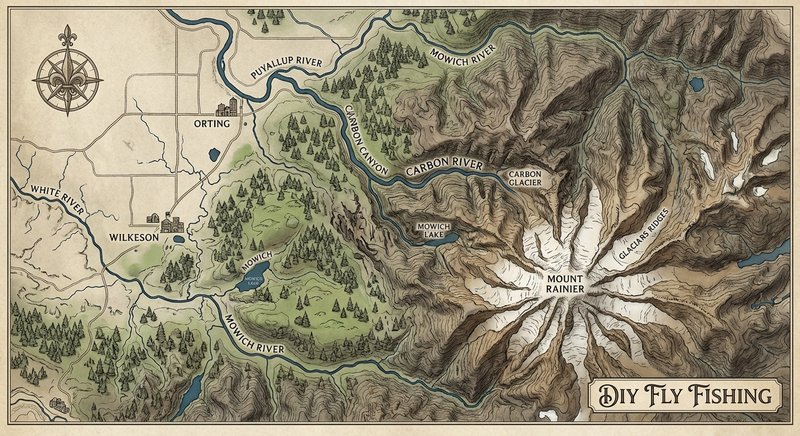
Carbon River
Fly fishing in Washington · Intermediate · Best seasons: Winter, Spring
Target Species
Steelhead
About This Water
Mt. Rainier tributary with wild steelhead. Flows through old-growth forest in national park buffer.
Fishing Recommendations
The Carbon River is a unique and challenging glacial system flowing from the north slope of Mt. Rainier. It is a river of raw, natural beauty, characterized by its "milky" glacial tint and its powerful, shifting braids. For the steelhead angler, the Carbon represents a "high-risk, high-reward" environment where the fish are bright, strong, and often elusive.
🎣 Location Overview
The Carbon River is a major tributary of the Puyallup River. Unlike many coastal rivers, the Carbon is a high-gradient, braided system. Its character is defined by "glacial flour"—fine sediment from the Carbon Glacier—which gives the water a distinct opaque, turquoise-grey hue.
Anglers love the Carbon because it feels wilder and more rugged than many other Puget Sound tributaries. The riverbed is constantly shifting; a "honey hole" from last year may be a dry gravel bar this year. This requires an angler to be a "prospector," searching for new holding water every season. It is a physically demanding river to fish, with unstable banks and heavy flows, but it offers a true sense of solitude and the chance at a wild Puget Sound winter steelhead.
🐟 Target Species & Behavior
The primary draw here is the Wild Winter Steelhead. These fish are part of the Puyallup River basin stock and are known for their incredible power.
- Behavior: Because of the glacial silt, visibility is often limited (usually 1.5 to 3 feet). Consequently, steelhead in the Carbon tend to hold in shallower, softer water than they might in a crystal-clear river. They rely heavily on their lateral line to sense movement.
- Where they hold: Look for "inside" seams, the heads of tailouts, and any large boulders that provide a break in the heavy current. Because the river is braided, don't overlook small side channels—if there is enough depth to cover their backs, there could be a fish there.
- Feeding: While adult steelhead aren't actively feeding to grow, they are highly territorial and reactive. In the murky water, they respond best to vibrations and large profiles.
📅 Best Times to Fish
- Optimal Months: January through March is the prime window. Late February and March often see the largest push of wild fish.
- Best Times of Day: In glacial water, the "early morning low light" rule is less critical than in clear rivers. Mid-day can actually be better as the sun may help improve visibility slightly through the silt.
- Prime Conditions: Visibility is everything. You want the river to be "dropping and clearing." If the river is rising, the glacial flour becomes too thick to fish. Look for a USGS gauge reading that shows a steady decline after a rain event. A "emerald green" tint is the Holy Grail; if it looks like thick chocolate milk, go get a coffee and wait a day.
🪰 Recommended Flies & Techniques
In the Carbon, your fly needs to be seen and felt.
Top Fly Patterns
- Intruders: Large, weighted patterns in Pink/Orange, Black/Blue, or Chartreuse. The "dirty water" combo of Pink and Orange is a local favorite.
- Prominent Profiles: Use flies with ostrich herl or rhea that move a lot of water.
- Egg Patterns: Large 10mm or 12mm beads in "Mottled Orange" or "Shrimp Pink" fished under an indicator can be deadly in the seams.
Effective Techniques
- The Swing (Spey/Switch): This is the classic approach. Use a Skagit head with a heavy sink tip (T-11 or T-14) to get the fly down quickly in the heavy glacial push. Keep your swings slow.
- Nymphing/Beading: Using a heavy float setup allows you to pick apart the small pockets and "buckets" in the braided sections where a swing might be difficult.
💡 Pro Tips & Local Knowledge
- Shorten Your Leader: In murky water, use a shorter leader (3–4 feet of 12-15lb Maxima Ultragreen). This keeps the fly tracking closer to the sink tip and ensures it stays in the "zone."
- Follow the Gravel: The Carbon is notorious for "walking" across its flood plain. If you find a stretch with fresh, basketball-sized cobble and a walking-speed current, stay there. Avoid areas with "dead water" or deep silt bottoms.
- The "Vibes": Use flies with brass or tungsten dumbbells. The extra "clack" and displacement help the fish track the fly when they can't see it clearly.
- The Puyallup Confluence: The area near the mouth where the Carbon enters the Puyallup can be a staging ground, but it gets the most pressure. If you have the stamina, hike upstream toward the Mount Rainier National Park boundary for more "frontier" fishing.
⚠️ Important Information
- Access: Much of the river runs through private timberland or near the town of Orting. Popular access points include the Orting City Parks and the bridges along Hwy 162. The Foothills Trail offers excellent foot/bike access to miles of the river that are unreachable by car.
- Regulations: Check the WDFW (Washington Department of Fish and Wildlife) pamphlet carefully before heading out. The Carbon often has specific "selective gear rules" (no bait, single barbless hooks).
- Wild Fish Policy: Almost all wild steelhead in this system must be released. Keep them in the water while unhooking. These fish are a threatened species and are vital to the ecosystem.
- Safety: The Carbon is a "moving" river. The banks are often composed of loose glacial till and can collapse. Be extremely cautious when wading; the silt makes it impossible to see the bottom, and "drop-offs" are common. A wading staff is non-negotiable here.
Guide’s Final Word: The Carbon is a "moody" river. You might go three trips without seeing a fish, but the fourth trip might reward you with a 15-pound chrome powerhouse in a setting that feels like the edge of the world. Patience and persistence are your best tools.
Bug Hatches & Matching Flies
| Hatch | Type | Peak months | Time of day | Hook sizes | Matching flies |
|---|---|---|---|---|---|
| Blue Winged Olive Baetis tricaudatus | mayfly | March, April, September, October | Late Morning/Afternoon | #16-20 | Parachute Adams #16-20, RS2 #18-20, Pheasant Tail #16-20 |
| March Brown Rhithrogena morrisoni | mayfly | March, April | Afternoon | #12-14 | March Brown Western Dry #12-14, Gold Ribbed Hare's Ear #12-14, March Brown Wet #12-14 |
| Golden Stonefly Hesperoperla pacifica | stonefly | June, July | Morning/Evening | #8-12 | Chubby Chernobyl (Gold) #8-12, Pat's Rubber Leg #8-12, Golden Stone #10-12 |
| October Caddis Dicosmoecus atripes | caddis | September, October | All Day/Evening | #8-10 | Orange Stimulator #8-10, October Caddis Pupa #8-10, Peeking Caddis #10 |
| Little Yellow Stonefly (Yellow Sally) Isoperla spp. | stonefly | June, July, August | Late Afternoon/Evening | #14-16 | Yellow Sally Dry #14-16, Little Yellow Stone Nymph #14-16 |
| Spotted Sedge Hydropsyche spp. | caddis | July, August | Evening | #14-16 | Elk Hair Caddis (Tan) #14-16, Hydropsyche Larva #14-16, LaFontaine Sparkle Pupa #14-16 |
| Salmonfly Pteronarcys californica | stonefly | May, June | All Day | #4-8 | Sofa Pillow #4-8, Giant Stone Nymph #4-8 |
| Winter Stonefly Capnia/Taeniopteryx | stonefly | February, March | Midday | #14-18 | Black Stimulator #16-18, Copper John (Black) #16-18 |
| Green Sedge Rhyacophila spp. | caddis | May, June, September | Evening | #12-16 | Green Weenie #12-14, Caddis Varians (Green) #14-16 |