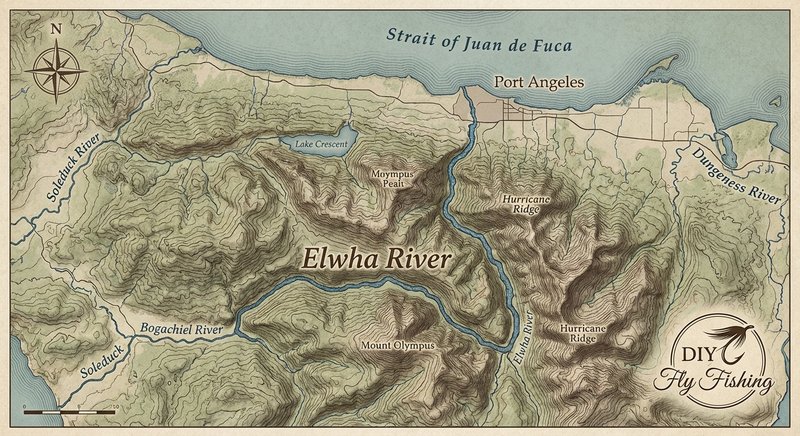
Elwha River
Fly fishing in Washington · Intermediate · Best seasons: Fall, Winter
Target Species
Steelhead, Chinook Salmon, Coho Salmon
About This Water
Restored Olympic Peninsula river after dam removal. Returning salmon and steelhead in recovering habitat.
Fishing Recommendations
The Elwha River is one of the most storied and ecologically significant rivers in the Pacific Northwest. Located on the Olympic Peninsula, it was the site of the largest dam removal project in U.S. history (completed in 2014). This has transformed the river into a "living laboratory," where salmon and steelhead are reclaiming over 70 miles of pristine habitat that was blocked for a century.
As your guide, I must provide a critical disclaimer: Because the Elwha is currently in a state of recovery, fishing regulations are subject to frequent changes and long-term closures to protect dwindling stocks. Always check the current Washington Department of Fish and Wildlife (WDFW) and Olympic National Park regulations before heading out.
🎣 Location Overview
The Elwha flows from the heart of the Olympic Mountains into the Strait of Juan de Fuca. What makes it special is its wildness. Since the removal of the Elwha and Glines Canyon dams, the river has been re-sculpting its path, pushing massive amounts of sediment downstream and creating a brand-new delta.
The water is classic "Olympic Peninsula" style: clear, cold, and boulder-strewn, though it can become "milky" with glacial flour or sediment during high flows. Anglers are drawn here by the ghost of the "Elwha Tyee"—a legendary strain of Chinook that historically reached weights of over 100 pounds. Today, the draw is the chance to witness a river being reborn.
🐟 Target Species & Behavior
Steelhead (Winter & Summer Runs)
- Behavior: These are the "silver ghosts." They are highly migratory and rest in "walking speed" water.
- Holding: Look for "tailouts" (the area just above a rapid) and "seams" where fast and slow water meet.
- Feeding: They don't feed much in freshwater; they strike out of aggression or instinct.
Chinook Salmon (King)
- Behavior: The heavyweights. They prefer the deepest, darkest pools and the "gut" of the run.
- Feeding: They are notorious for being "lock-jawed" once they enter the river, but they will strike large, bright intruders that invade their personal space.
Coho Salmon (Silver)
- Behavior: Much more aggressive than Chinook. They love structure—log jams, root balls, and slower "frog water" off the main current.
- Feeding: They are suckers for movement. Twitching jigs or swinging flashy streamers will often trigger a violent strike.
📅 Best Times to Fish
- Fall (September – November): This is the prime window for Coho and the tail end of the Chinook run. Look for the first major rains of October to "push" fish into the lower river.
- Winter (December – March): This is the heart of Winter Steelhead season. The fish are largest and most powerful during this time.
- Prime Conditions: You want "steelhead green" water. If the river is too clear, the fish are spooky; if it's "chocolate milk" from a storm, they can't see your fly. Aim for a dropping flow after a rain event.
🪰 Recommended Flies & Techniques
Techniques
- Spey Casting (The Swing): This is the preferred method on the Elwha. Using a two-handed rod allows you to cover large amounts of water and cast heavy tips and flies.
- Nymphing: Using a strike indicator with weighted flies (beaded nymphs or "beads") is highly effective for steelhead in the pocket water.
Fly Patterns
- Steelhead: Intruders (Pink/Orange or Blue/Black), Dirty Hohs, and Egg Leech patterns.
- Chinook: Large, heavy Comets or Bunny Leeches in chartreuse, hot pink, or orange.
- Coho: Flash Flies, Purple Perils, and the Coho Bugger. They love a bit of "flash" (silver or pink).
💡 Pro Tips & Local Knowledge
- Follow the Sediment: The river is constantly changing. A hole that held fish last year might be filled with gravel this year. Spend time "reading the water" rather than just fishing old spots.
- The "Lower River" Delta: The new delta at the mouth of the river is a productive place to find fish acclimating to freshwater. It is a surreal landscape of bleached driftwood and shifting sand.
- Small Water Mentality: While the Elwha is a "big" river in reputation, many of the best holding spots are small pockets behind boulders. Don't just blast long casts; fish the water at your feet first.
- Stealth Matters: Because the water can be incredibly clear, wear earthy tones and avoid splashing. These fish have traveled hundreds of miles and are wary of predators.
⚠️ Important Information
- Access: Much of the river is within Olympic National Park. You will need a Park Pass for certain areas. Access points include the Elwha River Road (check for washouts) and the Whiskey Bend trailhead.
- The Moratorium: As of recent years, the Elwha has been under a strict fishing closure to allow for salmon recovery. You must verify with the WDFW website (Washington Department of Fish & Wildlife) if the season is open.
- Regulations: If open, it is almost certainly Catch and Release only, barbless hooks, and no bait (selective gear rules).
- Safety: The Elwha is powerful. Wading can be treacherous due to shifting gravel and large woody debris. A wading staff and a PFD are highly recommended.
Guide’s Final Word: The Elwha is a sacred place for PNW anglers. If you find it closed to fishing, I highly recommend visiting anyway with a camera. Watching a 30-pound Chinook jump a former dam site is just as rewarding as hooking one.
Bug Hatches & Matching Flies
| Hatch | Type | Peak months | Time of day | Hook sizes | Matching flies |
|---|---|---|---|---|---|
| Blue-Winged Olive (BWO) Baetis | mayfly | March, April, September, October | Late Morning/Afternoon | #16-20 | Parachute Adams #16-20, RS2 #18-20, Pheasant Tail #16-18 |
| March Brown Rhithrogena morrisoni | mayfly | March, April, May | Mid-day | #12-14 | March Brown Western Red #12-14, Gold Ribbed Hare's Ear #12-14, March Brown Wet Fly #12-14 |
| Golden Stonefly Hesperoperla pacifica | stonefly | June, July | Morning/Evening | #8-12 | Rogue River Stone #8-10, Pat's Rubber Leg #8-12, Clark's Stone #10-12 |
| Green Sedge Rhyacophila | caddis | May, June, July, August | All Day/Evening | #12-16 | Deep Sparkle Pupa #12-16, Elk Hair Caddis (Green) #14-16, Cased Caddis #12-14 |
| October Caddis Dicosmoecus gilvipes | caddis | September, October | Afternoon/Evening | #8-10 | Orange Stimulator #8-10, October Caddis Pupa #8-10, Morrish's October Caddis #8-10 |
| Yellow Sally Isoperla | stonefly | June, July, August | Late Afternoon/Evening | #14-16 | Yellow Sally Dry #14-16, Little Yellow Stone Nymph #14-16, Yellow Stimulator #16 |
| Pale Morning Dun (PMD) Ephemerella | mayfly | June, July, August | Late Morning/Afternoon | #14-18 | PMD Sparkle Dun #16-18, Parachute PMD #14-18, Split Case PMD #16-18 |
| Salmonfly Pteronarcys californica | stonefly | May, June | All Day | #4-8 | Chubby Chernobyl (Orange) #6-8, Girdle Bug #4-8, Kaufmann's Stone #6-8 |