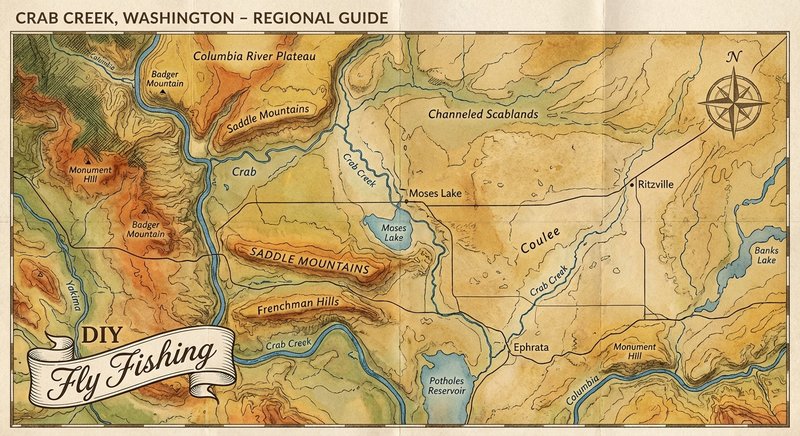
Crab Creek
Fly fishing in Washington · Intermediate · Best seasons: Spring, Fall
Target Species
Rainbow Trout, Brown Trout
About This Water
Eastern Washington desert stream with wild rainbow and brown trout. Unique high-desert fishing.
Fishing Recommendations
As an expert guide who has spent years navigating the high-desert coulees of Eastern Washington, I can tell you that Crab Creek is one of the most unique and rewarding fly fishing destinations in the Pacific Northwest. It is a true desert spring creek, winding through basalt cliffs and sagebrush, offering a technical challenge that rewards patience and precision.
Here is your comprehensive guide to fishing the "longest creek in Washington."
🎣 Location Overview
Crab Creek is a study in contrasts. While it technically runs for over 160 miles, the fly fishing interest is concentrated in two primary sections: the Upper Crab Creek (near the town of Odessa) and the Lower Crab Creek (within the Columbia National Wildlife Refuge near Othello).
What makes this water special is its "spring creek" nature in the middle of an arid desert. The water is nutrient-rich, alkaline, and stays relatively cool compared to the surrounding air temperatures. It is characterized by deep undercut banks, dense aquatic vegetation, and slow, glassy glides. Anglers love it because it offers a "stealth-first" stalking experience—this isn't blind-casting water; it's hunting water.
🐟 Target Species & Behavior
- Brown Trout: These are the kings of Crab Creek. The creek is famous for wild, buttery browns that can reach impressive sizes (18-22 inches). They are notoriously wary and spend most of the day tucked deep under the basalt ledges or overhanging grass.
- Rainbow Trout: Found throughout the system, often more aggressive than the browns. In the Lower section, you may find "escapees" from nearby lakes that grow large on the creek’s heavy insect biomass.
Behavior: These fish are easily spooked. Because the water is often clear and slow, they have plenty of time to inspect your fly and your leader. They hold tight to the banks and the edges of weed beds.
📅 Best Times to Fish
Optimal Seasons
- Spring (March – May): This is prime time. The water levels are stable, and the first major hatches of the year occur. The fish are hungry after the winter and less wary than they will be in the fall.
- Fall (September – November): This is the season for the "Big Brown" hunters. As the weather cools, the large browns become aggressive and territorial as they prepare for the spawn.
Best Times of Day
- Early Morning/Late Evening: During the heat of the day, fish retreat deep under cover. The "golden hour" provides enough shadow for big browns to venture out into the main channel to feed.
- Overcast Days: A cloudy day on Crab Creek is a gift. It cuts the glare and makes the fish significantly more comfortable rising to dry flies.
🪰 Recommended Flies & Techniques
Top Fly Patterns
- Nymphs: Scuds (Olive/Pink) #14-18, Sowbugs #16-18, Zebra Midges #18-22, and Pheasant Tails #16-20.
- Dry Flies: Blue Winged Olives (BWO) #18-20, Pale Morning Duns (PMD) #16, and various Hopper/Terrestrial patterns in late summer.
- Streamers: Black or Olive Woolly Buggers, Sculpzilla, or small Leeches.
Effective Techniques
- Tactical Nymphing: Using a "hopper-dropper" rig is highly effective here. Use a high-vis dry fly to act as your indicator so you don't spook fish with a heavy plastic bobber.
- The "Slow Strip" Streamer: In the deeper holes, cast a weighted streamer upstream and strip it back just faster than the current, keeping it close to the undercut banks.
- Sight Fishing: On the glassy flats, move slowly. Spot the fish first, then cast. If you can see the fish, they can see you.
💡 Pro Tips & Local Knowledge
- The Stealth Approach: This is the most important tip. Wear earthy tones (camo or tan) and stay low. Sometimes you have to crawl on your knees to the bank to avoid casting a shadow or a "silhouette" against the desert sky.
- Focus on the S-Curves: Crab Creek is exceptionally "snaky." The outside bends where the water carves under the bank are almost always where the largest fish hold.
- Mind the Vegetation: The creek is full of Chara and other aquatic weeds. Instead of getting frustrated, use them. Fish will sit in small "pockets" of open water between weed beds. A precise cast into a 2-foot window is often required.
- The "Sand" Factor: The bottom of the creek can be very silty. If you wade, do so sparingly and carefully—not only to avoid spooking fish with vibrations but to keep from getting stuck in deep mud.
⚠️ Important Information
Access
- Lower Crab Creek: Much of this is within the Columbia National Wildlife Refuge. There are several parking areas and well-marked trails.
- Upper Crab Creek: Significant portions run through private ranch land. Always respect "No Trespassing" signs and use public access points near Odessa.
Regulations & Permits
- WDFW Regulations: Crab Creek falls under "Selective Gear Rules" in many stretches (barbless hooks, no bait).
- Season: Parts of the creek are seasonal (typically opening the Saturday before Memorial Day), while others are open year-round. Always check the current WDFW pamphlet before heading out.
- Refuge Permits: If fishing within the National Wildlife Refuge, be aware of specific parking requirements (usually a Discover Pass or federal equivalent).
Special Considerations
- Rattlesnakes: This is desert country. From April through October, be extremely mindful of Western Rattlesnakes, especially when walking through tall grass near the banks.
- Ticks: Springtime brings heavy tick activity. Check yourself thoroughly after your session.
Bug Hatches & Matching Flies
| Hatch | Type | Peak months | Time of day | Hook sizes | Matching flies |
|---|---|---|---|---|---|
| Chironomids (Midges) Chironomidae | midge | February, March, April | All Day | #18-24 | Zebra Midge #18-22, Griffith's Gnat #20-24, Buzzer #18-20 |
| Blue Winged Olive (BWO) Baetis | mayfly | March, April, October, November | Mid-day | #18-22 | RS2 #20-22, Parachute Adams #18-22, Pheasant Tail Nymph #18-20 |
| Pale Morning Dun (PMD) Ephemerella excrucians | mayfly | June, July | Late Morning/Afternoon | #16-18 | Sparkle Dun #16-18, PMD Emerger #16-18, Frenchie #16 |
| Spotted Sedge Hydropsyche | caddis | June, July, August | Evening | #14-18 | Elk Hair Caddis #14-18, LaFontaine's Deep Sparkle Pupa #16, X-Caddis #16-18 |
| Trico Tricorythodes | mayfly | August, September | Early Morning | #20-24 | Trico Spinner #22-24, Trico Parachute #20-22 |
| Damselfly Enallagma | terrestrial | June, July | Mid-day | #10-14 | Marabou Damsel Nymph #12-14, Adult Damsel #12 |
| Grasshoppers Melanoplus | terrestrial | July, August, September | Afternoon | #8-12 | Morrish Hopper #8-12, Dave's Hopper #10-12, Chernobyl Ant #8-10 |
| Callibaetis Callibaetis | mayfly | June, August | Morning/Afternoon | #14-16 | Callibaetis Cripple #14-16, Hare's Ear Nymph #14-16 |
| October Caddis Dicosmoecus | caddis | September, October | Afternoon/Evening | #8-12 | Orange Stimulator #8-12, October Caddis Pupa #10 |