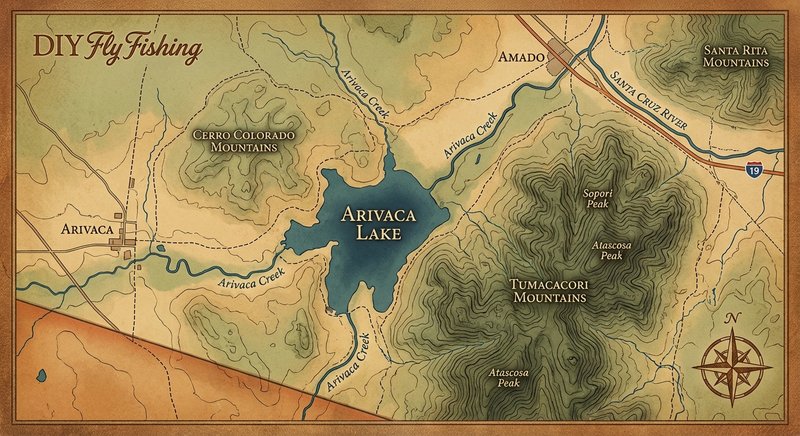
Arivaca Lake
Fly fishing in Arizona · beginner · Best seasons: fall, winter, spring
Target Species
Rainbow Trout
About This Water
Small southern Arizona lake with winter trout. Grassland setting with wildlife.
Fishing Recommendations
Arivaca Lake is a unique, high-desert gem tucked away in the rugged hills of Southern Arizona, just a few miles from the Mexican border. As an expert guide, I can tell you that Arivaca isn't your typical alpine trout stream. It is a 90-acre desert impoundment that offers a "wild west" fishing experience. While it is primarily known as a trophy Largemouth Bass fishery, the Arizona Game and Fish Department (AZGFD) transforms it into a productive Rainbow Trout destination during the cooler months.
🎣 Location Overview
Located at an elevation of roughly 3,800 feet, Arivaca Lake is a stark contrast to the pine-covered mountains of Northern Arizona. It is characterized by deep, narrow canyon arms, rocky bluffs, and thick riparian vegetation.
Anglers love Arivaca for its solitude. It is remote, and because of the "Electric Motors Only" rule, it remains quiet and serene. The water is typically stained (tea-colored or slightly murky), which allows fly anglers to use slightly heavier tippets than they would in crystal-clear tailwaters. It is a "sink or swim" fishery—when the winter stocking is active, the action is fast and furious.
🐟 Target Species & Behavior
The primary target for fly anglers in the winter is the Rainbow Trout.
- Stocked Behavior: These are hatchery-raised fish. Upon release, they tend to congregate near the boat ramp before dispersing along the shoreline and toward the dam.
- Holding Patterns: Look for trout cruising the edges of the weed lines and the submerged rocky points. Because the lake has a lot of structure, trout will often hold 5–10 feet off the bank where the bottom drops off into deeper water.
- Feeding: Initially, these fish look for hatchery pellets. However, they quickly adapt to the lake's natural forage, which includes Chironomids (midges), Damselfly nymphs, and small baitfish (threadfin shad and sunfish fry).
📅 Best Times to Fish
Because of the low elevation, Arivaca is a strictly seasonal trout fishery.
- Optimal Months: Late November through March. This is when water temperatures drop low enough for trout to survive and when AZGFD conducts regular stockings.
- Best Time of Day:
- Mornings (8 AM – 11 AM): As the sun hits the water, midge activity increases.
- Late Afternoon: The "golden hour" before sunset often sees a rise in surface activity or trout moving into the shallows to feed.
- Conditions: Overcast days are prime at Arivaca. The stained water and low light give the trout confidence to feed away from the deep-water sanctuaries.
🪰 Recommended Flies & Techniques
Top Fly Patterns
- Attractor Nymphs: Zebra Midges (Size 16–20) in Red/Silver or Black/Silver. These are staples for Arizona winter trout.
- The "Junk" Fly: Egg patterns or bright pink/orange Squirmy Wormies work exceptionally well for recently stocked fish.
- Streamers: Olive or Black Woolly Buggers (Size 8–12). A "Simi Seal Leech" in Blood Leech or Peacock color is a local favorite.
- Dry Flies: Griffith’s Gnat or a Parachute Adams (Size 18–22) if you see fish dimpling the surface in the evening.
Effective Techniques
- Indicator Nymphing: Suspend a Zebra Midge or a Pheasant Tail 4–6 feet below an indicator. Fish this along the rocky walls or near the dam.
- The "Slow Strip": Using a clear intermediate sinking line, cast an Olive Woolly Bugger toward the shore and retrieve it with slow, 3-inch tugs. This mimics the movement of a damselfly nymph or a small leech.
- Float Tube Fishing: This is arguably the best way to fish Arivaca. Since shore access is limited by thick brush, a float tube or kayak allows you to reach the steep canyon walls and "plop" your flies right against the rock face.
💡 Pro Tips & Local Knowledge
- Focus on the Dam: The area near the dam is some of the deepest water in the lake. If the sun is bright and the fish aren't in the shallows, they are likely holding deep near the concrete structure.
- The "Stocking Truck" Factor: Check the AZGFD Stocking Schedule before you go. If the truck just visited, focus your efforts near the boat ramp. After 48 hours, the fish will have migrated toward the "Arms" of the lake.
- Stealth in Stained Water: While the water is stained, these fish can still be boat-shy in shallow areas. Long casts are your friend.
- Don't Ignore the Bass: Even in winter, you might hook into a trophy Largemouth on a Woolly Bugger. Be prepared for a fight!
⚠️ Important Information
- Access: The road to Arivaca Lake (Arivaca Lake Rd) is unpaved and can be washboarded or muddy after a rain. High clearance is recommended, though most cars can make it if driven carefully.
- Regulations: A valid Arizona Fishing License is required.
- Boating: Electric motors only. Gas motors must be tilted up and not in use.
- Safety: This is a remote border region. While generally safe during the day, it is wise to fish with a partner, stay aware of your surroundings, and let someone know your itinerary. There is zero cell service at the lake.
- Supplies: The town of Arivaca is small. Gas up and grab your ice, water, and snacks in Amado or Tucson before heading in.
Bug Hatches & Matching Flies
| Hatch | Type | Peak months | Time of day | Hook sizes | Matching flies |
|---|---|---|---|---|---|
| Chironomids Chironomidae | midge | March, April, October, November | All Day | #18-24 | Zebra Midge #18-22, Griffith's Gnat #20-24, Ice Cream Cone #18-20 |
| Damselflies Enallagma | midge | May, June, July | Morning/Afternoon | #10-14 | Marabou Damsel Nymph #12-14, Adult Damsel #10-12, Damsel Emerger #12-14 |
| Callibaetis Callibaetis | mayfly | April, May, September, October | Late Morning | #14-16 | Callibaetis Spinner #14-16, Hare's Ear Nymph #14-16, RS2 #16 |
| Grasshoppers Acrididae | terrestrial | July, August, September | Afternoon | #8-12 | Dave's Hopper #10-12, Joe's Hopper #8-12, Parachute Hopper #12 |
| Dragonflies Anisoptera | terrestrial | June, July, August | Afternoon | #4-10 | Gummi Bugger #6-10, Dragonfly Nymph #4-8, Woolly Bugger (Olive) #6-10 |
| Water Boatmen Corixidae | midge | September, October | All Day | #14-18 | Water Boatman #14-16, Prince Nymph #14-18 |
| Black Ants Formicidae | terrestrial | July, August | Afternoon | #16-20 | Black Foam Ant #16-18, Cinnamon Ant #16-20 |
| Scuds Gammarus | midge | March, April, May | All Day | #12-16 | Ray Charles #14-16, Scud (Olive/Orange) #12-16 |