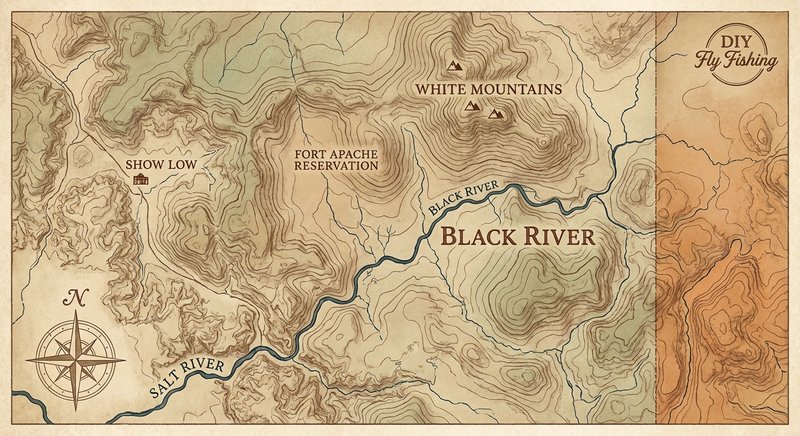
Black River
Fly fishing in Arizona · advanced · Best seasons: summer, fall
Target Species
Apache Trout, Brown Trout
About This Water
Remote Apache-Sitgreaves forest stream. Native Apache trout and wild browns in pristine habitat.
Fishing Recommendations
As an expert guide who has spent many seasons navigating the rugged terrain of the White Mountains, I can tell you that the Black River is the crown jewel of Arizona fly fishing. This isn't your typical desert stream; it is a high-altitude, cold-water sanctuary that offers some of the most remote and rewarding angling in the American Southwest.
Here is your comprehensive guide to fishing the Black River.
🎣 Location Overview
The Black River is located in eastern Arizona, carving through the high-elevation forests of the White Mountains. The river is divided into the East Fork, the West Fork, and the Main Stem.
What makes this water special is its isolation and its status as a stronghold for the native Apache Trout. The river transitions from tight, technical pocket water in the forks to larger, bouldery runs and deep pools in the main stem. It is characterized by volcanic rock, towering ponderosa pines, and crystal-clear water. Anglers love it because it offers a "backcountry" feel—once you hike a mile from the road, you are likely to have miles of pristine water all to yourself.
🐟 Target Species & Behavior
Apache Trout
The star of the show. These are native only to Arizona and are easily identified by their golden hue and the "mask" (two black dots on either side of the pupil).
- Behavior: They are opportunistic feeders but can be extremely spooky in clear water.
- Where they hold: They prefer the colder, higher-elevation stretches of the East and West forks. Look for them in the "head" of the pools and tucked tightly against undercut banks.
Brown Trout
The Black River is famous for producing surprisingly large, wild Browns.
- Behavior: Highly predatory. While they will take a dry fly, the larger specimens are nocturnal or low-light hunters.
- Where they hold: The "Big Browns" dominate the deeper pools and the dark water beneath overhanging willows in the Main Stem.
📅 Best Times to Fish
Summer (June – August)
- Pros: This is the prime window for dry fly fishing and terrestrial action.
- Conditions: Be wary of the "Monsoon Season" (typically starting in July). Afternoon thunderstorms are frequent. They can blow out the river with mud, but they also trigger aggressive feeding.
- Time of Day: Early morning (6 AM – 10 AM) and "the magic hour" before sunset.
Fall (September – October)
- Pros: This is my personal favorite time. The Brown Trout become aggressive as they prepare for the spawn, and the Apache Trout feed heavily before winter.
- Conditions: Crisp mornings and stunning fall colors. The water is usually at its clearest and lowest, requiring a stealthy approach.
- Time of Day: Mid-morning to late afternoon as the water warms slightly.
🪰 Recommended Flies & Techniques
Top Fly Patterns
- Terrestrials (Summer): Parachute Hoppers (#10-14), Amy’s Ant (#12), and Foam Beetles. The "Hopper-Dropper" rig is the gold standard here.
- Attractor Dries: Royal Wulff, Stimulators (Orange or Yellow #12-16), and Elk Hair Caddis.
- Nymphs: Bead-head Pheasant Tails (#16-18), Prince Nymphs (#14-16), and Copper Johns (Red or Blue).
- Streamers: Black or Olive Woolly Buggers and Near Nuff Crawfish (the river has a massive population of crawfish).
Effective Techniques
- The Hopper-Dropper: Use a buoyant foam hopper as your indicator and hang a weighted Pheasant Tail about 18–24 inches below it. This covers two levels of the water column simultaneously.
- High-Sticking: In the pocket water of the East Fork, keep as much fly line off the water as possible to avoid drag caused by swirling currents around boulders.
- Streamer Stripping: In the deep pools of the Main Stem, cast an olive Woolly Bugger toward the far bank and use erratic, short strips to mimic a fleeing crawfish.
💡 Pro Tips & Local Knowledge
- The "Apache Stealth": If you can see the fish, they have likely already seen you. Wear earthy tones (no bright shirts) and stay low. Crawling to the bank on your knees is sometimes necessary on the West Fork.
- Watch the Tributaries: During the monsoons, if the main river is muddy, hike up into the smaller side tributaries. They often clear up much faster and hold plenty of hungry fish.
- Crayfish Connection: The Black River Browns are obsessed with crayfish. If the dry fly action is slow, fish a heavy, rust-colored nymph or streamer deep and slow.
- The Three Forks Area: This is a great "home base" where the East and West forks converge. It offers diverse water types within a short hiking distance.
⚠️ Important Information
Access & Navigation
- Access is primarily via Forest Service roads (FR 273 and FR 249). These roads are gravel and can be rough; a high-clearance vehicle is strongly recommended.
- Note: Many areas are very remote with no cell service. Carry a map, plenty of water, and a spare tire.
Regulations & Permits
- Arizona State Fishing License: Required for all anglers.
- White Mountain Apache Tribal Permit: Crucial! Large portions of the Black River border or reside within the White Mountain Apache Reservation. If you are fishing on tribal land, you must have a specific Tribal Fishing Permit. They do not accept state licenses on the reservation side.
- Barbless Hooks: It is highly recommended to use barbless hooks to protect the delicate Apache Trout populations.
Special Considerations
- Wildlife: This is prime Black Bear and Mexican Gray Wolf country. Practice "Bear Aware" camping and keep food secured.
- Flash Floods: During July and August, a storm 10 miles upstream can send a wall of water down the canyon. If the water starts to turn chocolate milk brown and rises suddenly, get to high ground immediately.
The Black River is a place of rugged beauty. If you respect the water and the fish, it will provide one of the best fly fishing experiences in the American West. Tight lines!
Bug Hatches & Matching Flies
| Hatch | Type | Peak months | Time of day | Hook sizes | Matching flies |
|---|---|---|---|---|---|
| Blue-winged Olive Baetis spp. | mayfly | April, May, September, October | Mid-day/Afternoon | #18-22 | RS2 #20-22, Parachute Adams #18-22, WD-40 #20-22 |
| Pale Morning Dun Ephemerella excrucians | mayfly | June, July | Late Morning/Early Afternoon | #16-18 | PMD Sparkle Dun #16-18, Pheasant Tail Nymph #16-18, Trigger Finger PMD #16 |
| Golden Stonefly Hesperoperla pacifica | stonefly | June, July | All Day/Evening | #6-10 | Pat's Rubber Leg #8-10, Rogue River Stone #6-8, Golden Twenty-Incher #10 |
| Spotted Sedge Hydropsyche spp. | caddis | June, July, August | Evening | #14-16 | Elk Hair Caddis #14-16, LaFontaine's Deep Sparkle Pupa #14-16, Goddard Caddis #14 |
| Yellow Sally Isoperla spp. | stonefly | June, July | Afternoon/Evening | #14-16 | Yellow Sally Stimulator #14-16, Iron Lotus #16, Little Yellow Sloan #14 |
| Grasshopper Melanoplus spp. | terrestrial | July, August, September | Mid-day/Afternoon | #8-12 | Dave's Hopper #10-12, Morrish Hopper #8-12, Parachute Hopper #12 |
| Trico Tricorythodes spp. | mayfly | August, September | Early Morning | #20-24 | Trico Spinner #20-24, Sunken Trico Spinner #22, Zebra Midge #20-22 |
| Black Ant Formicidae | terrestrial | June, July, August | All Day | #14-18 | Carpenter Ant #14-16, Cinnamon Ant #16-18, Chernobyl Ant #12-14 |
| Zebra Midge Chironomidae | midge | March, April, May, October | All Day | #18-24 | Zebra Midge #18-22, Griffith's Gnat #20-22, Morgan's Midge #20 |