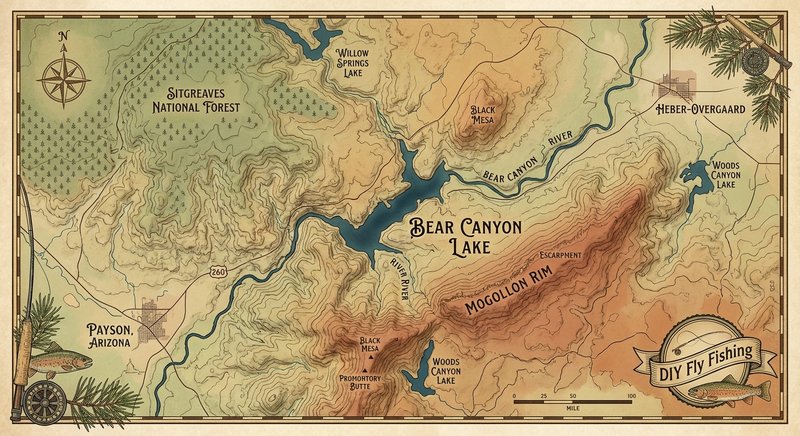
Bear Canyon Lake
Fly fishing in Arizona · beginner · Best seasons: spring, summer, fall
Target Species
Rainbow Trout
About This Water
Rim country lake with good trout fishing. Forest setting with camping nearby.
Fishing Recommendations
Welcome to the Mogollon Rim. As your guide for this trip, I’m excited to introduce you to Bear Canyon Lake. Located at an elevation of roughly 7,500 feet, this is arguably the most scenic of the "Rim Lakes."
Unlike its shallower neighbors (like Woods Canyon), Bear Canyon is deep, narrow, and tucked into a steep-walled canyon. This geography dictates how you must fish it.
🎣 Location Overview
Bear Canyon Lake is a 60-acre ribbon of water carved into the Ponderosa Pine forest of the Apache-Sitgreaves National Forest. What makes it special is its "wild" feel; while other lakes have paved parking lots right at the water's edge, Bear Canyon requires a bit of a hike down a steep trail to reach the shoreline.
The water is remarkably clear for an Arizona lake, and its depth (over 50 feet in spots) allows it to stay cooler longer into the summer than other Rim waters. Because gas motors are prohibited, it is a cathedral of silence, making it a favorite for float tubers and those seeking a quiet, backcountry-lite experience.
🐟 Target Species & Behavior
The primary target here is the Rainbow Trout.
- Behavior: Because the lake is canyon-bound, the fish are very light-sensitive. They tend to cruise the steep rocky shorelines and submerged timber.
- Feeding: Their diet consists heavily of Midges (Chironomids), which hatch year-round. In the summer, terrestrial insects (ants, beetles, and grasshoppers) falling from the overhanging trees are a major food source. You will also find a healthy population of crayfish and small fathead minnows.
- Holding Patterns: During the day, fish retreat to the "thermocline" (the cool middle layer of water). Early and late, they patrol the "shelves"—the narrow strips of shallow water before the bottom drops off into the abyss.
📅 Best Times to Fish
- Spring (Late April – June): This is prime time. As the ice melts and the water warms, the trout become aggressive. This is when you’ll see the most consistent surface activity.
- Summer (July – August): The fishing remains good, but you must adapt. The fish move deep during midday. Focus on the "Shadow Lines" created by the canyon walls.
- Fall (September – early November): My personal favorite. The crowds disappear, and the trout feed heavily to bulk up for winter. The bite stays consistent all day as water temperatures drop.
- The "Magic Hour": Because of the steep canyon walls, the sun leaves the water earlier than the surrounding forest. The 90 minutes before sunset is the most productive window for dry fly fishing.
🪰 Recommended Flies & Techniques
Top Fly Patterns
- Midges: Zebra Midges (size 18-22) in red, black, or silver.
- Attractor Dries: Royal Wulff or Humpy (size 14-16) for choppy water; Parachute Adams for calm water.
- Terrestrials: Black Foam Ants or Chernobyl Ants (size 12-14) during the summer monsoon season.
- Streamers: The Simi Seal Leech (Blood Red or Olive) is the "gold standard" in Arizona. Size 10-12.
- Nymphs: Gold-ribbed Hare’s Ear or Pheasant Tail (size 14-16).
Techniques
- Indicator Nymphing: Suspend a Zebra Midge 4–8 feet below a small indicator. This is the most effective way to catch fish here. Fish it along the drop-offs.
- The "Slow Strip": Using an intermediate (slow-sinking) line, cast a Simi Seal Leech toward the shore or downed timber and retrieve it with very slow, 2-inch tugs.
- Dry-Dropper: In the summer, use a foam ant as your "bobber" and hang a small midge 2 feet below it. This covers both bases.
💡 Pro Tips & Local Knowledge
- Bring a Float Tube: If you only fish from the shore, you are limited to about 15% of the lake due to the steep terrain. A float tube or kayak allows you to reach the "Narrows" at the far end of the lake, where the best fishing usually is.
- The "Shadow Line": In the late afternoon, the canyon walls cast a shadow across half the lake. Fish will congregate right on the edge of that shadow line. Move your fly from the sunlight into the shadow to trigger strikes.
- Look for Deadfall: The lake is full of submerged trees. Rainbows use these for cover. Casting a leech right into the "skeleton" of a downed tree is risky for your tippet but highly rewarding.
- Stealth Matters: Because the water is clear, use a long leader (9–12 feet) and a light tippet (5X or 6X). If the fish are "rising" but not taking your fly, you are likely using a tippet that is too thick.
⚠️ Important Information
- Access: Access is via Forest Road 300 (The Rim Road). The turnoff to Bear Canyon Lake is well-marked. Be prepared for a steep walk from the parking lot to the water; if you are bringing a float tube, get a backpack-style carrier.
- Regulations: A valid Arizona Fishing License is required. There are no special gear restrictions (artificial only is not required), but as a fly angler, practicing Catch & Release is encouraged to maintain the fishery.
- Safety: This is bear and mountain lion country. While rare, keep a clean camp if you stay at the nearby Mogollon Campground.
- Weather: Storms move fast on the Rim. If you see lightning or hear thunder, get off the water immediately. You are the tallest thing on the lake in a float tube!
Guide’s Final Word: Bear Canyon is a "thinking angler's" lake. It’s not always easy, but the reward of catching a wild-looking Rainbow in such a dramatic setting is why we keep coming back. Tight lines!
Bug Hatches & Matching Flies
| Hatch | Type | Peak months | Time of day | Hook sizes | Matching flies |
|---|---|---|---|---|---|
| Chironomids Chironomidae | midge | April, May, June, September | All Day | #14-22 | Zebra Midge #16-20, Ice Cream Cone #14-18, Griffith's Gnat #18-22 |
| Callibaetis Callibaetis ferrugineus | mayfly | June, July, August | Late Morning/Afternoon | #12-16 | Hare's Ear Nymph #14-16, Parachute Adams #12-16, RS2 Callibaetis #14-16 |
| Damselfly Enallagma | terrestrial | June, July | Morning/Afternoon | #10-14 | Marabou Damsel Nymph #10-12, Adult Damsel #12-14, Sheep Creek Special #10-14 |
| Traveling Sedge Hesperophylax | caddis | July, August | Evening/Dusk | #8-12 | Goddard Caddis #10-12, Mikulak Sedge #8-10, Soft Hackle Hare's Ear #12-14 |
| Terrestrial Ants Formicidae | terrestrial | July, August, September | Afternoon | #14-18 | Cinnamon Ant #14-16, Black Foam Ant #16-18, Hard Body Ant #14-18 |
| Dragonfly Anisoptera | terrestrial | June, July, August | Morning/Afternoon | #4-10 | Olive Wooly Bugger #6-10, Dragon Slayer #4-8, Rubber Legged Dragon #6-10 |
| Water Boatmen Corixidae | terrestrial | September, October | Afternoon | #14-18 | Prince Nymph #14-16, Water Boatman #14-18, Backswimmer #12-14 |
| Cinnamon Caddis Hydropsyche | caddis | May, June | Evening | #14-18 | Elk Hair Caddis #14-18, LaFontaine's Deep Sparkle Pupa #14-16, Peacock Caddis #16-18 |