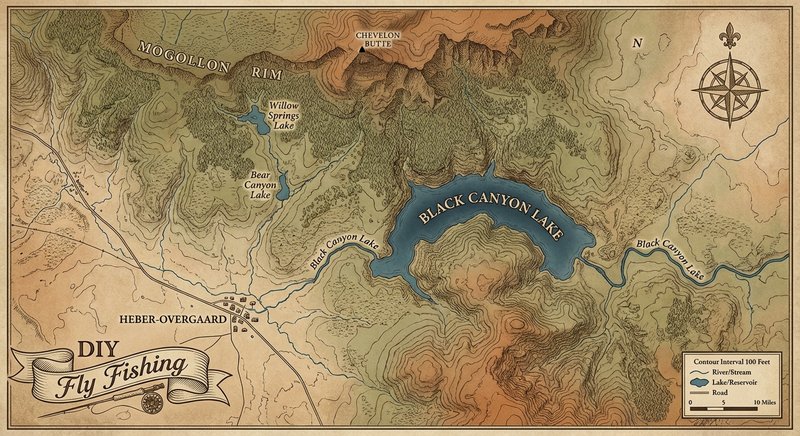
Black Canyon Lake
Fly fishing in Arizona · beginner · Best seasons: spring, summer, fall
Target Species
Rainbow Trout, Brown Trout
About This Water
Mogollon Rim lake surrounded by pine forest. Stocked trout with primitive camping.
Fishing Recommendations
Welcome to the Mogollon Rim. As your guide, I can tell you that Black Canyon Lake is one of the "Rim Country" crown jewels. Situated at about 7,000 feet elevation, this 78-acre lake offers a classic high-country experience. It’s a deep, canyon-bound fishery that provides a much cooler escape than the desert floors of Phoenix or Tucson.
Here is your comprehensive guide to fly fishing Black Canyon Lake.
🎣 Location Overview
Black Canyon Lake is located about 15 miles southwest of Heber, Arizona, tucked into the Apache-Sitgreaves National Forests. What makes this water special is its dramatic topography. Unlike the shallow, weedy lakes of the White Mountains, Black Canyon is deep (up to 60 feet) with steep, rocky walls and submerged timber.
The water is generally clear with a sapphire-to-emerald tint. Because gasoline motors are prohibited, the lake is exceptionally quiet, making it a haven for float tubers and kayakers who want to escape the noise of larger recreational reservoirs.
🐟 Target Species & Behavior
- Rainbow Trout: These are the primary residents. The Arizona Game and Fish Department (AZGFD) stocks them regularly from spring through fall. They tend to cruise the upper 10-15 feet of the water column, often patrolling the shoreline or the edges of the submerged creek channel.
- Brown Trout: The "prizes" of Black Canyon. While fewer in number than the Rainbows, the Browns here can grow to impressive sizes by feeding on crawfish and smaller stockered trout. They are notoriously light-sensitive and stay deep near the rocky ledges or under fallen timber during the day.
- Forage Base: The fish here key in on Midges (Chironomids), Damselflies, Scuds, and Crayfish. During late summer, terrestrial insects (ants and beetles) falling from the overhanging pines become a major food source.
📅 Best Times to Fish
- Spring (Late April – June): This is prime time. As the ice melts and the water warms, trout become hyper-active. The "Damselfly migration" in June is legendary; fish will move into the shallows to gorge on nymphs.
- Fall (September – November): My personal favorite. The Brown trout become aggressive as they prepare for their (attempted) spawn. The water cools, and fish move from the depths back toward the surface.
- Summer (July – August): Fishing is best in the "magic hours"—dawn and dusk. Mid-day can be slow as fish retreat to the thermocline (cooler deep water).
- Prime Window: Low-light conditions are vital here. Because of the canyon walls, the lake goes into shadow earlier than the surrounding forest. Fish the "shadow line" as it moves across the water.
🪰 Recommended Flies & Techniques
Top Fly Patterns
- Streamers: Simi Seal Leech (Black/Red or Olive), Woolly Bugger (Size 8-12 in Thin Mint or Peacock), and Clouser Minnows for deeper Browns.
- Nymphs: Zebra Midges (Red or Black, size 18-22), Hare’s Ear, and Pheasant Tails. Don't forget Beaded Damselfly Nymphs in Olive.
- Dries: Parachute Adams (size 16), Elk Hair Caddis, and Foam Ants or "Chernobyl Ant" terrestrials during the summer monsoon season.
Effective Techniques
- The "Deep Hang" (Indicator Nymphing): Use a long leader (10–12 feet) under a slip-indicator. Suspend a Zebra Midge or Scud just a foot off the bottom near the dam or the drop-offs.
- The Intermediate Strip: Using an intermediate (slow-sink) fly line is the most effective way to fish this lake. Cast a Simi Seal Leech toward the shore or submerged timber, let it sink for 5–10 seconds, and use a slow, erratic "inchworm" strip.
- Dry-Dropper: Along the steeper rocky walls, hang a small nymph 3 feet below a foam terrestrial. Fish will often rise out of the shadows to hit the dry.
💡 Pro Tips & Local Knowledge
- Bring a Vessel: While there is a trail around the lake, the best fishing is inaccessible by foot due to the steep canyon walls. A float tube, kayak, or canoe is essential to reach the "honey holes" near the submerged trees on the opposite side of the ramp.
- Focus on the "Fingers": The lake has several small coves or "fingers." These areas trap wind-blown insects and provide slightly shallower feeding shelves for cruising Rainbows.
- The "Brown Trout Secret": If you want a big Brown, fish the dam breast or the steepest rock faces at last light using a large, dark streamer (Size 4-6). Strip it fast to trigger a predatory strike.
- Watch the Monsoons: In July and August, afternoon thunderstorms are common on the Rim. If you see clouds building, get off the water. Lightning on a high-altitude lake is no joke.
⚠️ Important Information
- Access: Access is via Forest Road 300 (the Rim Road). The turn-off is well-marked. The road is generally paved or well-maintained gravel, accessible by most passenger cars.
- Regulations:
- A valid Arizona Fishing License is required.
- Electric motors only (or paddle/oar). Internal combustion engines are prohibited.
- Check current AZGFD regulations for bag limits (usually 6 trout, but check for seasonal updates).
- Amenities: There is a boat ramp and vault toilets available. There is no treated drinking water at the lake, so pack plenty in.
- Bear Country: This is active Black Bear territory. If you are camping nearby or bringing food, keep a clean camp and use bear-proof containers.
Tight lines! The Black Canyon is a special place—treat the water with respect, and it will likely reward you with some of the prettiest trout in the Southwest.
Bug Hatches & Matching Flies
| Hatch | Type | Peak months | Time of day | Hook sizes | Matching flies |
|---|---|---|---|---|---|
| Chironomids (Midges) Family Chironomidae | midge | April, May, September, October | All Day | #12-22 | Zebra Midge #16-20, Chironobunny #12-14, Griffith's Gnat #18-22 |
| Callibaetis (Speckled Duns) Callibaetis spp. | mayfly | May, June, August, September | Late Morning/Afternoon | #12-16 | Parachute Adams #14-16, Pheasant Tail Nymph #14-16, Callibaetis Spinner #14-16 |
| Damselfly Enallagma spp. | other | June, July | Morning/Afternoon | #10-14 | Marabou Damsel Nymph #10-12, Adult Damsel #12-14 |
| Cinnamon Caddis Family Leptoceridae | caddis | June, July, August | Evening | #14-18 | Elk Hair Caddis (Cinnamon) #14-16, LaFontaine's Deep Sparkle Pupa #14-16 |
| Water Boatmen Family Corixidae | other | September, October | Afternoon | #14-18 | Water Boatman #14-16, Prince Nymph #14-18 |
| Carpenter Ants Camponotus spp. | terrestrial | July, August, September | Afternoon | #10-16 | Chernobyl Ant #10-14, Black Foam Ant #14-16 |
| Traveling Sedge Hesperophylax spp. | caddis | June, July | Dusk | #8-12 | Goddard Caddis #8-12, Mikulak Sedge #8-10 |
| Backswimmers Family Notonectidae | other | September, October | Afternoon | #10-14 | Backswimmer #10-12, Hares Ear Nymph #12-14 |