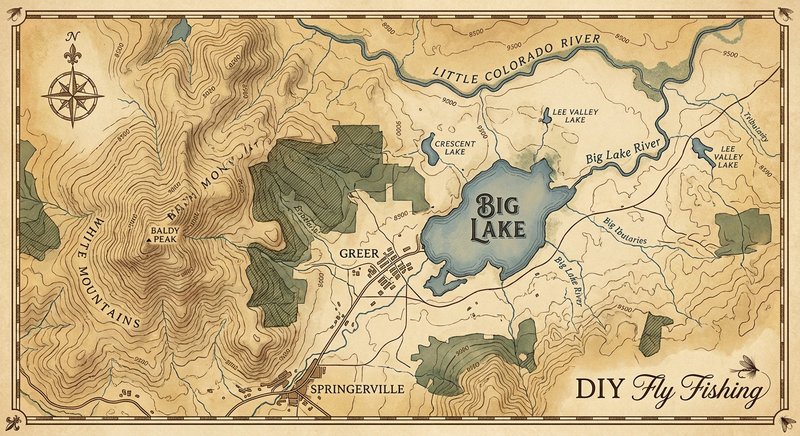
Big Lake
Fly fishing in Arizona · intermediate · Best seasons: spring, summer, fall
Target Species
Rainbow Trout, Brown Trout, Brook Trout, Apache Trout
About This Water
Largest White Mountains lake with trophy potential. Multi-species fishery at 9,000 feet.
Fishing Recommendations
As your guide to the high country of the Southwest, it is my pleasure to walk you through one of Arizona’s most storied fisheries. Located at over 9,000 feet in the White Mountains, Big Lake is often referred to as the "Crown Jewel" of Arizona trout fishing.
While many think of Arizona as a desert, Big Lake is a high-alpine, fertile "spring-fed" bowl that offers some of the most consistent fly fishing in the Western United States.
🎣 Location Overview
Big Lake is a 450-acre alpine lake tucked into the Apache-Sitgreaves National Forest. What makes it special is its productivity. Unlike many sterile high-mountain lakes, Big Lake is incredibly rich in nutrients, supporting massive populations of scuds (freshwater shrimp), damselflies, and midges.
The water is generally clear but has significant weed growth during the summer months. It is a shallow lake compared to its size, which means trout can feed throughout the entire water column. Anglers love it because it offers a "grand slam" opportunity—the chance to catch four distinct species of trout in a single day against a backdrop of pine forests and rolling meadows.
🐟 Target Species & Behavior
- Rainbow Trout: The most abundant species. They are active, fight hard, and are often found cruising the weed edges in 5–10 feet of water.
- Brown Trout: The "kings" of the lake. Big Lake holds some massive Browns that feed primarily on smaller trout and crayfish. They are elusive and tend to hold deeper or near rocky structure during the day, moving into the shallows at dawn and dusk.
- Brook Trout: Known for their stunning colors, especially in the fall. They congregate near the springs and the dam area.
- Apache Trout: Arizona’s state fish. These are unique, yellowish trout with black spots. They are opportunistic feeders and are often caught in the same areas as the Rainbows.
📅 Best Times to Fish
Optimal Seasons
- Spring (Late April – June): This is "Ice-Off" season. As soon as the ice melts (usually late April), the fish are ravenous and cruising the shallows. This is the best time for trophy Rainbows and Browns.
- Fall (September – October): My personal favorite. The Brookies and Browns go into spawn mode and become aggressive. The "fall feed" is on as fish bulk up for winter.
Prime Windows
- The Morning Glass: 6:00 AM to 10:00 AM is vital. The wind is usually down, and the "Callibaetis" (mayfly) hatches begin.
- Monsoon Evenings: In July and August, afternoon thunderstorms are common. The hour after a rainstorm can be the most productive fishing of the year as the water cools and insects are washed into the lake.
🪰 Recommended Flies & Techniques
Top Fly Patterns
- Simi-Seal Leech: (Size 10-12) The "state fly" of Arizona. Colors: Black/Red, Peacock, or "Dirty Olive."
- Chironomids: (Size 14-18) In red (the "Bloodworm") or silver/black.
- Callibaetis Nymphs & Dries: (Size 14-16) Hare’s Ear nymphs or Parachute Adams for the hatch.
- Damselfly Nymphs: (Size 10-12) Long, olive, and wiggly. Crucial for mid-summer.
- Woolly Buggers: (Size 6-10) In olive or rusty orange to mimic crayfish.
Effective Techniques
- The "Static" Midge Rig: Use a long leader (12–15 feet) under a small slip-indicator. Suspend a chironomid 12 inches off the bottom. This is the most effective way to catch fish when they aren't rising.
- The Slow Strip: Using an intermediate sinking line (Type 3), cast a Simi-Seal Leech over weed beds and use a very slow, rhythmic "figure-eight" retrieve.
- Dry-Dropper: During a hatch, use a Parachute Adams as your indicator and hang a small unweighted pheasant tail nymph 2 feet below it.
💡 Pro Tips & Local Knowledge
- Focus on the Points: Railroad Point and the areas around the South Cove are magnets for fish. The transition where the bottom drops from 5 feet to 12 feet is the "kill zone."
- The Wind is Your Friend: It gets windy at 9,000 feet. Don't head for the shore where the wind is at your back. Fish the "windward" shore where the waves are crashing; the chop oxygenates the water and concentrates the food.
- Float Tubes are King: While you can fish from the bank, a float tube or kayak allows you to stay on the edge of the weed line where the big fish patrol.
- The "Hang": When stripping flies, always pause for 5 seconds when your fly is right next to the boat/tube. Many Big Lake trout will follow a fly and only strike when it appears to be "escaping" toward the surface.
⚠️ Important Information
- Access: The roads to Big Lake (Hwy 261 and Hwy 273) are closed in winter (usually mid-November to mid-April) due to heavy snow.
- Regulations: You must have a valid Arizona Fishing License. Barbless hooks are recommended for easy release, though not always mandated (check current AZGFD regulations for specific bag limits).
- Weather Safety: High-altitude weather changes in minutes. Lightning is a serious threat on Big Lake. If you hear thunder, get off the water immediately.
- Supplies: The Big Lake Store offers rentals, basic tackle, and snacks, but it is seasonal. Fill up your gas tank in Eagar or Greer before heading up the mountain.
Guide's Final Word: Bring a 5-weight rod for the dry fly action, but keep a 6-weight rigged with a sinking line for the leeches. If you see a big swirl near the rocks at dusk, it’s a Brown—throw a large streamer and hold on tight.
Bug Hatches & Matching Flies
| Hatch | Type | Peak months | Time of day | Hook sizes | Matching flies |
|---|---|---|---|---|---|
| Chironomids Chironomidae | midge | May, June, September | All Day | #12-22 | Zebra Midge #16-20, Chironobone #12-16, Griffith's Gnat #18-22 |
| Callibaetis Callibaetis ferrugineus | mayfly | June, July, August | Late Morning/Afternoon | #12-16 | Parachute Adams #14-16, Hare's Ear Nymph #14-16, Callibaetis Spinner #16 |
| Damselfly Enallagma spp. | terrestrial | June, July | Late Morning/Afternoon | #10-14 | Marabou Damsel #10-12, Adult Damsel #12-14 |
| Scuds Gammarus | terrestrial | May, June, October | All Day | #12-18 | Ray Charles #14-16, Orange Scud #12-18 |
| Cinnamon Caddis Hesperophylax spp. | caddis | July, August | Evening | #12-16 | Elk Hair Caddis #14-16, Goddard Caddis #12-14 |
| Terrestrial Ants and Beetles Formicidae / Coleoptera | terrestrial | July, August, September | Afternoon | #12-18 | Black Foam Ant #14-18, Juicy Beetle #12-16 |
| Water Boatmen Corixidae | midge | September, October | Afternoon | #14-16 | Water Boatman #14-16, Prince Nymph #12-16 |
| Dragonfly Nymph Anisoptera | terrestrial | June, August | All Day | #6-10 | Dragon Nymph #8-10, Woolly Bugger (Olive) #6-10 |