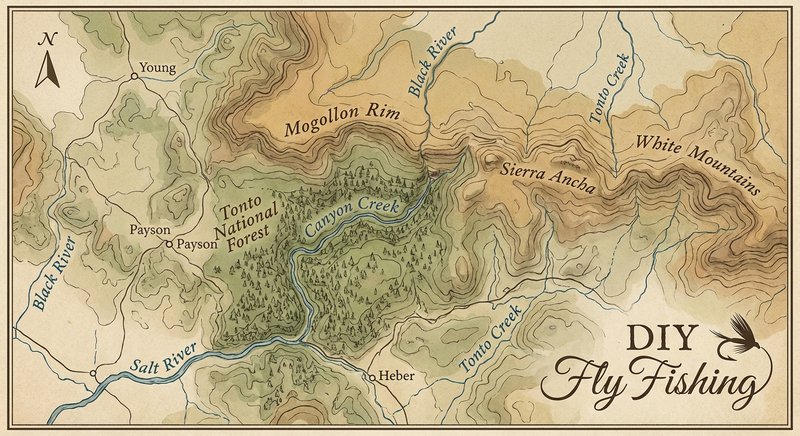
Canyon Creek
Fly fishing in Arizona · intermediate · Best seasons: spring, summer, fall
Target Species
Brown Trout, Rainbow Trout
About This Water
White Mountains stream with wild trout. Scenic canyon setting with good public access.
Fishing Recommendations
Welcome to one of Arizona’s most storied fly fishing destinations. As a guide who has spent many seasons on the Mogollon Rim, I can tell you that Canyon Creek is a "technical gem." It isn’t a wide-open river where you can air out 60 feet of line; it’s a tight, spring-fed, willow-lined stream that demands stealth, precision, and a bit of patience.
Here is your comprehensive guide to fishing Canyon Creek.
🎣 Location Overview
Located east of Payson below the Mogollon Rim, Canyon Creek is a spring-fed tributary of the Salt River. What makes it special is its "Blue Ribbon" character—specifically the catch-and-release section below the Canyon Creek Hatchery.
The water is remarkably clear, filtered by the limestone and volcanic rock of the Rim. It transitions from high-altitude ponderosa pine forest into a lush riparian corridor of willows, alders, and sycamores. Anglers love it because it offers a "small stream" experience where you can actually sight-fish for wild, buttery Brown Trout in the middle of the desert state.
🐟 Target Species & Behavior
- Brown Trout: These are the "kings" of Canyon Creek. They are wild, spooky, and highly intelligent. They hold in deep undercut banks, beneath overhanging willow branches, and in the dark shadows of boulders. They are opportunistic but wary of shadows and heavy splashing.
- Rainbow Trout: Generally found closer to the hatchery or in the more oxygenated riffles. While some are wild, many are holdovers from upstream stockings. They tend to be slightly less "skittish" than the Browns but still require a good drift.
- Behavior: In the thin, clear water, fish often face upstream at the head of pools. During the heat of the day, they retreat deep under the banks. They feed heavily on midges, small mayflies, and—most importantly—crayfish and terrestrials.
📅 Best Times to Fish
- Spring (Late March – May): This is prime time. As the Rim snowpack melts, the water remains stable due to the spring-fed nature. You’ll see the first major hatches of Blue Winged Olives (BWOs) and Caddis.
- Summer (June – August): Best for terrestrial fishing. While the Phoenix valley swelters at 110°F, the creek stays cool. Focus on the "edges of the day"—dawn and dusk. The "Monsoon" season (July/August) can bring sudden flash floods, so watch the sky.
- Fall (September – November): My personal favorite. The Brown Trout begin to color up for the spawn. The crowds thin out, the maples turn red, and the fish become aggressive.
- Prime Windows: 30 minutes before sunrise is magical here. In the fall, the mid-afternoon sun can trigger significant midge activity.
🪰 Recommended Flies & Techniques
Top Fly Patterns
- Dry Flies: Elk Hair Caddis (#14-18), Parachute Adams (#16-20), and Stimulators (#12-14) for the pocket water.
- Terrestrials: Foam Grasshoppers, Black Ants (size 16), and Beetle patterns are mandatory from June through September.
- Nymphs: Zebra Midges (Black/Silver or Red), Pheasant Tails (#16-20), and Gold-Ribbed Hare’s Ears.
- Streamers: Small Woolly Buggers (Olive or Black) or Simi Seals. Pro Secret: Use a rusty-orange colored streamer to mimic the local crayfish.
Techniques
- The "Creeper" Approach: You must stay low. I often tell clients to fish from their knees. If you can see the fish, they have likely already seen you.
- Tight-Line/Euro Nymphing: Great for the deeper runs near the OW Ranch area where the current is complex.
- Dapping: In the thickest willow sections, you won't be casting. You’ll be poking your rod tip through the brush and dropping the fly vertically into the water.
💡 Pro Tips & Local Knowledge
- The OW Ranch Stretch: Focus on the area known as the OW Ranch. This section has undergone significant restoration to create deeper pools and better habitat. It holds the largest wild Browns in the system.
- Camo Matters: Wear drab colors (olive, tan, or camo). Bright white or blue shirts act as a warning signal to the trout in this clear water.
- The "Crayfish Kick": Canyon Creek is loaded with crayfish. If the dry fly action is slow, swing a small orange woolly bugger through the deep holes.
- Light Tippet: You’ll often need to drop down to 6X or even 7X fluorocarbon for nymphs in the slow-moving pools to avoid being spotted.
⚠️ Important Information
- Regulations: The section from the Canyon Creek Hatchery downstream to the Apache-Sitgreaves National Forest boundary is strictly Catch and Release and Artificial Fly and Lure Only. Check current AZGFD regulations as they can change.
- Access: Access is primarily via Forest Road 33. The road is generally well-maintained but can become muddy and treacherous after heavy rain or snow.
- Special Considerations:
- Wildlife: This is bear and mountain lion country. Carry bear spray and be aware of your surroundings.
- Rattlesnakes: Arizona Black Rattlesnakes love the rocky banks of Canyon Creek. Watch where you step and where you put your hands when climbing banks.
- The Hatchery: Do not fish within the marked boundaries of the hatchery itself.
Final Guide Advice: Don't measure your success here by the number of fish, but by the quality of the stalk. Hooking one 14-inch wild Brown in Canyon Creek is worth ten fish in a stocked pond. Tight lines!
Bug Hatches & Matching Flies
| Hatch | Type | Peak months | Time of day | Hook sizes | Matching flies |
|---|---|---|---|---|---|
| Blue Winged Olive Baetis | mayfly | March, April, October, November | Late Morning/Afternoon | #18-22 | Parachute Adams #18-22, RS2 #20-22, Pheasant Tail Nymph #18-20 |
| Trico Tricorythodes | mayfly | August, September, October | Early Morning | #20-24 | Trico Spinner #20-24, Drowned Trico #22, Griffith's Gnat #20-22 |
| Pale Morning Dun Ephemerella excrucians | mayfly | June, July | Late Morning/Early Afternoon | #16-18 | PMD Sparkle Dun #16-18, Barr's PMD Emerger #16-18, Frenchie #14-16 |
| Cinnamon Caddis Hydropsyche | caddis | May, June, July, August | Evening | #14-18 | Elk Hair Caddis (Tan/Cinnamon) #14-18, LaFontaine's Deep Sparkle Pupa #14-16, Holy Grail #14-18 |
| Yellow Sally Isoperla | stonefly | June, July | Afternoon/Evening | #14-16 | Yellow Sally Stimulator #14-16, Iron Lotus (Yellow) #16 |
| Midges Chironomidae | midge | December, January, February, March | All Day | #18-24 | Zebra Midge (Black/Silver) #18-22, Morgan's Midge #20-22, Palomino Midge #20-22 |
| Grasshoppers Acrididae | terrestrial | August, September | Mid-day/Afternoon | #8-12 | Dave's Hopper #10-12, Parachute Hopper #12 |
| Carpenter Ants & Beetles Formicidae/Coleoptera | terrestrial | July, August | All Day | #12-18 | Chernobyl Ant #12-14, Black Foam Beetle #14-18, Cinnamon Ant #16-18 |