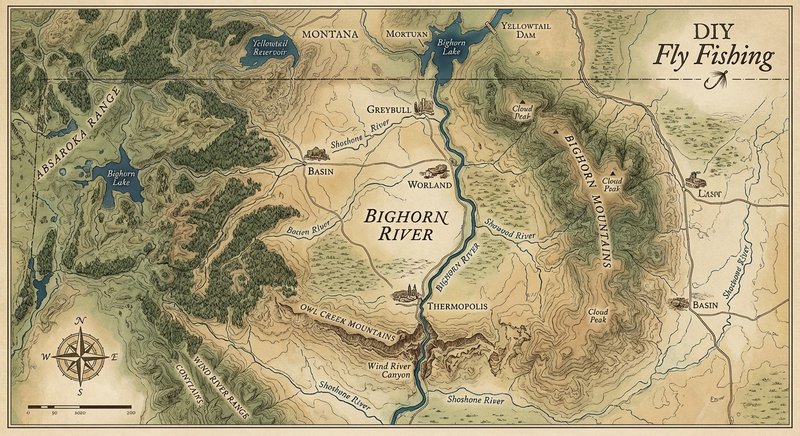
Bighorn River
Fly fishing in Wyoming · Intermediate · Best seasons: Spring, Summer, Fall, Winter
Target Species
Rainbow Trout, Brown Trout
About This Water
World-class tailwater with incredible trout densities. Consistent year-round fishing.
Fishing Recommendations
The Bighorn River in Wyoming, specifically the stretch flowing through the Wind River Canyon and out into the valley near Thermopolis, is one of the most productive tailwater fisheries in the American West. While its sister water in Montana gets more international fame, the Wyoming Bighorn offers world-class density and size, often with fewer crowds.
Here is your comprehensive guide to fishing the Wyoming Bighorn.
🎣 Location Overview
The Bighorn River begins its "trout" journey at the Wedding of the Waters, where the Wind River officially becomes the Bighorn. This is a classic tailwater ecosystem moderated by the Boysen Reservoir.
What makes this water special is the extraordinary nutrient load. The water is alkaline and rich in minerals, creating a "bug factory" environment. The river transitions from a deep, bouldery canyon environment into a classic braided meandering river. Anglers love it because it is incredibly consistent; unlike freestone rivers that blow out or freeze over, the Bighorn stays fishable and productive nearly 365 days a year.
🐟 Target Species & Behavior
The Bighorn is a "numbers" river, but the average size is impressive, with many fish falling in the 16–20 inch range.
- Rainbow Trout: These are the powerhouse of the river. They tend to hold in faster, highly oxygenated riffles and the heads of pools. During the spring spawn (March–May), they move toward gravel bars. They are aggressive feeders and will often move several feet to snatch a nymph.
- Brown Trout: The Bighorn holds some massive, "crocodile" status Browns. They are more calculated, often holding in the slower "inside" seams, under cut banks, or behind large boulders in the canyon. In the fall, they become highly aggressive as they prepare to spawn.
- Feeding Habits: These fish are opportunistic but can be "micro-focused." Because of the sheer volume of small midges and scuds, they don't always look for a big meal; they look for the right meal in the right drift.
📅 Best Times to Fish
Spring (March – May)
- Conditions: The "Blue Winged Olive" (BWO) season. The water is cool, and the fish are shaking off winter lethargy.
- Highlights: Exceptional nymphing and the first real dry fly opportunities of the year on overcast days.
Summer (June – August)
- Conditions: PMDs (Pale Morning Duns) and Yellow Sallies dominate the hatch.
- Highlights: July is prime time for dry fly enthusiasts. August brings "Hopper-Copper-Dropper" season, where terrestrial fishing near the banks becomes lethal.
Fall (September – November)
- Conditions: My personal favorite time. The crowds thin out, and the BWO hatch returns.
- Highlights: Brown trout are in their pre-spawn aggression phase. This is the best time to throw large streamers for a trophy.
Winter (December – February)
- Conditions: Cold, but the tailwater release stays around 38–42 degrees.
- Highlights: Midge fishing. On calm, sunny days, you can find pods of fish rising to tiny clusters in the slow eddies. You’ll have the river to yourself.
🪰 Recommended Flies & Techniques
Nymphing (The Bread & Butter)
90% of the fish in the Bighorn are caught sub-surface. A two-fly rig under an indicator is the standard.
- Scuds: The Bighorn is famous for these. Use Ray Charles (Grey, Tan, Pink) or Soft Hackle Sowbugs (Size 14–18).
- Midges: Zebra Midges (Black, Red, Olive) and Manhattan Midges (Size 18–22).
- Mayflies: Pheasant Tails and RS2s in Sparkle Wing or Mercury versions.
Dry Fly (The Spectacle)
- BWOs: Parachute Adams or Thorax BWOs (Size 18–20).
- Tricos: Tiny but effective in late summer mornings.
- Terrestrials: Fat Alberts, Morrish Hoppers, or Amy's Ants during August.
Streamers (The Trophy Hunter)
- Patterns: Goldie, Sex Dungeon, or Black Buggers.
- Technique: Use a sink-tip line in the canyon. Work the transitions from deep water to shallow flats.
💡 Pro Tips & Local Knowledge
- The "Bighorn Bounce": The river bottom is covered in slick, mossy rocks and gravel. When nymphing, you must be "ticking" the bottom. If you haven't adjusted your weight (split shot) in 20 minutes and aren't catching fish, you’re likely drifting over their heads.
- The Wedding of the Waters: This is the most popular launch point. If you want solitude, avoid the first two miles and focus on the stretches further downstream toward Thermopolis.
- Wind Strategy: Wyoming is famously windy. If the wind is howling, abandon the dry fly and go to a "tight-line" or Euro-nymphing setup to maintain contact with your flies, or switch to a heavy streamer.
- Color Matters: In the Bighorn, "Hot Spots" on nymphs (orange or pink beads/collars) work exceptionally well due to the slightly turbid nature of the water compared to high-mountain creeks.
⚠️ Important Information
- Access: Much of the river flows through private land or the Wind River Indian Reservation. Stay in your boat or within the high-water mark unless you are at a designated public access point.
- Permits: If you fish within the Wind River Canyon, you are on the Wind River Reservation and require a special Tribal Fishing Permit (purchasable in Thermopolis). A standard Wyoming state license is not sufficient for the canyon stretch.
- Regulations: Be sure to check the current Wyoming Game & Fish "Area 4" regulations. There are specific creel limits and tackle restrictions (usually artificial flies and lures only in the prime stretches).
- Safety: The Bighorn is a powerful river. If wading, use a wading staff and felt-soled boots (with studs) because the rocks are notoriously greasy.
Guide’s Final Word: The Bighorn is a "trust the drift" river. If you find the right depth and get a drag-free drift, the fish will eat. It is one of the most rewarding technical fisheries in the lower 48. Tight lines!
Bug Hatches & Matching Flies
| Hatch | Type | Peak months | Time of day | Hook sizes | Matching flies |
|---|---|---|---|---|---|
| Midges Chironomidae | midge | January, February, March, April | All Day | #18-24 | Zebra Midge #18-22, Griffith's Gnat #18-22, Palomino Midge #20-24 |
| Blue-Winged Olives (BWO) Baetis | mayfly | April, May, September, October | Late Morning/Afternoon | #18-22 | RS2 #18-22, Parachute Adams #18-22, Pheasant Tail Nymph #18-20 |
| Pale Morning Dun (PMD) Ephemerella excrucians | mayfly | July, August | Late Morning/Afternoon | #16-18 | PMD Sparkle Dun #16-18, Split Case PMD #16-18, Quigley Cripple #16-18 |
| Tricos Tricorythodes | mayfly | August, September | Early Morning | #20-24 | Trico Spinner #20-24, Drowned Trico Spinner #22-24, Trico Parachute #20-22 |
| Tan Caddis Hydropsyche | caddis | June, July | Evening | #14-18 | Elk Hair Caddis #14-16, LaFontaine's Deep Pupa #16-18, Iris Caddis #16-18 |
| Yellow Sallies Isoperla | stonefly | June, July | Afternoon/Evening | #14-16 | Yellow Sally Stone #14-16, Little Yellow Sloan #14-16 |
| Black Caddis (Mother's Day) Brachycentrus | caddis | May | Afternoon | #14-16 | Mother's Day Caddis #14-16, Peacock Caddis #14-16 |
| Terrestrials Orthoptera/Formicidae | terrestrial | August, September | Midday/Afternoon | #8-16 | Morrish Hopper #10-14, Chernobyl Ant #8-12, Black Foam Beetle #14-16 |