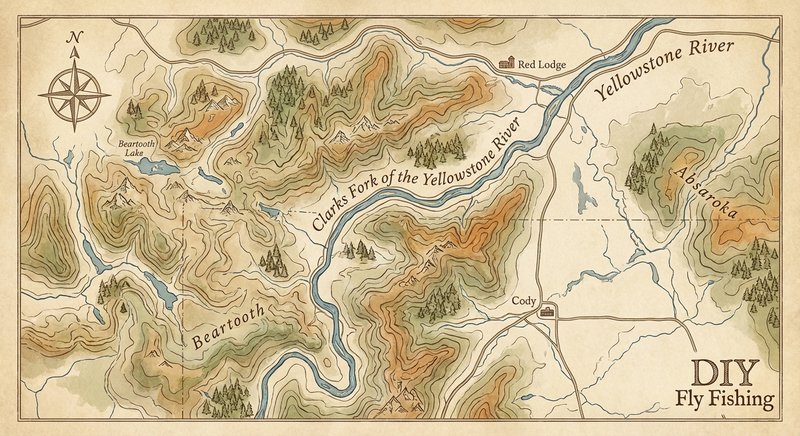
Clarks Fork of the Yellowstone
Fly fishing in Wyoming · Intermediate · Best seasons: Summer, Fall
Target Species
Cutthroat Trout, Rainbow Trout, Brown Trout
About This Water
Northeast Wyoming river with diverse trout species. Scenic canyon fishing.
Fishing Recommendations
The Clarks Fork of the Yellowstone is one of the most rugged, spectacular, and rewarding fly fishing destinations in the American West. As Wyoming’s only federally designated "Wild and Scenic River," it offers a true wilderness experience, carving a massive granite canyon between the Beartooth and Absaroka Mountains.
🎣 Location Overview
The Clarks Fork is a river of two personalities. The Upper Section (Sunlight Basin and the Beartooth Plateau) is a classic high-country meadow and canyon stream. The Middle Section—the "Grand Canyon of the Clarks Fork"—is a daunting, boulder-choked chasm that is one of the deepest canyons in the U.S. The Lower Section transitions into a larger, more traditional valley river as it flows toward Montana.
What makes it special is the sheer physical beauty and the lack of crowds. Unlike the nearby Madison or Yellowstone rivers, you will often have miles of water to yourself. The water is crystal clear, high-gradient, and filled with "pocket water"—small eddies and slicks behind massive boulders where trout lie in wait.
🐟 Target Species & Behavior
- Yellowstone Cutthroat Trout: The crown jewel of the river. They are opportunistic feeders and famously "look up," making them a dry-fly angler's dream.
- Rainbow Trout & "Bowcut" Hybrids: Found throughout the river, especially in the faster oxygenated water. They are harder fighters than the pure cutthroats.
- Brown Trout: More prevalent in the lower sections and the deeper pools of the canyon. They tend to be more elusive and are best targeted with streamers or during low-light hours.
- Behavior: Because the growing season is short and the water is nutrient-poor compared to tailwaters, these fish are aggressive. They don't have the luxury of being "picky" like a Henry’s Fork trout; if a fly looks like food and is presented without drag, they will usually take it.
📅 Best Times to Fish
- Summer (July – August): This is the prime window. Runoff usually subsides by late June or early July. Once the water clears, the dry fly fishing is world-class.
- Fall (September – October): My personal favorite time. The cottonwoods turn gold, the crowds vanish, and the Brown Trout become aggressive as they prepare to spawn. Blue Winged Olive (BWO) hatches can be prolific on overcast days.
- Time of Day: In the summer, there is no need to be on the water at dawn. The water is cold; fishing usually picks up around 10:00 AM as the sun hits the water and insects become active.
🪰 Recommended Flies & Techniques
Top Fly Patterns
- Dries: Chubby Chernobyl (Size 8-12, Gold or Olive), Stimulators (Orange or Royal), Amy’s Ant, Parachute Adams (Size 12-16), and Purple Haze.
- Nymphs: Prince Nymph, Pat’s Rubber Legs (Coffee/Black), Copper John (Red or Chartreuse), and Bead-head Pheasant Tails.
- Streamers: Black or Olive Wooly Buggers, Gold-bead Rubber Legged Buggers, and Sparkle Minnows.
Techniques
- Hopper-Dropper: This is the "bread and butter" on the Clarks Fork. Use a buoyant dry fly (like a Chubby) and hang a weighted nymph 2-3 feet below it.
- Pocket Water Picking: Don't spend 30 minutes in one hole. These fish are spread out. Cast into the soft water behind boulders, the "seams" where fast and slow water meet, and the "pillows" in front of rocks.
- High-Sticking: Because the currents are complex, keep as much fly line off the water as possible to avoid drag.
💡 Pro Tips & Local Knowledge
- Shorten Your Cast: In the canyon stretches, you rarely need to cast more than 20-30 feet. Accuracy and drift control are far more important than distance.
- The "Two-Cast" Rule: In the pocket water, if a fish doesn't rise in the first two or three clean drifts, move to the next pocket. These fish are not shy; if they are there and hungry, they will move for the fly.
- Look for the "Bucket": Even in the middle of a raging rapid, there are often deep "buckets" or depressions where the water slows down. These are honey pots for large Rainbows.
- The Lower Canyon Access: Accessing the canyon floor requires a steep hike. If you are physically fit, the "Crandall Bridge" area offers a good starting point to hike down.
⚠️ Important Information
- Access: Much of the upper river is accessible via the Chief Joseph Scenic Byway (Hwy 296) and the Beartooth Highway (Hwy 212). Be prepared for steep climbs and rugged terrain.
- Grizzly Bear Country: This is critical. The Clarks Fork is in the heart of prime Grizzly habitat. Always carry bear spray on your person (not in your pack), fish with a partner, and make noise when walking through thick brush.
- Regulations: A Wyoming fishing license is required. Always check current WY Game & Fish regulations for creel limits and tackle restrictions (most of the river is open to bait, but fly fishing is the most effective and ethical method here).
- Wading Safety: The rocks here are notoriously slippery and the current is heavy. Use felt-soled boots (where legal) or studs, and a wading staff is highly recommended.
Bug Hatches & Matching Flies
| Hatch | Type | Peak months | Time of day | Hook sizes | Matching flies |
|---|---|---|---|---|---|
| Blue Winged Olive Baetis | mayfly | April, May, September, October | Late Morning/Afternoon | #18-22 | BWO Sparkle Dun #18-22, Pheasant Tail #18-20, RS2 #20-22 |
| Midges Chironomidae | midge | March, April, October, November | All Day | #18-24 | Zebra Midge #18-22, Griffith's Gnat #18-20, Morgan's Midge #20-22 |
| Salmonfly Pteronarcys californica | stonefly | June, July | All Day | #4-8 | Rogue River Stone #4-8, Pat's Rubber Leg Stone #6-10, Chubby Chernobyl #6-10 |
| Golden Stonefly Hesperoperla pacifica | stonefly | July, August | Morning/Afternoon | #8-12 | Golden Chubby Chernobyl #8-12, Twenty Incher #8-12, Half-Back #10-12 |
| Pale Morning Dun Ephemerella excrucians | mayfly | July, August | Late Morning/Early Afternoon | #14-18 | PMD Parachute #16-18, Split Case PMD #16-18, Quigley Cripple #14-18 |
| Spotted Sedge Hydropsyche | caddis | July, August, September | Evening | #14-18 | Elk Hair Caddis #14-18, LaFontaine's Deep Sparkle Pupa #14-16, X-Caddis #16-18 |
| Yellow Sally Isoperla | stonefly | July, August | Afternoon/Evening | #14-16 | Yellow Stimulator #14-16, Iron Lotus (Yellow) #16, Little Yellow Sloan #14-16 |
| Trico Tricorythodes | mayfly | August, September | Early Morning | #20-24 | Trico Spinner #20-24, Drowned Trico #22, Trico Parachute #20-22 |
| Grasshoppers Orthoptera | terrestrial | August, September | Afternoon | #8-12 | Morrish Hopper #8-12, Parachute Hopper #10-12, Letort Hopper #12 |