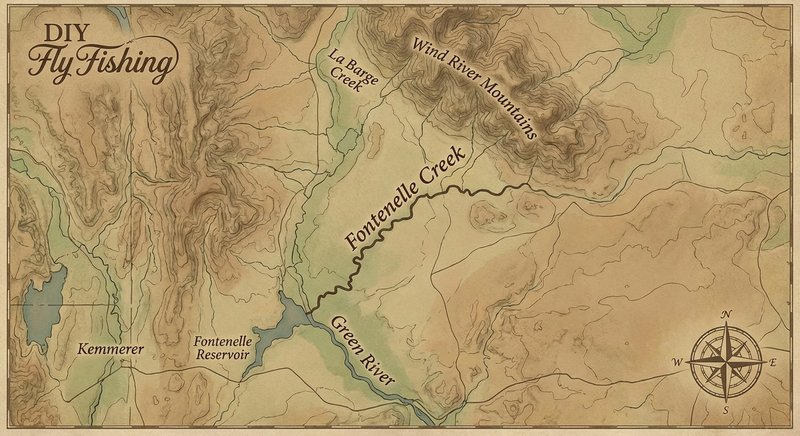
Fontenelle Creek
Fly fishing in Wyoming · Intermediate · Best seasons: Summer, Fall
Target Species
Cutthroat Trout, Brown Trout
About This Water
Western Wyoming stream with Colorado River cutthroat. Scenic high-desert fishing.
Fishing Recommendations
Welcome to one of Wyoming’s best-kept secrets. As a guide, I often steer clients toward Fontenelle Creek when they want to escape the crowds of the main-stem Green River and experience technical, high-desert meadow fishing at its finest.
Here is your comprehensive guide to fly fishing Fontenelle Creek.
🎣 Location Overview
Fontenelle Creek is a major tributary to the Green River, flowing out of the Wyoming Range and snaking through high-desert sagebrush country before entering Fontenelle Reservoir.
What makes this water special is its classic meadow meandering. This isn't a brawling mountain river; it is a ribbon of water characterized by deep undercut banks, tight oxbow bends, and dense willow lining. It offers a "small water" experience where stealth and accuracy are rewarded far more than long-distance casting. Anglers love it because it feels prehistoric—you’re often the only soul out there, surrounded by moose, antelope, and some surprisingly large trout for such a small stream.
🐟 Target Species & Behavior
- Bonneville/Colorado River Cutthroat Trout: These are the native crown jewels of the creek. They are opportunistic feeders but can be spooky in the crystal-clear meadow stretches. They love to hold right against the grass lines.
- Brown Trout: Large Browns migrate up from Fontenelle Reservoir, especially in the late summer and fall. These fish are predatory and territorial.
- Behavior: In the early morning, fish will often be at the tail-outs of pools. As the sun rises, they retreat under the overhanging willows and deep into the undercut banks. Because the water is often slow-moving, your "shadow" is your biggest enemy here.
📅 Best Times to Fish
Optimal Seasons
- Summer (Late June – August): This is the prime window for dry fly enthusiasts. Once the spring runoff subsides (usually by late June), the terrestrial fishing becomes world-class.
- Fall (September – October): This is the time for trophy hunters. As the Brown Trout prepare to spawn, they become aggressive. The cottonwoods turn gold, the mosquitoes die off, and the big fish move into the deeper holes.
Best Times of Day
- Summer: Morning (until 11:00 AM) and "Magic Hour" (the last two hours of light). Mid-day can be tough due to high sun and flat water.
- Fall: Mid-day is actually excellent as the water warms slightly, triggering bug activity.
🪰 Recommended Flies & Techniques
Top Fly Patterns
- Dry Flies:
- Terrestrials: Chernobyl Ants (size 10-14), Hoppers (Parachute Hopper or Dave’s Hopper, size 12), and Beetles/Ants.
- Mayflies: PMDs (size 16-18) and Parachute Adams.
- Nymphs:
- Bead-head Pheasant Tails (size 16-18), Zebra Midges (red or black, size 18-20), and Pat’s Rubber Legs (small, size 12) for the deeper holes.
- Streamers:
- Gold Ribbed Hare’s Ear streamers or small Wooly Buggers (Olive or Black, size 8-12).
Effective Techniques
- Hopper-Dropper: This is the "bread and butter" of Fontenelle Creek. Use a buoyant foam hopper on top and hang a small unweighted nymph 18-24 inches below it.
- The "Dapping" Approach: In the tight willow sections, don't even try to cast. Walk quietly to the bank and drop your fly directly over the edge.
- Streamer Stripping: In the fall, cast a small streamer into the deep "black" water of an undercut bank and strip it erratically.
💡 Pro Tips & Local Knowledge
- The Stealth Factor: If you walk up to the bank like you're walking into a grocery store, you will see "V-wakes" of fish fleeing. Stay 10 feet back from the bank, crouch low, and wear earthy colors.
- Focus on the Bends: 90% of the biggest fish live in the deep holes created by the sharpest turns in the creek. Spend more time picking apart one "perfect" bend than walking miles of straight, shallow water.
- Manage the Willows: Bring a shorter rod if you have one. A 7’6” or 8’6” 4-weight is much easier to navigate through the brush than a standard 9-foot rod.
- The Reservoir Influence: The lower reaches (closer to the reservoir) hold bigger fish but are more affected by water levels. The upper reaches (in the Bridger-Teton National Forest) offer more consistent numbers of smaller, eager Cutthroats.
⚠️ Important Information
Access Information
- Much of the lower creek flows through BLM (Bureau of Land Management) land, which is open to the public. However, there are significant patches of private ranch land.
- Always check a mapping app (like onX or Gaia GPS) to ensure you are on public ground. Access is primarily via Fontenelle Creek Road (County Road 313).
Regulations & Permits
- A valid Wyoming Fishing License is required.
- You must also possess a Wyoming Conservation Stamp.
- Regulations can change; always check the current Wyoming Game & Fish Department (WGFD) booklet for specific creel limits or tackle restrictions (many areas are catch-and-release or artificial flies/lures only).
Special Considerations
- Moose Safety: This area is heavily populated by moose. They are often tucked in the willows where you want to fish. Give them a wide berth; they are far more dangerous than bears in this specific drainage.
- Wind: This is Wyoming. The wind usually kicks up by 2:00 PM. Plan your technical dry fly work for the morning.
Bug Hatches & Matching Flies
| Hatch | Type | Peak months | Time of day | Hook sizes | Matching flies |
|---|---|---|---|---|---|
| Midges Chironomidae | midge | March, April, September, October | All Day | #18-24 | Zebra Midge #18-22, Griffith's Gnat #20-22, Morgan's Midge #20-22 |
| Blue Winged Olive Baetis | mayfly | April, May, September, October | Late Morning/Afternoon | #18-22 | RS2 #20-22, BWO Sparkle Dun #18-20, Pheasant Tail #18-20 |
| Pale Morning Dun Ephemerella excrucians | mayfly | July, August | Late Morning | #16-18 | PMD Sparkle Dun #16-18, Split Case PMD #16-18, Quigley Cripple #16-18 |
| Spotted Sedge / Tan Caddis Hydropsyche | caddis | July, August | Evening | #14-18 | Elk Hair Caddis #14-16, LaFontaine's Deep Sparkle Pupa #16-18, X-Caddis #14-18 |
| Yellow Sally Isoperla | stonefly | June, July | Afternoon/Evening | #14-16 | Yellow Sally Foam Stone #14-16, Iron Lotus #16, Stimulator (Yellow) #14-16 |
| Trico Tricorythodes | mayfly | August, September | Early Morning | #20-24 | Trico Spinner #20-24, Sunken Trico Spinner #22, Drowned Trico #20-22 |
| Golden Stonefly Hesperoperla pacifica | stonefly | June, July | Morning/Evening | #8-12 | Chubby Chernobyl #10-12, Pat's Rubber Leg #8-12, Water Walker #10 |
| Grasshoppers Acrididae | terrestrial | August, September | Afternoon | #8-12 | Morrish Hopper #10-12, Panty Dropper Hopper #12, Charlie Boy Hopper #10-12 |
| Red Quill / Western March Brown Rhithrogena morrisoni | mayfly | May, June | Afternoon | #12-14 | March Brown Para #12-14, Gold Ribbed Hare's Ear #12-14, Quill Gordon #14 |