Fremont Lake
Fly fishing in Wyoming · Intermediate · Best seasons: Summer, Fall
Target Species
Lake Trout, Rainbow Trout, Brown Trout
About This Water
Wind River Range lake with lake trout and mackinaw. Deep glacial water.
Fishing Recommendations
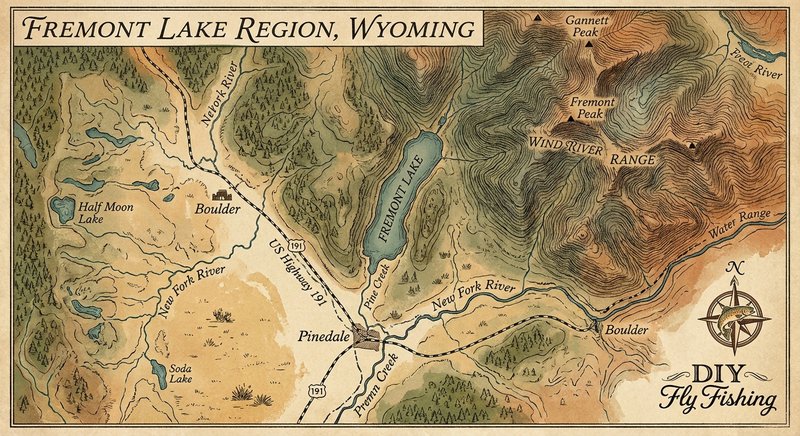
Welcome to the Wind River Range. As your guide, I can tell you that Fremont Lake is one of the most unique and breathtaking fisheries in Wyoming. Located just outside Pinedale, it is the state’s second-largest natural lake and its deepest (over 600 feet).
Fishing Fremont is a "big water" experience. It is a glacial-carved marvel with crystal-clear water and a dramatic shoreline. While many anglers overlook it in favor of the nearby Green River, those who know how to fish deep or work the rocky shorelines are rewarded with trophy-sized Lake Trout and hard-fighting Rainbows.
🎣 Location Overview
Fremont Lake is a pristine, oligotrophic (low nutrient, high oxygen) alpine lake. Because the water is so clear, the fish are notoriously "spooky" and have excellent vision. The lake is surrounded by granite cliffs and pine forests, providing a stunning backdrop.
What makes it special is the sheer scale. This isn't a small mountain pond; it’s a massive body of water that behaves more like a Great Lake. For fly anglers, the challenge lies in the depth, but the reward is the chance to hook into a 20-pound Mackinaw (Lake Trout) on a fly rod—a feat rarely accomplished elsewhere in the lower 48.
🐟 Target Species & Behavior
- Lake Trout (Mackinaw): The kings of the lake. In the heat of summer, they retreat to the abyss (80–150 feet). However, in the late spring and again in the fall, they move into the "shallows" (10–30 feet) to feed and spawn. They are opportunistic predators, feeding primarily on Kokanee salmon and smaller trout.
- Rainbow Trout: Found mostly in the upper 20 feet of the water column. They cruise the rocky shorelines and the drop-offs looking for terrestrial insects, midges, and small baitfish.
- Brown Trout: Less common than the others but they grow large here. They hang near submerged structure and the mouths of incoming creeks, especially as they prepare to spawn in the fall.
📅 Best Times to Fish
Optimal Seasons
- Summer (July – August): Best for Rainbows and Browns using dries and light nymphs. Lake trout are deep now, requiring specialized sinking lines or fishing the very early morning "grey light" hours.
- Fall (September – October): Prime Time. As water temperatures drop, the Lake Trout move into the shallows (15–30 feet) to spawn. This is your best chance to target trophy Mackinaw with a fly rod.
Best Times of Day
- First Light/Dusk: Essential on Fremont. The water is so clear that fish become wary in direct sunlight. The "magic hour" before the sun hits the water is when the biggest fish are caught near the surface.
- Windy Days: A light "chop" on the water breaks up the surface, making fish less likely to see you and more likely to rise to a fly.
🪰 Recommended Flies & Techniques
For Lake Trout (The Heavy Hitters)
- Technique: Use a 9-weight rod with a heavy 300-500 grain sinking tip. You want to "dredge" the drop-offs. Cast toward the shore and let the fly sink deep as it drifts over the ledge.
- Flies: Large streamers (6–10 inches).
- Game Changers (White/Pearl to mimic Kokanee)
- Bunny Leeches (White, Chartreuse)
- Sex Dungeon (White or Olive)
For Rainbows & Browns (The Shoreline Cruise)
- Technique: "Be the Heron." Walk the shoreline quietly and look for cruising fish. Use a 5 or 6-weight rod with a floating line or an intermediate sink tip.
- Dry Flies: Chubby Chernobyls, Hoopers (in August), and Griffith’s Gnats (for midge hatches).
- Nymphing: Hanging a Balanced Leech or a Pheasant Tail under a dry fly near the rocky points.
💡 Pro Tips & Local Knowledge
- The "Narrows": Focus your efforts on the area known as "The Narrows." The underwater topography here creates bottlenecks for baitfish, making it a prime hunting ground for large predators.
- Inlet Power: The north end where Pine Creek enters the lake is a hotspot. The moving water brings in nutrients and oxygen, attracting all species. It requires a boat or a long hike to access, but it is often the most productive spot on the lake.
- Watch the Weather: Fremont can go from glass-calm to 4-foot swells in thirty minutes. If you see clouds building over the Wind Rivers, head for the dock immediately.
- Long Leaders: Because the water is gin-clear, use longer leaders than usual (12-15 feet for dries) and fluorocarbon tippet for sub-surface work to keep your line invisible.
⚠️ Important Information
- Access: The most popular access is at the south end near the CCC Ponds and the Forest Service boat ramps. There are several campgrounds (Fremont Lake Campground) that offer great shoreline access.
- Regulations: Always check the current Wyoming Game and Fish Department (WGFD) regulations. There are specific creel limits for Lake Trout to help manage the population and protect the Kokanee food source.
- Boating: While you can fish from the shore, a boat (even a float tube or kayak on calm days) is a massive advantage for reaching the drop-offs where the big Lake Trout hold.
- Invasive Species: Wyoming is very strict about AIS (Aquatic Invasive Species). Ensure your boat/kayak has a valid Wyoming AIS decal and has been inspected if coming from out of state.
Guide’s Final Word: Fremont Lake is a game of patience and stealth. Don't be discouraged if you don't catch dozens of fish; the ones you do catch here are often the fish of a lifetime. Tight lines!
Bug Hatches & Matching Flies
| Hatch | Type | Peak months | Time of day | Hook sizes | Matching flies |
|---|---|---|---|---|---|
| Chironomids Chironomidae | midge | May, June, September | All Day | #12-22 | Zebra Midge #16-20, Ice Midge #12-16, Griffith's Gnat #18-22 |
| Callibaetis Callibaetis ferrugineus | mayfly | July, August | Late Morning/Early Afternoon | #14-16 | Parachute Adams #14-16, Pheasant Tail Nymph #14-16, Callibaetis Spinner #14-16 |
| Blue Damselfly Enallagma spp. | terrestrial | June, July | Mid-day | #10-14 | Marabou Damsel #10-12, Braided Butt Damsel #12-14 |
| Traveling Sedge Hesperophylax designatus | caddis | July, August | Evening | #10-14 | Goddard Caddis #10-12, Mikulak Sedge #10-14 |
| Terrestrial Ants and Beetles Formicidae / Coleoptera | terrestrial | August, September | Afternoon | #12-18 | Black Foam Ant #14-18, Terrestrial Beetle #12-16 |
| Water Boatmen Corixidae | terrestrial | September, October | Afternoon | #14-16 | Prince Nymph #14-16, Water Boatman Pattern #14-16 |
| Pale Morning Dun Ephemerella excrucians | mayfly | July | Late Morning | #16-18 | PMD Sparkle Dun #16-18, Mercer's Trigger Case PMD #16-18 |
| Dragonfly Anisoptera | terrestrial | July, August | Morning/Afternoon | #4-8 | Dragonfly Nymph #6-10, Gomphus Pattern #8-10 |