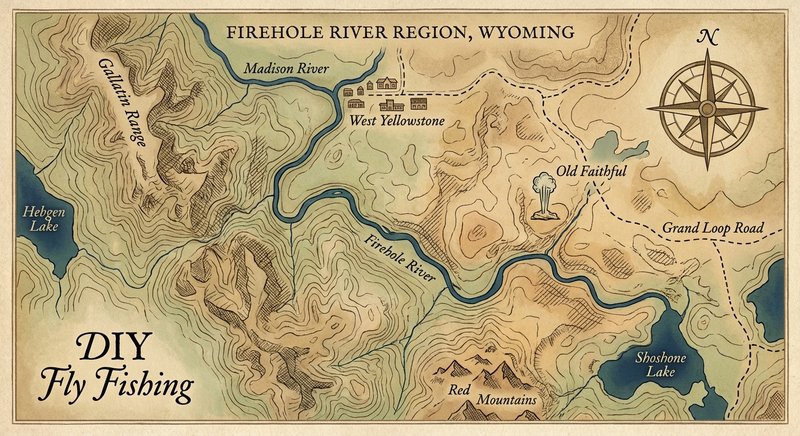
Firehole River
Fly fishing in Wyoming · Intermediate · Best seasons: Spring, Fall
Target Species
Rainbow Trout, Brown Trout, Brook Trout
About This Water
Unique geothermal river in Yellowstone with warm water and incredible hatches. Fishing among geysers.
Fishing Recommendations
The Firehole River is perhaps the most unique trout stream on the planet. Flowing through the heart of Yellowstone National Park’s geyser basins, it is a river where geology and biology collide. As an expert guide, I consider the Firehole the ultimate "technical meadow" experience—a place where you can catch trout while Old Faithful erupts in the background.
🎣 Location Overview
The Firehole River is a geothermal wonder. Unlike most Rocky Mountain streams fed by cold snowmelt, the Firehole is tempered by thousands of gallons of hot mineral water from geysers and hot springs (including the Midway and Lower Geyser Basins).
Characteristics:
- Water Type: It behaves like a large, alkaline spring creek. Expect long, flat glides, weed beds, and subtle current seams.
- The Aesthetic: Steam rises from the banks, bison often graze in the river meadows, and the water has a distinct "soft" feel due to the mineral content.
- Why Anglers Love It: It offers world-class dry fly fishing in a surreal, prehistoric landscape. It is also one of the few rivers in the Rockies that is "fishable" in late May and June when every other river is blown out by snowmelt.
🐟 Target Species & Behavior
The Firehole is home to Wild Rainbow Trout and Brown Trout.
- Size: These are not "trophy" fish in terms of size—most average 10–14 inches—but they are incredibly hardy, beautiful, and can be frustratingly selective.
- Behavior: Due to the flat water, these fish are "PhD trout." They hold in the channels between weed beds and along the undercut banks. They are highly attuned to hatches and will often ignore anything that doesn't have a perfect drift.
- Feeding: They are primarily insectivores. Because the water is nutrient-rich and warm, the insect biomass is staggering.
📅 Best Times to Fish
The Firehole has a unique "U-shaped" season due to its water temperature.
- The Spring Window (Late May – June): This is the prime time. While other rivers are flooding, the Firehole is at its peak. The water temperatures are perfect (55–65°F), and the hatches are prolific.
- The Fall Window (September – Early November): As air temperatures drop, the river "recovers" from the summer heat. The fall BWO (Blue Winged Olive) hatches here are legendary.
- The Mid-Summer Gap (July – August): AVOID. Geothermal input can push water temperatures above 75°F, which is lethal for trout. The park often implements "hoot owl" restrictions or temporary closures during this time to protect the fish.
- Time of Day: On cloudy days, look for midday hatches (11:00 AM – 3:00 PM). On sunny days, the evening caddis flights are spectacular.
🪰 Recommended Flies & Techniques
Top Fly Patterns
- Dry Flies:
- White Miller Caddis (Size 14-16) - The signature hatch of the Firehole.
- Sparkle Dun / PMD (Size 16-18) - For the morning hatches.
- Blue Winged Olive (BWO) (Size 18-22) - Essential for fall or drizzly days.
- Parachute Adams (Size 16-20) - The ultimate searcher.
- Soft Hackles (The Secret Weapon):
- Partridge and Orange or Pheasant Tail Soft Hackle (Size 14-16).
- Nymphs:
- Zebra Midge (Size 18-22).
- Pheasant Tail (Unweighted) (Size 16-20).
Effective Techniques
- The "Down and Across" Swing: This is the classic Firehole technique. Cast a soft hackle or small wet fly quartering downstream, let it swing through the surface film, and give it slight twitches. The take is usually aggressive.
- Technical Dry Fly: Use long leaders (12ft+) and 6X or 7X fluorocarbon tippet. Accuracy and a drag-free drift are more important than the specific fly pattern.
- No-Weight Nymphing: Because of the thick weed beds, heavy split shot will only snag. Fish unweighted nymphs just under the surface film.
💡 Pro Tips & Local Knowledge
- The "White Miller" Phenomenon: In June, the White Miller (Nectopsyche) caddis hatch is so thick it looks like a blizzard. Fish will gorge on them. Be sure to have white-bodied caddis patterns.
- Focus on the Meadows: The stretches through Lower Geyser Basin and Fountain Flat offer the best dry fly water.
- The Firehole Canyon: For a change of pace, the Canyon section has swifter water and deeper pools. This is a great place to swing streamers or larger soft hackles for bigger (but fewer) Brown Trout.
- Stealth is Mandatory: The water is clear and flat. If you can see the fish, they have likely already seen you. Kneel when approaching the bank and avoid heavy wading.
⚠️ Important Information
- Permits: You need a Yellowstone National Park Fishing Permit. A Wyoming state license is not valid inside the park. You can buy these online or at park visitor centers.
- Regulations: The Firehole is Catch and Release only. Barbless hooks are required.
- Lead-Free Zone: The use of lead split shot or lead-weighted flies is strictly prohibited in Yellowstone. Use tungsten or tin.
- Felt Soles: Felt-soled wading boots are banned in Yellowstone to prevent the spread of invasive species. Use rubber soles (with studs if needed).
- Wildlife Safety: You are in Grizzly and Bison country. Always carry Bear Spray, keep your distance (100 yards from bears/wolves, 25 yards from bison), and never fish alone if possible.
- Geothermal Hazards: Never walk on "crusty" ground near the river in geyser basins. Stick to established paths or the riverbed itself. The ground can be paper-thin with boiling water underneath.
Bug Hatches & Matching Flies
| Hatch | Type | Peak months | Time of day | Hook sizes | Matching flies |
|---|---|---|---|---|---|
| Blue Winged Olive (BWO) Baetis tricaudatus | mayfly | May, June, September, October | Late Morning/Afternoon | #18-22 | RS2 #20-22, Parachute Adams #18-22, Pheasant Tail #18-20 |
| White Miller Nectopsyche | caddis | June, July | Morning/Evening | #14-16 | White Miller Soft Hackle #14-16, White Goddards Caddis #14-16, LaFontaine Sparkle Pupa #14-16 |
| Pale Morning Dun (PMD) Ephemerella excrucians | mayfly | June, July | Late Morning/Early Afternoon | #16-18 | PMD Sparkle Dun #16-18, Quigley Cripple #16-18, Military Mayfly #16-18 |
| Midges Chironomidae | midge | May, June, September, October | All Day | #20-24 | Zebra Midge #20-22, Griffith's Gnat #20-24, Brooks Sprout Midge #20-22 |
| Yellow Sally Isoperla | stonefly | June, July | Afternoon/Evening | #14-16 | Yellow Sally Stimulator #14-16, Little Yellow Sloan #14-16, Kush's Yellow Sally #16 |
| Small Western Dark Olive (Flavs) Drunella flavilinea | mayfly | September, October | Midday | #16-18 | Flav Sparkle Dun #16-18, Hare's Ear #16-18 |
| Hydropsyche Caddis Hydropsyche | caddis | June, July | Evening | #14-18 | Elk Hair Caddis #14-18, Pulsating Caddis Pupa #16-18, Hydropsyche Larva #14-16 |
| Terrestrials (Ants and Beetles) Formicidae/Coleoptera | terrestrial | July, August, September | Midday | #12-18 | Cinnamon Ant #16-18, Black Foam Beetle #14-16, Fur Ant #16-18 |