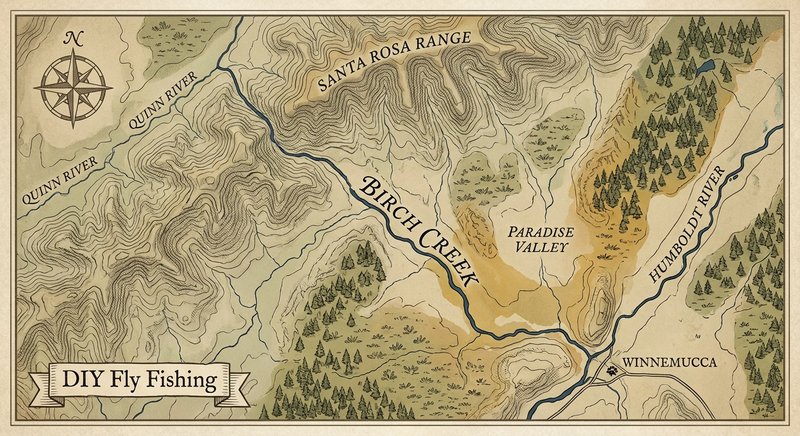
Birch Creek
Fly fishing in Nevada · intermediate · Best seasons: summer, fall
Target Species
Lahontan Cutthroat Trout
About This Water
Monitor Range stream with Lahontan cutthroat restoration. Quality wild trout.
Fishing Recommendations
Birch Creek is one of the hidden gems of the Great Basin, offering a rare opportunity to pursue a native icon—the Lahontan Cutthroat Trout (LCT)—in a classic small-stream desert environment. Tucked away in the Toiyabe Range near Austin, Nevada, this creek represents some of the most remote and rewarding fly fishing in the Silver State.
🎣 Location Overview
Birch Creek is a high-desert oasis. Located in the Humboldt-Toiyabe National Forest, it is a small, cold-water tributary that flows through a rugged canyon before disappearing into the Big Smoky Valley.
What makes Birch Creek special is its population of genetically pure Lahontan Cutthroat Trout. Unlike the giants of Pyramid Lake, these are stream-resident fish. The water is crystalline, characterized by plunge pools, tight pocket water, and undercut banks shaded by willows and birch trees. Anglers love it because it offers a "blue-ribbon" small-stream experience in a landscape where water is otherwise scarce. It is intimate, technical, and incredibly scenic.
🐟 Target Species & Behavior
The star of the show is the Lahontan Cutthroat Trout.
- Behavior: These fish are opportunistic but can be wary due to the clarity of the water. Because Birch Creek is a nutrient-poor environment, the trout aren't usually "picky" eaters, but they are "spooky" residents.
- Holding Patterns: Look for fish in the deeper plunge pools below small waterfalls, in the "kitchen" (the head of the pool where the current enters), and tucked tight against undercut banks. In the summer heat, they will move into the oxygenated riffles or deep under the willow overshoots.
- Size: These are not monsters. A 10-inch fish is a "trophy" here, with most averaging 6–8 inches. However, their vibrant orange slashes and spotting patterns make them some of the most beautiful trout in the West.
📅 Best Times to Fish
- Summer (Late June – August): This is the prime window. The high-elevation snowpack has usually melted off, and the water levels stabilize. Terrestrial activity is at its peak.
- Fall (September – October): This is the "magic hour" for Birch Creek. The temperatures drop, the aspens turn gold, and the trout feed aggressively to bulk up for winter. Water levels will be low, requiring a stealthy approach.
- Time of Day: During the summer, fish early and late to avoid the midday high-desert sun. In the fall, the fishing is excellent throughout the warmer parts of the day (10:00 AM – 4:00 PM).
🪰 Recommended Flies & Techniques
Top Fly Patterns
- Dry Flies:
- Royal Wulff or Royal Coachman (#14-18): High visibility is key in the broken water.
- Elk Hair Caddis (#14-16): A staple for the evening hatch.
- Hopper Patterns (#10-14): In late summer, a foam Dave’s Hopper or Joe’s Hopper dropped near the banks is deadly.
- Ants and Beetles (#16-18): Essential for "finicky" fish in the fall.
- Nymphs:
- Pheasant Tail (#16-20): Mimics the small mayflies present in the system.
- Gold-Ribbed Hare’s Ear (#14-16): Great for prospecting deeper pools.
Effective Techniques
- Dry-Dropper: This is the most effective way to fish Birch Creek. Use a buoyant dry fly (like a Stimulator) as your indicator and hang a small unweighted Pheasant Tail 12–18 inches below it.
- Dapping: In many spots, the willows are too thick for a traditional cast. "Dapping"—poking your rod tip through the brush and dropping the fly vertically—is a pro move here.
Presentation Tips
- The Stealth Approach: Stay low. If you can see the fish, they have likely already seen you. Wear earthy colors (camo, olive, or tan) to blend into the desert background.
- Short Casts: You will rarely need to cast more than 15–20 feet. Accuracy and a drag-free drift are far more important than distance.
💡 Pro Tips & Local Knowledge
- Small Gear Only: Leave your 5-weight at home. A 2-weight or 3-weight rod (7' to 7'6") is perfect for these fish and the tight quarters. A fiberglass rod is particularly fun here for its soft action.
- The Upstream Walk: Always fish upstream. The water is shallow and clear; if you fish downstream, you'll send silt and "danger signals" to every fish in the pool before you get there.
- Tenkara Territory: This creek is arguably the best Tenkara water in Nevada. The ability to keep line off the water and reach over willow branches makes Tenkara an unfair advantage at Birch Creek.
- Watch for Rattlesnakes: This is high-desert country. While rare in the higher elevations of the canyon, keep an eye out near the trailheads and rocky outcroppings.
⚠️ Important Information
- Access: Access is via Highway 50 (the "Loneliest Road in America") near Austin, NV. Take Birch Creek Road into the canyon. A high-clearance vehicle is recommended, though the main road is generally well-maintained during summer.
- Regulations: Nevada Department of Wildlife (NDOW) regulations apply. You must have a valid Nevada Fishing License.
- Special Consideration: This is a fragile ecosystem. These Lahontan Cutthroats are a sensitive species. Practice 100% Catch and Release, use barbless hooks, and keep the fish in the water while unhooking.
- Environment: This is a "Pack it in, Pack it out" area. There are primitive camping spots available, but no services (water, gas, or cell service) are nearby. Austin is your last stop for supplies.
Bug Hatches & Matching Flies
| Hatch | Type | Peak months | Time of day | Hook sizes | Matching flies |
|---|---|---|---|---|---|
| Blue-Winged Olive (BWO) Baetis spp. | mayfly | March, April, September, October | Late Morning/Afternoon | #18-22 | Parachute BWO #18-20, RS2 #20-22, Pheasant Tail Nymph #18-20 |
| Pale Morning Dun (PMD) Ephemerella excrucians | mayfly | June, July | Late Morning/Afternoon | #14-18 | PMD Sparkle Dun #16-18, Split Case PMD #16, Hare's Ear Nymph #14-16 |
| American Grannom (Mother's Day Caddis) Brachycentrus occidentalis | caddis | May | All Day/Evening | #14-16 | Elk Hair Caddis (Olive) #14-16, Peacock Caddis Larva #14-16, LaFontaine's Deep Sparkle Pupa #14 |
| Yellow Sally Isoperla spp. | stonefly | June, July | Afternoon/Evening | #12-16 | Yellow Sally Stimulator #14-16, Iron Lotus #16, Little Yellow Sloan #14 |
| Spotted Sedge Hydropsyche spp. | caddis | July, August | Late Afternoon/Evening | #14-18 | Godzilla Caddis #16, Copper John #14-18, Soft Hackle Hare's Ear #14-16 |
| Trico Tricorythodes spp. | mayfly | August, September | Early Morning | #20-24 | Trico Spinner #20-24, Zebra Midge #20-22, Griffith's Gnat #20-22 |
| Grasshopper Melanoplus spp. | terrestrial | August, September | Late Morning/Afternoon | #8-12 | Hopper Juan #10-12, Dave's Hopper #8-12, Morrish Hopper #10 |
| Golden Stonefly Hesperoperla pacifica | stonefly | June | Morning/Evening | #6-10 | Golden Stimulator #8-10, Pat's Rubber Legs #8-12, Golden Stone Nymph #10 |
| Midge Chironomidae | midge | February, March, November | Midday | #18-24 | Zebra Midge (Red/Black) #18-22, Morgan's Midge #20-22, Palomino Midge #20-22 |