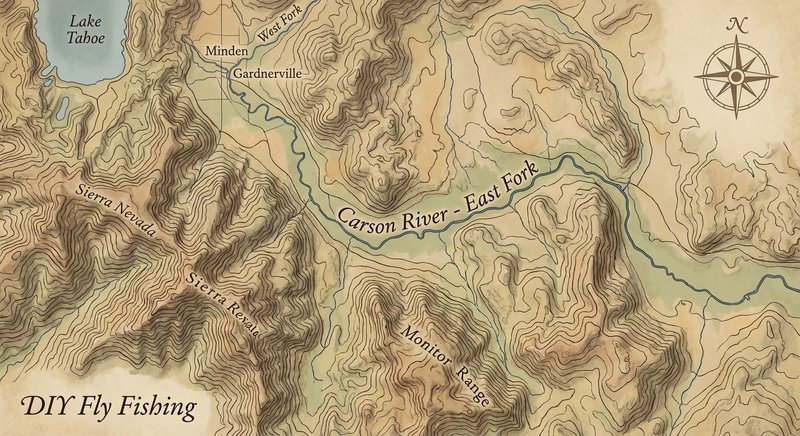
Carson River - East Fork
Fly fishing in Nevada · intermediate · Best seasons: spring, summer, fall
Target Species
Brown Trout, Rainbow Trout
About This Water
Sierra Nevada freestone with wild trout. Beautiful mountain scenery with good access.
Fishing Recommendations
The East Fork of the Carson River as it flows through Nevada is a true "high desert gem." While the California side gets a lot of glory for its Wild & Scenic designation, the Nevada stretch—flowing from the state line down toward Gardnerville—offers a unique blend of rugged canyon water and winding valley currents. As a guide, I consider this one of the most rewarding technical fisheries in the Eastern Sierra/Great Basin region.
🎣 Location Overview
The East Fork Carson in Nevada is a transition river. It begins in the jagged peaks of the Sierra Nevada and spills into the high desert of Douglas County. This section is characterized by stunning granite boulder gardens, deep emerald pools, and classic riffle-run-pool sequences.
What makes it special is the solitude and diversity of water. You can fish high-gradient "pocket water" near the California/Nevada border (Hangman’s Bridge area) or move downstream into the valley for slower, meandering water that feels like a classic meadow stream. It feels wilder than the nearby Truckee, and because it is largely undammed (save for some small diversions), it retains the soul of a true freestone river.
🐟 Target Species & Behavior
- Rainbow Trout: These are the most common residents. You’ll find a mix of wild fish and some larger holdover rainbows. They love the fast water—look for them in the "heads" of pools, oxygenated riffles, and right behind large boulders.
- Brown Trout: The prize of the East Fork. The Nevada side holds some truly large, buttery Browns. They are much more wary and predatory. They hold in undercut banks, deep "buckets," and the slower tail-outs of pools during low light.
- Behavior: In the spring and early summer, fish are focused on weight and calories to recover from winter. By late summer, they become "lookers," rising for terrestrials and caddis.
📅 Best Times to Fish
- Spring (Late April – June): This is runoff season. The river can get "big" and murky. However, this is the best time to fish large stonefly nymphs and streamers along the banks. If the flows are below 800 CFS, it’s game on.
- Summer (July – August): This is the prime dry fly window. Morning and evening sessions are critical as water temperatures can rise in the afternoon. Look for the "Caddis blizzard" at dusk.
- Fall (September – November): My personal favorite. The water clears and cools, the crowds vanish, and the Brown Trout become aggressive as they prepare to spawn. The colors of the cottonwoods against the desert sky make for a spectacular backdrop.
🪰 Recommended Flies & Techniques
Nymphing (The Bread & Butter)
The East Fork is a nymphing river first.
- Patterns: Pat’s Rubber Legs (#8-12) in coffee or black, Prince Nymphs (#12-16), and Pheasant Tails (#16-18).
- Technique: Use a "Drop-Shot" rig or a standard indicator rig. Because the bottom is rocky, you need to be within inches of the substrate. If you aren't bouncing off rocks, you aren't deep enough.
Dry Fly Fishing
- Patterns: Elk Hair Caddis (#14-16), Stimulators (Orange/Yellow #10-14), and Hoppers (Dave's or PMX #8-12) in late summer.
- Technique: "Hopper-Dropper" is lethal here. Use a high-visibility foam grasshopper and hang a Beadhead Hare's Ear 24 inches below it.
Streamers
- Patterns: Woolly Buggers (Olive, Black), Sparkle Minnows, or Sculpzilla.
- Technique: Swing them through deep holes or strip them aggressively through undercut banks to trigger a territorial strike from a big Brown.
💡 Pro Tips & Local Knowledge
- The "S-Curve" and Canyon Reach: The water between Hangman’s Bridge (just inside CA) and the Nevada state line is rugged. Most anglers stay near the bridge. If you are willing to hike a mile downstream into the canyon, you will find fish that rarely see a fly.
- Watch the "Bubble Line": On the East Fork, the fish are very predictable about their feeding lanes. Look for the foam lines (the "bubble line")—90% of the feeding fish will be directly under that foam.
- The Wind Factor: This is Nevada. The "Washoe Zephyr" (afternoon wind) can be brutal. If the wind picks up, switch to a shorter leader and heavier streamers, or find a canyon bend that offers a windbreak.
- Stealth Matters: As the water drops in late summer, it becomes crystal clear. Long, fine leaders (5X) and a stealthy approach (don't shadow the water) are mandatory for the big Browns.
⚠️ Important Information
- Access: Much of the river in the valley runs through private ranch land (like the Dressler Ranch). Stick to public access points like Hangman’s Bridge or the Riverview Park area in Gardnerville. Always respect "No Trespassing" signs; Nevada trespass laws are strictly enforced.
- Regulations: You must have a Nevada Fishing License. Be sure to check the NDOW (Nevada Department of Wildlife) Eastern Region regulations, as certain stretches may have specific tackle restrictions (barbless hooks/artificials only) or seasonal closures to protect spawning fish.
- Safety: The East Fork can be deceptively powerful. Use a wading staff, especially during the spring. Also, keep an eye out for Rattlesnakes in the rocky canyon areas during the summer months.
- Hydration: It is high desert. Even in the fall, the sun is intense. Carry more water than you think you need.
Guide’s Final Word: The East Fork of the Carson in Nevada rewards the angler who moves. Don't spend two hours in one hole. Hit the high-percentage water, move a hundred yards, and repeat. You’ll cover more fish and see some of the most beautiful desert-canyon country in the West.
Bug Hatches & Matching Flies
| Hatch | Type | Peak months | Time of day | Hook sizes | Matching flies |
|---|---|---|---|---|---|
| Golden Stonefly Hesperoperla pacifica | stonefly | June, July | Morning/Afternoon | #8-12 | Pats Rubber Legs #8-12, Chubby Chernobyl #8-12, Golden Rogue Stone #10-12 |
| Pale Morning Dun Ephemerella excrucians | mayfly | June, July, August | Late Morning/Afternoon | #16-18 | Parachute Adams #16-18, Pheasant Tail Nymph #16-18, PMD Sparkle Dun #16-18 |
| Blue Winged Olive Baetis | mayfly | March, April, October, November | Late Morning/Afternoon | #18-22 | RS2 #18-22, BWO Parachute #18-22, JujuBaetis #18-22 |
| Spotted Sedge / Tan Caddis Hydropsyche | caddis | July, August, September | Evening | #14-18 | Elk Hair Caddis #14-18, LaFontaine's Deep Sparkle Pupa #14-16, Goddard Caddis #14-16 |
| Little Yellow Stonefly (Yellow Sallies) Isoperla | stonefly | June, July | Afternoon/Evening | #14-16 | Yellow Sally Dry #14-16, Iron Lotus #16, Micro Mayfly (Yellow) #14-16 |
| Grasshoppers Caelifera | terrestrial | August, September | Late Morning/Afternoon | #8-14 | Morrish Hopper #10-12, Dave's Hopper #8-12, Parachute Hopper #12-14 |
| Midges Chironomidae | midge | January, February, March, December | Morning/Afternoon | #20-24 | Zebra Midge #20-24, Griffith's Gnat #20-22, Top Secret Midge #20-22 |
| Mother's Day Caddis Brachycentrus | caddis | May | All Day | #14-16 | Peacock Caddis #14-16, Holy Grail #14-16, Z-Caddis #14-16 |
| Carpenter Ants / Flying Ants Camponotus | terrestrial | August, September | Afternoon | #12-18 | Black Ant #14-18, Cinnamon Ant #14-16, Chernobyl Ant #12-14 |