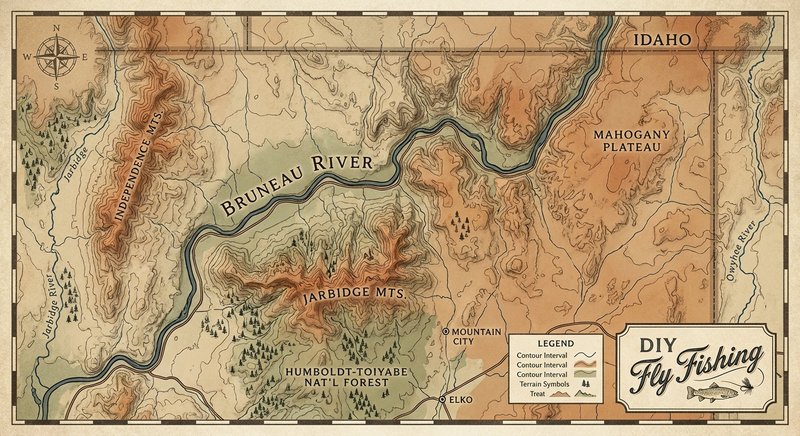
Bruneau River
Fly fishing in Nevada · advanced · Best seasons: spring, summer, fall
Target Species
Redband Trout
About This Water
Remote high desert stream with native redband trout. Challenging access to pristine waters.
Fishing Recommendations
As an expert guide who has spent years navigating the high-desert drainages of the Great Basin, I can tell you that the Bruneau River in Nevada is one of the West's best-kept secrets. Flowing through the rugged, remote canyons of Elko County before crossing into Idaho, the upper Bruneau offers a "wild and scenic" experience that feels like stepping back in time.
Here is your comprehensive guide to fly fishing the Nevada reaches of the Bruneau River.
🎣 Location Overview
The Bruneau River in Nevada is a high-desert freestone stream characterized by dramatic volcanic canyons, sagebrush plateaus, and stunning isolation. Unlike the tailwaters of the West, the Bruneau is entirely dependent on snowpack from the Jarbidge and Independence Mountains.
What makes this water special is its remoteness. This isn't a river where you’ll find crowds; it’s a place where you’re more likely to see a bighorn sheep than another angler. The water is crystalline, flowing over a bed of volcanic cobble, creating a classic mix of plunges, pocket water, and long, glassy glides. It is the quintessential "backcountry" trout stream for those who value solitude and wild fish.
🐟 Target Species & Behavior
The primary prize here is the Interior Columbia River Redband Trout.
- Characteristics: These are native, genetically distinct rainbows adapted to the harsh temperature fluctuations of the high desert. They are breathtakingly beautiful, featuring a brilliant crimson stripe and heavy spotting.
- Behavior: Redbands are notoriously hardy and aggressive. In this nutrient-poor environment, they cannot afford to be picky eaters. They are opportunistic predators that hit flies with surprising violence.
- Holding Water: In the spring/early summer, look for them in the softer seams near the bank. As the heat of summer sets in, they move into the "bubble curtains" and highly oxygenated riffles. In the fall, they drop into the deeper, cooler pools.
📅 Best Times to Fish
Timing is everything on the Bruneau, as flows can fluctuate wildly.
- Spring (Late May – June): This is the "Goldilocks" window. Once the peak snowmelt runoff subsides, the river becomes fishable. This is the time for big stonefly hatches.
- Summer (July – August): Excellent dry fly fishing, but watch the water temps. By August, the Nevada side can get low and warm. Focus on the early morning (6 AM to 11 AM) and late evening. If the water exceeds 68°F, give the fish a break and head to higher elevations.
- Fall (September – October): My personal favorite. The air cools, the water temps stabilize, and the Redbands feed heavily to prepare for winter. The light in the canyons this time of year is world-class.
🪰 Recommended Flies & Techniques
Top Fly Patterns
- Dry Flies:
- Chubby Chernobyl (Size 8-12): Orange or Tan. High buoyancy makes it a great indicator fly.
- Stimulators (Size 10-14): Yellow or Royal. Mimics the large stoneflies and grasshoppers.
- Elk Hair Caddis (Size 14-18): A staple for the evening rise.
- Morrish Hopper: Vital for the late summer "hopper-slapping" season.
- Nymphs:
- Bead-head Prince Nymph (Size 12-16): The "silver bullet" for Redbands.
- Pheasant Tail (Size 14-18): To mimic the small mayflies in the slower glides.
- Copper John (Red or Copper): Great for getting deep in the faster chutes.
- Streamers:
- Wooly Bugger (Olive or Black, Size 8-10): Swing these through deep canyon pools to find the larger 16-inch+ residents.
Effective Techniques
- Hopper-Dropper: This is the most effective way to cover the Bruneau. Use a large foam dry fly (like a Chubby) and hang a Prince Nymph or Copper John 18–24 inches below it.
- Stealth Approach: Because the water is clear and the river is relatively small, these fish are "spooky." Avoid wearing bright colors and try to stay low. Approach pools from downstream and cast "up and across."
💡 Pro Tips & Local Knowledge
- The "Desert Hopper" Factor: In August, the sagebrush is crawling with grasshoppers. On windy days, the fish line up against the banks waiting for a hopper to blow in. Don't be afraid to "splat" your fly onto the water to get their attention.
- Focus on the Shadows: In the deep canyons, the fish will often hold in the shade cast by the canyon walls. As the sun moves, the fish move.
- Mobility is Key: If a hole doesn't produce in 10 minutes, move on. The Bruneau rewards the angler who covers a lot of ground.
- The Charleston Stretch: The area near Charleston, NV, offers some of the most accessible water, but for the true Bruneau experience, explore the rugged sections downstream toward the Idaho border (Rowland area).
⚠️ Important Information
- Access & Vehicles: Warning: This is "flat tire country." High-clearance, 4WD vehicles with 10-ply tires are strongly recommended. Many roads are dirt/shale and become impassable when wet.
- Regulations: You must have a valid Nevada Fishing License. Always check the current NDOW (Nevada Department of Wildlife) regulations for season dates and bag limits (though catch-and-release is highly encouraged for native Redbands).
- Safety:
- Rattlesnakes: Be extremely careful when hiking through tall grass or over volcanic rocks.
- Communications: There is zero cell service in these canyons. Carry a satellite messenger (Garmin inReach or similar) and tell someone your itinerary.
- Supplies: The nearest gas and food are hours away in Elko. Bring more water, fuel, and spare tires than you think you'll need.
The Bruneau is a demanding mistress, but for the angler seeking a raw, wild, and native trout experience, there is simply nowhere else like it. Tight lines!
Bug Hatches & Matching Flies
| Hatch | Type | Peak months | Time of day | Hook sizes | Matching flies |
|---|---|---|---|---|---|
| Salmonfly Pteronarcys californica | stonefly | May, June | Afternoon | #4-8 | Rogue River Stone #6-8, Kaufmann's Stone #4-8, Chubby Chernobyl (Orange) #6-10 |
| Golden Stonefly Hesperoperla pacifica | stonefly | June, July | Afternoon/Evening | #8-12 | Norm Wood Special #8-10, Pat's Rubber Leg #8-12, Golden Stimulator #10-12 |
| Pale Morning Dun Ephemerella excrucians | mayfly | June, July | Late Morning/Early Afternoon | #14-18 | Sparkle Dun #14-18, PMD Emerger #16-18, Pheasant Tail #14-18 |
| Blue Winged Olive Baetis spp. | mayfly | March, April, September, October | Afternoon | #16-22 | Parachute Adams #18-22, RS2 #20-22, JujuBaetis #18-22 |
| Spotted Sedge Hydropsyche | caddis | June, July, August | Evening | #14-18 | Elk Hair Caddis #14-16, LaFontaine's Deep Sparkle Pupa #14-16, Goddard Caddis #14-18 |
| Yellow Sally Isoperla spp. | stonefly | June, July | Afternoon/Evening | #14-16 | Yellow Stimulator #14-16, Iron Sally #14-16, Little Yellow Sloan #16 |
| Mother's Day Caddis Brachycentrus | caddis | April, May | Afternoon | #14-16 | Peacock Caddis #14-16, Guide's Choice Hare's Ear #14-16 |
| Grasshoppers Orthoptera | terrestrial | August, September | Late Morning/Afternoon | #8-12 | Morrish Hopper #8-12, Dave's Hopper #10-12, Amy's Ant #10-14 |