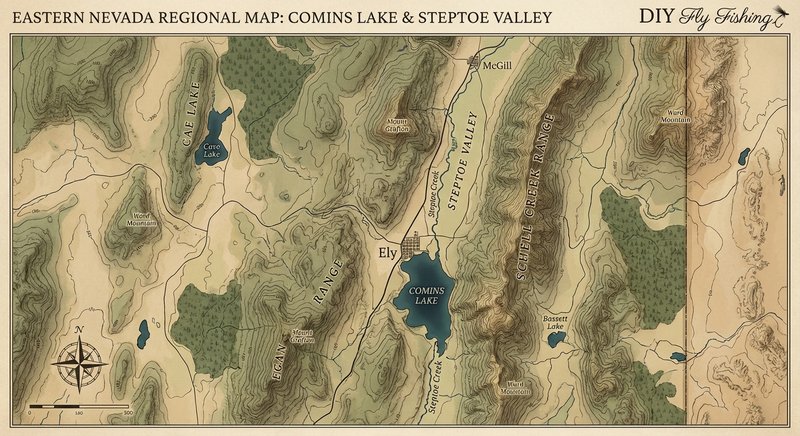
Comins Lake
Fly fishing in Nevada · intermediate · Best seasons: spring, fall
Target Species
Rainbow Trout, Tiger Trout
About This Water
Wildlife management area lake with quality trout. Special regulations enhance fishing.
Fishing Recommendations
As a guide who has spent significant time in the high desert of the Great Basin, I can tell you that Comins Lake is one of the greatest "comeback stories" in Western fly fishing. Located just south of Ely, Nevada, at an elevation of about 6,600 feet, this is a nutrient-rich, productive "factory" for trophy-sized trout.
Here is your comprehensive guide to fishing Comins Lake.
🎣 Location Overview
Comins Lake is a high-altitude desert impoundment characterized by its vast weed beds, alkaline water, and incredible growth rates. What makes it special is the biomass. Because the water is alkaline and relatively shallow, it produces a massive amount of aquatic insects and crustaceans.
Anglers love Comins because it offers a legitimate chance at a 20-plus inch Rainbow or Tiger Trout on any given cast. After a successful restoration project by the Nevada Department of Wildlife (NDOW) to remove invasive Northern Pike, the lake has regained its status as a premier "stillwater" destination. It is surrounded by the stunning scenery of the Schell Creek Range, offering a rugged, quiet, and uniquely Nevadan fishing experience.
🐟 Target Species & Behavior
- Rainbow Trout: These fish grow exceptionally fast here. They are known for being thick-bodied and hard-fighting. They primarily cruise the edges of weed beds looking for scuds, midges, and damselflies.
- Tiger Trout: A sterile hybrid of a Brook Trout and a Brown Trout. They are the "enforcers" of Comins. Tigers are highly aggressive and more piscivorous (fish-eating) than the Rainbows. They love to patrol the drop-offs and will often ambush streamers from the shadows of the weeds.
- Behavior: Because the lake is shallow (averaging 10–14 feet in most fishing areas), the fish are light-sensitive. On bright days, they hold deep in the weeds; on overcast days or during "magic hour," they move into the shallows to hunt.
📅 Best Times to Fish
- Spring (Late March – June): This is the gold standard. As soon as the ice melts (usually late March), the fish are hungry and active. The "Damselfly Hatch" in June is legendary and provides some of the best fishing of the year.
- Fall (September – November): As water temperatures drop, the fish go on a feeding binge to prepare for winter. The Tiger Trout become especially aggressive during this window.
- Best Time of Day: Early morning (first light) and the two hours before sunset are most productive. However, in the spring, the midday sun can actually trigger midge hatches and move fish into the feeding lane.
- Avoid: Mid-to-late summer (July/August). The lake gets very weedy, and water temperatures can stress the trout.
🪰 Recommended Flies & Techniques
Techniques
- Indicator Nymphing: The most consistent producer. Suspend your flies 12–24 inches above the top of the weed beds.
- The "Slow Strip": Using an intermediate sinking line, crawl a damselfly nymph or scud pattern just over the vegetation.
- Streamer Barking: For the Tiger Trout, use a sinking line and an erratic "strip-strip-pause" retrieve.
Top Fly Patterns
- Scuds: This is the primary forage. Use Ray Charles or UV Scuds in shades of orange, pink, or olive (#14–16).
- Midges: Zebra Midges (black/silver or red/silver) and Chironomids (#16–20) are essential for indicator rigs.
- Damselflies: Marabou Damsels (olive) with gold beads. These are deadly in June.
- Leeches/Streamers: Balanced Leeches (black, peacock, or "bruiser" purple/black) under an indicator. For Tigers, try Woolly Buggers or Game Changers in white or perch patterns.
💡 Pro Tips & Local Knowledge
- Get Off the Shore: While you can catch fish from the bank near the boat ramp or the highway side, the weeds make it difficult. A float tube, kayak, or pontoon boat is a massive advantage. It allows you to fish the "outside" edge of the weed lines where the big fish cruise.
- The Wind is Your Friend (To a Point): Don't be afraid of a little chop on the water. It breaks up the surface, makes the fish less wary, and pushes food toward the windward shore. If the wind is blowing into a bank, fish that bank!
- The "Hang": When nymphing under an indicator, if it twitches or goes under, count to one and set the hook firmly. The fish here often "sip" midges, but when they hit a leech, they move.
- Stealth Matters: The water at Comins can be quite clear. Use fluorocarbon tippet (4X or 5X) to ensure the fish don't see your line in the bright desert sun.
⚠️ Important Information
- Access: The lake is easily accessed via US-93/50. There is a developed boat ramp and several pull-outs on the west side of the lake.
- Regulations: A valid Nevada fishing license is required. Always check current NDOW regulations for bag limits, though Catch and Release is strongly encouraged to maintain the trophy quality of the fishery.
- Invasive Species: Nevada is strict about Aquatic Invasive Species (AIS). Ensure your boat, waders, and gear are Clean, Drain, and Dry before and after visiting to prevent the spread of quagga mussels.
- Weather: This is high-desert country. Weather can turn from 70°F and sunny to a freezing windstorm in 30 minutes. Bring layers and plenty of water.
Guide’s Final Word: Comins Lake isn't about catching 50 small fish; it's about the quality of the hunt. Stay patient, watch the weed lines, and hold on tight—the Tigers here hit like a freight train.
Bug Hatches & Matching Flies
| Hatch | Type | Peak months | Time of day | Hook sizes | Matching flies |
|---|---|---|---|---|---|
| Chironomids (Midges) Chironomidae | midge | April, May, September, October | All Day | #12-20 | Zebra Midge #16-20, Ice Midge #12-14, Griffith's Gnat #18-22 |
| Callibaetis Callibaetis nigritus | mayfly | June, July, August | Morning/Afternoon | #12-16 | Parachute Adams #14-16, Callibaetis Nymph #14-16, Mercer's Poxyback Callibaetis #14-16 |
| Damselfly Enallagma spp. | odonate | June, July | Morning/Afternoon | #10-14 | Marabou Damsel Nymph #10-12, Adult Damsel #12-14, Braided Butt Damsel #12 |
| Scud Gammarus lacustris | crustacean | March, April, October, November | All Day | #12-16 | Ray Charles #14-16, Olive Scud #12-16, Orange Scud #14-16 |
| Water Boatman Corixidae | terrestrial | September, October | Afternoon | #14-18 | Prince Nymph #14-18, Water Boatman #14-16 |
| Dragonfly Anisoptera | odonate | July, August | Afternoon | #4-10 | Kaufmann's Lake Dragon #6-10, Olive Wooly Bugger #4-10 |
| Grasshoppers Acrididae | terrestrial | August, September | Afternoon | #8-12 | Chernobyl Ant #8-12, Joe's Hopper #10-12, Morrish Hopper #10-12 |
| Caddis Hydropsyche spp. | caddis | June, July | Evening | #14-18 | Elk Hair Caddis #14-18, LaFontaine's Deep Sparkle Pupa #14-16 |