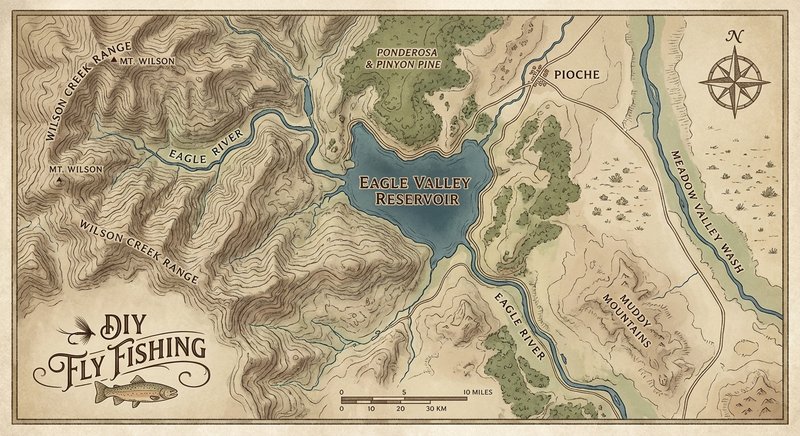
Eagle Valley Reservoir
Fly fishing in Nevada · beginner · Best seasons: spring, fall
Target Species
Rainbow Trout
About This Water
Central Nevada reservoir with stocked trout. Easy access near Pioche.
Fishing Recommendations
Welcome to Eagle Valley Reservoir, a true oasis in the high desert of Lincoln County, Nevada. As your guide, I can tell you that while Nevada is often associated with neon lights or barren sand, this fishery—located within Spring Valley State Park—is one of the most consistent and scenic trout destinations in the Silver State.
Here is your comprehensive guide to fly fishing Eagle Valley Reservoir.
🎣 Location Overview
Eagle Valley Reservoir is a 65-acre impoundment situated at an elevation of approximately 5,900 feet. Surrounded by stunning volcanic rock formations and rolling hills, it serves as the centerpiece of Spring Valley State Park.
What makes this water special is its accessibility and the contrast of its lush environment against the rugged Nevada landscape. The water is generally clear, with extensive weed beds forming in the shallower bays during the warmer months. It offers a classic "stillwater" experience where both shore anglers and float-tubers can find success. It’s a "quality over quantity" destination where the fish are healthy, hard-fighting, and beautifully colored.
🐟 Target Species & Behavior
The primary draw here is the Rainbow Trout. The Nevada Department of Wildlife (NDOW) stocks this water heavily, but because of the rich insect life, these fish "wild up" quickly.
- Rainbow Trout: These fish tend to cruise the littoral zones (near the shore) looking for easy meals. In the morning and evening, they will move into the shallows to feed on midge clusters and callibaetis.
- Tiger Trout: In recent years, NDOW has stocked Tiger Trout (a Brook/Brown hybrid). These are aggressive predators. Unlike the Rainbows, Tigers often hold tight to structure—like the submerged rock faces or the edges of heavy weed beds—waiting to ambush smaller fish.
- Behavior: During the spring and fall, the trout are highly active in the top 5–10 feet of the water column. They follow the "edge effect," patrolling where the weed line meets open water.
📅 Best Times to Fish
Optimal Seasons
- Spring (March – May): This is the prime window. As the ice melts and the water warms into the 45–55°F range, the fish become incredibly active. This coincides with the first major midge and callibaetis hatches of the year.
- Fall (September – November): As the summer heat fades, the water "turns over," and trout return to the shallows to bulk up for winter. The colors of the surrounding canyon turn golden, and the fish are often at their heaviest.
Best Times of Day
- Early Morning: From dawn until the sun hits the water is peak time for streamers and midge pupa.
- Late Afternoon/Dusk: This is when you’ll see the most surface activity. The "evening rise" at Eagle Valley can be spectacular during a calm spring sunset.
🪰 Recommended Flies & Techniques
Top Fly Patterns
- Midges: Zebra Midges (size 18–22) in black/silver or red/gold.
- Nymphs: Hare’s Ear, Pheasant Tail, and Prince Nymphs (size 14–16).
- Streamers: Woolly Buggers (size 8–12) in Olive, Black, or Thin Mint. The "Damselfly Nymph" is also a local killer.
- Dry Flies: Parachute Adams, Griffith’s Gnat, and Callibaetis Sparkle Duns (size 16–20).
Effective Techniques
- The Indicator Rig: Suspend a Zebra Midge or a small Pheasant Tail 4–7 feet below a strike indicator. This is the most effective way to fish the reservoir. Let the wind provide the movement; the subtle "chop" on the water gives the fly a lifelike dance.
- The Slow Strip: Use an intermediate sinking line with a Woolly Bugger or a Damsel Nymph. Cast toward the weed edges and use a very slow, rhythmic "figure-eight" retrieve or short 2-inch strips.
- Dry-Dropper: During a hatch, use a high-visibility Parachute Adams as your "buoy" and drop a small midge pupa 18 inches below it.
💡 Pro Tips & Local Knowledge
- The Tufa Formations: Fish the areas near the white volcanic rock formations on the eastern shore. These rocks provide unique underwater contours where fish like to hold.
- The North End Inlet: Where the creek enters the reservoir at the north end is a hotspot, especially in the spring. The moving water brings in higher oxygen levels and a conveyor belt of food.
- Float Tubes are King: While shore fishing is good near the dam and the pier, a float tube or kayak allows you to reach the "honey holes" on the far western bank that are inaccessible by foot.
- Watch the Wind: Eagle Valley can get breezy in the afternoon. If the wind picks up, don't pack up—move to the "windward" shore. The wind pushes plankton and insects toward that bank, and the trout follow the food.
⚠️ Important Information
- Access: Entry is via Spring Valley State Park (about 20 miles east of Pioche, NV). There is a day-use vehicle fee.
- Regulations: A valid Nevada Fishing License is required. You can purchase these online via the NDOW website. Ensure you check the current "Nevada Fishing Guide" for any seasonal limit changes.
- Facilities: The park has excellent camping facilities, clean restrooms, and a boat ramp.
- Cell Service: Be prepared for limited to no cell service in the canyon. Download your maps and licenses for offline use before you leave Pioche.
Guide’s Final Word: Eagle Valley is a "rhythm" water. Take five minutes to sit on the bank and watch the water before you rig up. Look for the dimples of rising fish or the flash of a flank near the weeds. Match your speed to the mood of the fish, and you’ll have a world-class day in the Nevada desert.
Bug Hatches & Matching Flies
| Hatch | Type | Peak months | Time of day | Hook sizes | Matching flies |
|---|---|---|---|---|---|
| Chironomids (Midges) Chironomidae | midge | March, April, May, September, October | All Day | #12-22 | Zebra Midge #16-20, Ice Cream Cone #12-16, Griffith's Gnat #18-22 |
| Callibaetis (Speckled Duns) Callibaetis spp. | mayfly | May, June, August, September | Late Morning/Afternoon | #12-16 | Adams #14-16, Callibaetis Nymph #14-16, Quigley's Cripple #14-16 |
| Damselflies Enallagma spp. | terrestrial | June, July | Late Morning/Afternoon | #10-14 | Marabou Damsel Nymph #10-12, Adult Damsel #12-14 |
| Scuds (Freshwater Shrimp) Gammarus spp. | crustacean | April, May, September, October | All Day | #12-18 | Ray Charles #14-16, Flashback Scud #12-18 |
| Cinnamon Caddis Hesperophylax spp. | caddis | July, August, September | Evening | #12-16 | Elk Hair Caddis #14-16, LaFontaine's Deep Pupa #14-16 |
| Water Boatmen Corixidae | terrestrial | September, October | All Day | #14-18 | Water Boatman #14-16, Prince Nymph #14-18 |
| Terrestrial Ants and Beetles Formicidae / Coleoptera | terrestrial | July, August | Afternoon | #12-18 | Cinnamon Ant #14-18, Foam Beetle #12-16 |
| Dragonflies Anisoptera | terrestrial | June, July, August | Daylight | #4-10 | Olive Woolly Bugger #6-10, Dragonfly Nymph #8-10 |