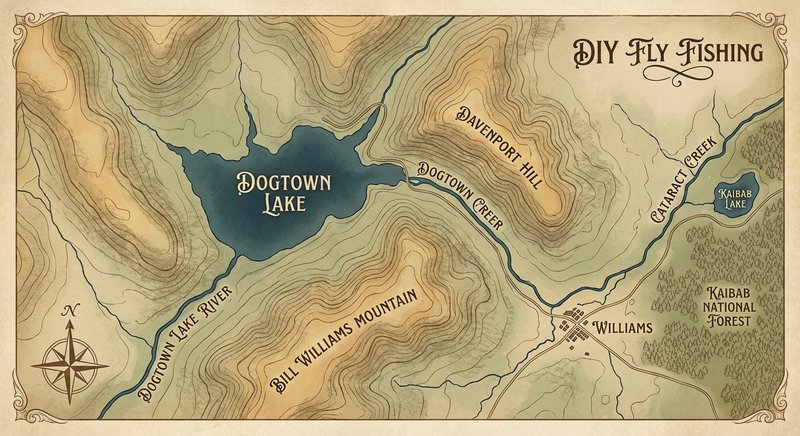
Dogtown Lake
Fly fishing in Arizona · beginner · Best seasons: spring, summer, fall
Target Species
Rainbow Trout, Brown Trout
About This Water
Williams area lake with excellent trout fishing. Forest Service recreation area.
Fishing Recommendations
As an expert guide familiar with the high-country waters of the Southwest, I can tell you that Dogtown Lake is one of the "crown jewels" of the Williams area. Located at approximately 7,000 feet in the Kaibab National Forest, this 50-acre reservoir offers a classic alpine fishing experience surrounded by ponderosa pines and a stunning view of Bill Williams Mountain.
Here is your comprehensive guide to fly fishing Dogtown Lake.
🎣 Location Overview
Dogtown Lake is a quintessential "high-desert" mountain lake. Unlike the rushing freestones of the White Mountains, Dogtown is a stillwater environment characterized by relatively shallow depths (averaging 10–15 feet) and rich aquatic vegetation.
What makes it special is its productivity. Because it is shallower and warmer than some of the deeper rim lakes, it has a massive biomass of insects. For the fly angler, this means the fish are often looking for specific hatches rather than just opportunistically grabbing whatever floats by. It is a "quiet" lake—electric motors only—making it a sanctuary for float tubers and kayakers.
🐟 Target Species & Behavior
- Rainbow Trout: These are the primary residents. The Arizona Game and Fish Department (AZGFD) stocks them regularly. You’ll find "stockers" (10–12 inches) that are aggressive, but there are always holdovers that reach the 16–18 inch range. They tend to cruise the littoral zones (where the sunlight hits the bottom) looking for midges and scuds.
- Brown Trout: The "ghosts" of Dogtown. Browns here are less frequent but grow significantly larger. They are structure-oriented and light-sensitive. They tend to hold deeper during the day or bury themselves in the heavy weed beds, coming out to hunt along the shoreline shadows during low-light hours.
- Feeding Habits: The trout here are "bottom feeders" by necessity. Their diet consists heavily of Chironomids (midges), Damsel fly nymphs, Scuds (freshwater shrimp), and the occasional Crayfish.
📅 Best Times to Fish
- Spring (April – June): This is prime time. As the ice melts and the water warms, the trout become extremely active. The Damselfly migration in late May and June provides some of the most exciting fishing of the year.
- Summer (July – August): Fishing remains good but requires a shift in tactics. High noon can be tough; the fish retreat to the deepest water near the dam. Focus on the "Monsoon" afternoons when cloud cover cools the surface.
- Fall (September – November): This is the best window for Brown Trout. As temperatures drop, Browns become aggressive in preparation for spawning. The lake crowds thin out, and the fish move back into the shallows.
- Prime Windows: The "Golden Hour" (first and last 90 minutes of light) is non-negotiable here. Mid-day is often slow unless there is significant cloud cover or wind chop to break up the surface.
🪰 Recommended Flies & Techniques
Top Fly Patterns
- Chironomids: Size 14–18. Zebra Midges (black/silver, red/silver) and "Ice Candy" patterns.
- Damselflies: Size 10–14. Marabou Damsel nymphs in olive or bright green.
- Woolly Buggers: Size 8–12. Thin Mint, Olive, or Rusty Brown (to mimic crayfish).
- Scuds: Size 14–16. Pale olive or pinkish-orange.
- Dry Flies: Size 14–16. Parachute Adams or Griffith's Gnat (for evening midge clusters).
Effective Techniques
- The "Static" Midge Rig: Use a long leader (12–15 feet) and a strike indicator. Suspend a Zebra Midge or Scud about 12 inches off the bottom. If there is a slight chop on the water, let the waves provide the action.
- The "Damsel Strip": Use an intermediate (slow-sink) line. Cast toward the weed edges and use a short, erratic "inchworm" strip. This mimics the swimming motion of a damselfly nymph heading to shore to emerge.
- The Deep Crawl: For Brown Trout, use a weighted Woolly Bugger on a sink-tip line. Retrieve it very slowly along the rocky edges near the dam.
💡 Pro Tips & Local Knowledge
- Get off the bank: While you can catch fish from the shore near the pier, Dogtown is heavily weeded. A float tube, kayak, or small boat is a massive advantage. It allows you to fish the "edge" where the weeds drop off into deeper water—this is where the big fish cruise.
- The "Dogtown Chop": If the water is glass-calm, the fish are very spooky. A light breeze that creates a "chop" on the surface is your best friend; it hides your leader and allows you to get closer to the fish.
- Watch the Dam: The deepest water is near the dam structure. During the heat of the summer, the trout will congregate in the "bathtub" right in front of the dam.
- Crayfish Factor: There are many crayfish in this lake. If you aren't getting hits on nymphs, switch to a burnt-orange or rusty-brown streamer and bounce it along the bottom.
⚠️ Important Information
- Access: Located about 6 miles south of Williams. Take FR 141 to FR 132. The road is generally well-maintained but can be muddy after heavy rains.
- Regulations: A valid Arizona Fishing License is required. Dogtown is subject to standard state regulations (check the latest AZGFD booklet for bag limits, though most fly anglers practice Catch & Release).
- Boating: No internal combustion engines. Electric motors only.
- Amenities: There is a developed campground (Dogtown Lake Campground) which is excellent, but it fills up fast in the summer—reserve ahead of time via Recreation.gov.
- Special Consideration: This is high country. Weather changes rapidly. Always carry a rain jacket and be prepared to get off the water if you hear thunder; lightning is a serious risk for an angler holding a graphite rod on open water.
Tight lines, and enjoy the peace of the Kaibab!
Bug Hatches & Matching Flies
| Hatch | Type | Peak months | Time of day | Hook sizes | Matching flies |
|---|---|---|---|---|---|
| Chironomids (Midges) Chironomidae | midge | April, May, June, September | All Day | #14-22 | Zebra Midge #18-20, Ice Cream Cone #14-16, Griffith's Gnat #18-22 |
| Callibaetis (Speckled Duns) Callibaetis ferrugineus | mayfly | May, June, July, August | Late Morning/Early Afternoon | #12-16 | Callibaetis Spinner #14-16, Pheasant Tail #14-16, Hares Ear #12-16 |
| Damselflies Enallagma spp. | terrestrial | June, July | Morning/Afternoon | #10-14 | Marabou Damsel #10-12, Adult Damsel #12-14, Swimming Damsel Nymph #12-14 |
| Cinnamon Caddis Hesperophylax designatus | caddis | July, August | Evening | #12-16 | Elk Hair Caddis (Cinnamon) #14-16, Pupa Emerger #14-16, Soft Hackle Hare's Ear #14-16 |
| Dragonflies Anisoptera | terrestrial | June, July, August | Afternoon | #4-10 | Dragonfly Nymph #6-10, Woolly Bugger (Olive/Brown) #4-8 |
| Water Boatmen & Backswimmers Corixidae / Notonectidae | terrestrial | September, October | Full Sun/Afternoon | #14-18 | Water Boatman #14-18, Prince Nymph #14-16 |
| Terrestrial Ants and Beetles Formicidae / Coleoptera | terrestrial | July, August, September | Afternoon | #12-18 | Black Foam Ant #14-16, Peacock Beetle #14-18, Chernobyl Ant #10-12 |
| Scuds (Freshwater Shrimp) Gammarus | terrestrial | April, May, October, November | All Day | #12-18 | Ray Charles #14-16, Flashback Scud (Olive/Orange) #12-18 |