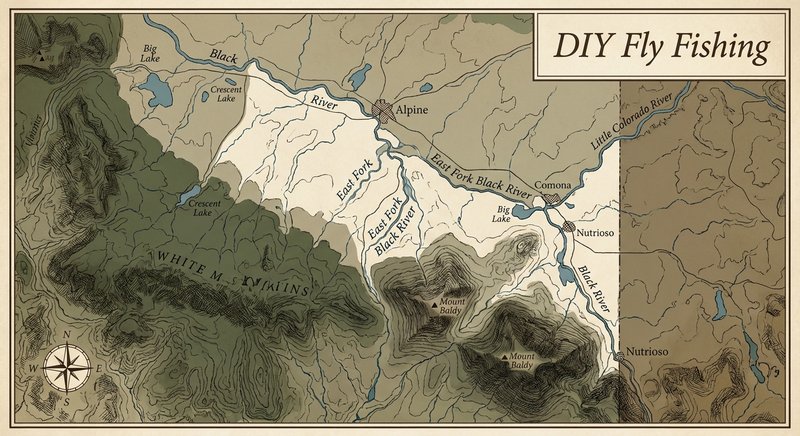
East Fork Black River
Fly fishing in Arizona · advanced · Best seasons: summer
Target Species
Apache Trout
About This Water
High elevation stream with native Apache trout. Wilderness fishing experience.
Fishing Recommendations
Welcome to the high country of the White Mountains. As your guide, I can tell you that the East Fork of the Black River is one of the crown jewels of Arizona fly fishing. It offers a quintessential small-stream mountain experience: cold water, stunning scenery, and the opportunity to catch a fish found nowhere else on Earth.
Here is your comprehensive guide to fishing the East Fork.
🎣 Location Overview
The East Fork of the Black River is a high-altitude gem located in the Apache-Sitgreaves National Forest near the towns of Greer and Alpine. Flowing at elevations between 8,000 and 9,500 feet, this is a classic "blue ribbon" mountain stream.
What makes it special is the diversity of the water. You’ll find high-gradient "pocket water" where the river tumbles over volcanic boulders, alternating with lush, meandering meadow stretches. The water is gin-clear, and the surroundings are a mix of ponderosa pine, aspen groves, and open alpine valleys. Anglers love it because it offers a sense of solitude and a chance to pursue the rare Apache Trout in its native habitat.
🐟 Target Species & Behavior
The primary draw here is the Apache Trout, Arizona’s state fish. While there are also Brown Trout and occasional Rainbows, the native Apache is the star.
- Behavior: Apache Trout are opportunistic but can be incredibly "spooky." In the thin, clear water of the East Fork, they have excellent vision. They are most active when the sun is off the water or during the "monsoon" cloud cover.
- Holding Patterns: Look for them in the "cushion" in front of large boulders, the tail-outs of deep pools, and under undercut banks in the meadow sections. In the faster pocket water, they will sit in the small, quiet eddies behind rocks.
- Feeding: They are highly insectivorous. In the summer, they transition from aquatic larvae to a heavy diet of terrestrials (ants, beetles, and hoppers).
📅 Best Times to Fish
- Optimal Months: June through September. June offers great dry fly action before the rains. July and August are "Monsoon Season," which brings life to the river but requires a watchful eye on the weather.
- Best Time of Day: During the heat of summer, the "magic hour" is from dawn until 10:00 AM and again from 4:00 PM until dusk.
- Prime Conditions: Overcast days are gold on the Black River. The lower light levels embolden the larger fish to leave their undercut banks and feed in the open.
🪰 Recommended Flies & Techniques
Small stream tactics are the name of the game here. Leave the 6-weight at home; a 3-weight or 4-weight rod (7'6" to 8'6") is perfect.
Top Fly Patterns
- Dry Flies: Parachute Adams (#14–18), Elk Hair Caddis (#14–16), and Royal Wulff (#14–16).
- Terrestrials: Dave’s Hopper (#10–12), Foam Beetles (#16), and Carpenter Ants (#16).
- Nymphs: Gold-Ribbed Hare’s Ear (#16–18), Pheasant Tail (#16–20), and Prince Nymphs (#14–16).
Effective Techniques
- Dry-Dropper: This is the most effective summer setup. Run a buoyant foam hopper or a Royal Wulff on top, with a small Pheasant Tail nymph tied 18–24 inches below on 5X or 6X tippet.
- The "Dapping" Approach: In the brushy meadow sections, you often can't make a traditional cast. Sneak up to the bank on your knees and simply drop the fly over the edge.
- Upstream Presentation: Always fish upstream. Because the water is so clear, if you fish downstream, the fish will see you before you see them.
💡 Pro Tips & Local Knowledge
- The "Stealth" Factor: Wear drab colors (camo, olive, or tan). If you can see the fish, they have likely already seen you. Use the boulders and trees as cover to break up your silhouette.
- Focus on the Pockets: Many anglers spend too much time at the large, obvious pools near the campgrounds (like Buffalo Crossing). The real trophies are often in the "pocket water"—the small 2-foot-wide soft spots between rapids that most people walk past.
- The Monsoon Buffet: When the afternoon thunderstorms hit in July and August, they wash thousands of ants and beetles into the river. If the rain is light, stay on the water! The fish go into a feeding frenzy. If the water turns "chocolate milk" brown, it’s time to head to the cabin.
- Hike to Escape: Walk at least a half-mile away from any bridge or developed campground (like Diamond Rock). The fishing quality improves exponentially with every step away from the road.
⚠️ Important Information
- Access: Access is primarily via Forest Road 249 and FR 276. The roads are gravel and can be washboarded; a high-clearance vehicle is recommended but not always necessary.
- Regulations: The East Fork has specific reaches with different rules. Much of it is Catch and Release only for Apache Trout, and most of the river is Artificial Fly and Lure Only. Always check the current Arizona Game and Fish Department (AZGFD) regulations before your trip.
- Tribal Lands: Be aware that the river borders the White Mountain Apache Tribe reservation. If you cross onto tribal land, you must have a specific tribal fishing permit. The boundaries are generally marked, but a GPS map (like onX) is highly recommended.
- Safety: You are in bear and wolf country. Keep a clean camp. Also, at 9,000 feet, lightning is a serious threat during summer afternoons—if you hear thunder, get off the water immediately.
Tight lines, and enjoy the pursuit of the Arizona native!
Bug Hatches & Matching Flies
| Hatch | Type | Peak months | Time of day | Hook sizes | Matching flies |
|---|---|---|---|---|---|
| Blue Winged Olive Baetis | mayfly | April, May, September, October | Late Morning/Afternoon | #18-22 | Parachute Adams #18-22, RS2 #20-22, Pheasant Tail #18-20 |
| Pale Morning Dun Ephemerella | mayfly | June, July | Late Morning/Early Afternoon | #14-18 | PMD Sparkle Dun #16-18, Mercer's PMD Trigger #16, Frenchie #14-16 |
| Golden Stonefly Hesperoperla pacifica | stonefly | June, July | Morning/Evening | #8-12 | Pat's Rubber Leg #8-12, Rogue River Stone #8-10, Golden Stone Nymph #10 |
| Spotted Sedge Hydropsyche | caddis | May, June, July, August | Evening | #14-18 | Elk Hair Caddis #14-16, LaFontaine's Deep Sparkle Pupa #16, Peacock Caddis #16-18 |
| Yellow Sally Isoperla | stonefly | June, July, August | Afternoon/Evening | #14-16 | Yellow Sally Dry #14-16, Iron Lotus #16, Stimulator (Yellow) #14-16 |
| Terrestrials | terrestrial | July, August, September | All Day | #10-16 | Morrish Hopper #10-12, Black Foam Ant #14-16, Grapehead Beetle #12-14 |
| Trico Tricorythodes | mayfly | August, September | Early Morning | #20-24 | Trico Spinner #20-24, Zebra Midge #20-22, Griffith's Gnat #20-22 |
| Midges Chironomidae | midge | March, April, October, November | All Day | #18-24 | Zebra Midge (Red/Black) #18-22, Morgan's Midge #20-22, Top Secret Midge #20-22 |