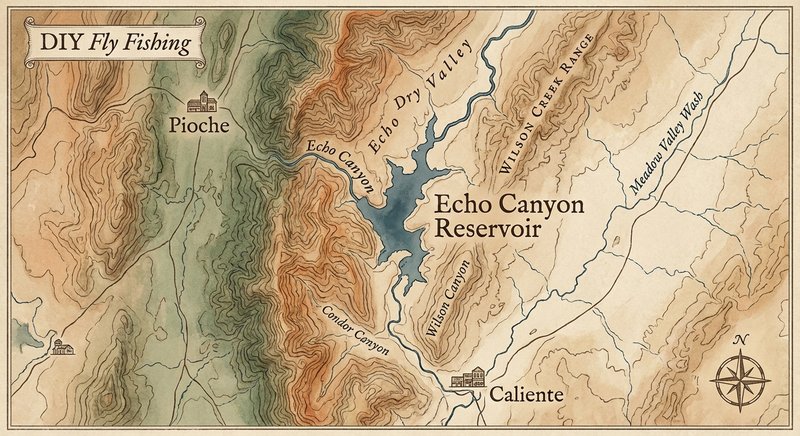
Echo Canyon Reservoir
Fly fishing in Nevada · beginner · Best seasons: spring, fall
Target Species
Rainbow Trout
About This Water
State park reservoir with rainbow trout. Eastern Nevada destination with camping.
Fishing Recommendations
Welcome to the high desert oasis of Eastern Nevada. As your guide, I’m excited to walk you through Echo Canyon Reservoir. Located near Pioche in Lincoln County, this 65-acre reservoir is a gem of the state park system. It offers a classic Great Basin fishing experience: rugged volcanic cliffs, clear desert air, and surprisingly productive waters.
Here is your comprehensive guide to fly fishing Echo Canyon Reservoir.
🎣 Location Overview
Echo Canyon Reservoir is a man-made impoundment surrounded by the striking orange and brown rock formations of the Meadow Valley Wash. What makes it special is the contrast between the arid, sagebrush-covered hills and the life-giving water that holds a healthy population of trout.
The water is generally clear to slightly stained, depending on the spring runoff. Because it is an irrigation reservoir, the water levels can fluctuate, but the Nevada Department of Wildlife (NDOW) manages it heavily as a cold-water fishery. Anglers love it for its accessibility and the fact that it rarely feels "overcrowded" compared to waters closer to Las Vegas or Reno.
🐟 Target Species & Behavior
The primary draw here is the Rainbow Trout.
- Behavior: These are largely stocked fish, but they naturalize quickly. In the spring, they are aggressive and cruise the shorelines looking for food after the winter doldrums. In the fall, they pack on weight for the winter.
- Holding Patterns: Look for fish near the dam face (where the water is deepest), along the northern shoreline where the old creek channel once ran, and near any submerged vegetation.
- Feeding: Their diet consists mainly of midges, damselfly nymphs, scuds, and small baitfish (leech patterns are highly effective here).
📅 Best Times to Fish
Optimal Seasons: Spring and Fall
- Spring (March – May): This is the prime window. As the water warms to the 50°F range, the trout become highly active. The "ice-off" period (if applicable) often triggers a feeding frenzy.
- Fall (Late September – November): As temperatures drop, trout move from the deep holes back into the shallows. The colors of the canyon walls during this time are spectacular.
Best Times of Day
- Early Morning: The first two hours of light are often glass-calm, perfect for spotting rising fish.
- Dusk: A frantic midge hatch often occurs right as the sun dips behind the canyon walls.
Prime Conditions
Overcast days are a secret weapon here. The lack of shadows makes the trout feel secure enough to cruise the shallow flats near the boat ramp and the upper end of the reservoir.
🪰 Recommended Flies & Techniques
Top Fly Patterns
- Nymphs:
- Zebra Midge (Size 18-22) in black/silver or red.
- Hare’s Ear or Pheasant Tail (Size 14-16).
- Pale Olive Damselfly Nymphs (Size 12-14) — a local staple.
- Streamers:
- Woolly Buggers (Size 8-12) in Olive, Black, or Brown.
- Balanced Leeches (Size 10-12) in "Bruised" or Black/Red.
- Dry Flies:
- Griffith’s Gnat (Size 20) for midge clusters.
- Parachute Adams (Size 16-18) for general hatches.
Effective Techniques
- The Indicator Rig: Hang a Zebra Midge or a Scut 4–6 feet under a small indicator. On windy days, the "chop" on the water gives the fly a natural lifelike movement.
- The "Slow Strip": Using an intermediate sinking line, cast a Woolly Bugger or Damselfly nymph toward the weed edges and retrieve with very slow, 2-inch tugs.
- The Balanced Leech: This is deadly here. Fishing a balanced leech under an indicator allows the fly to sit horizontally, mimicking a swimming leech perfectly.
💡 Pro Tips & Local Knowledge
- Bring a Float Tube: While you can fish from the shore near the dam and the campground, the best fishing is accessed by water. A float tube or kayak allows you to reach the old creek channel and fish the edges of the weed beds that shore anglers can’t reach.
- The "Inflow" Secret: At the upper (East) end of the reservoir where the creek enters, the water is more oxygenated. If the main lake is slow, head to the inflow; trout often stack up there.
- Wind Management: The canyon can act as a wind tunnel. If the wind picks up, move to the leeward side of the cliffs or use a heavier sinking line to get your flies beneath the surface turbulence.
⚠️ Important Information
- Access: Echo Canyon State Park is about 12 miles east of Pioche via NV-322. There is a nominal day-use fee to enter the park.
- Regulations: Nevada fishing regulations apply. Ensure you have a valid Nevada Fishing License. There is a limit on trout (typically 5), but check the current NDOW guidebook for any emergency closures or limit changes.
- Amenities: The state park offers excellent camping with hookups, restrooms, and a dump station. It’s a great "base camp" for exploring other nearby waters like Eagle Valley Reservoir.
- Safety: This is remote country. Cell service can be spotty. Always carry water and be mindful of the desert sun, even in the "cool" seasons.
Guide’s Final Word: Echo Canyon is a place of quiet beauty. Slow down your retrieve, watch the canyon walls for bighorn sheep, and keep your fly in the water—the rainbows here are more than willing to play!
Bug Hatches & Matching Flies
| Hatch | Type | Peak months | Time of day | Hook sizes | Matching flies |
|---|---|---|---|---|---|
| Chironomids Chironomidae | midge | March, April, May | All Day | #12-22 | Zebra Midge #16-20, Ice Cream Cone #12-16, Griffith's Gnat #18-22 |
| Speckled Dun Callibaetis spp. | mayfly | May, June, September | Morning/Afternoon | #12-16 | Callibaetis Spinner #14-16, Hare's Ear Nymph #14-16, Parachute Adams #14-18 |
| Cinnamon Sedge Limnephilidae | caddis | June, July, August | Evening | #12-16 | Elk Hair Caddis #14-16, LaFontaine's Deep Sparkle Pupa #14-16, Peacock Caddis #16 |
| Damselfly Enallagma spp. | terrestrial | June, July | Morning/Afternoon | #10-14 | Marabou Damsel Nymph #10-12, Adult Damselfly #12-14, Braided Butt Damsel #12 |
| Grasshoppers Acrididae | terrestrial | July, August, September | Afternoon | #8-12 | Dave's Hopper #10-12, Morrish Hopper #8-12, Joe's Hopper #10-14 |
| Water Boatman Corixidae | midge | September, October | Afternoon | #14-18 | Water Boatman #14-16, Prince Nymph #14-18, Backswimmer #12-14 |
| Pale Morning Dun Ephemerella excrucians | mayfly | June, July | Morning | #16-18 | PMD Sparkle Dun #16-18, Pheasant Tail Nymph #16-20, Light Cahill #16 |
| Black Ants Formicidae | terrestrial | July, August | All Day | #16-20 | Black Foam Ant #16-20, Cinnamon Ant #18, Fur Ant #16 |