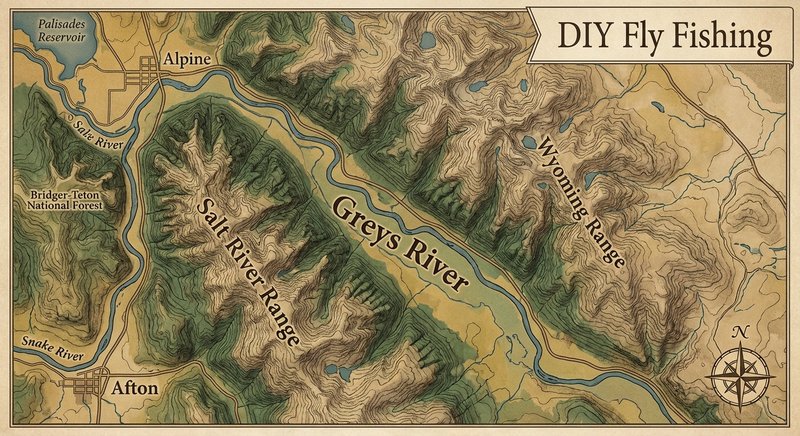
Greys River
Fly fishing in Wyoming · Intermediate · Best seasons: Summer, Fall
Target Species
Cutthroat Trout
About This Water
Remote western Wyoming stream with cutthroat trout. Scenic mountain fishing.
Fishing Recommendations
The Greys River in western Wyoming is arguably one of the most scenic and rewarding "freestone" rivers in the Rocky Mountains. Tucked between the Salt River Range and the Wyoming Range, this river offers over 60 miles of gravel-road access through a stunning, high-alpine valley. For the fly angler, the Greys represents the pinnacle of classic Western dry-fly fishing for native trout.
🎣 Location Overview
The Greys River is a crystal-clear, high-gradient mountain stream that flows north to join the Snake River at Alpine, Wyoming. It is a quintessential "pocket water" fishery, characterized by a steep drop, boulder gardens, riffles, and deep, turquoise-colored pools.
What makes the Greys special is its wildness. Unlike the nearby Snake or South Fork, there are no dams here; the river’s flow is dictated entirely by snowpack. It feels remote, rugged, and untouched. Anglers love it because it is one of the few places where you can consistently catch large, native Snake River Fine-Spotted Cutthroat trout on large dry flies in a setting that looks like a postcard.
🐟 Target Species & Behavior
The primary inhabitant is the Snake River Fine-Spotted Cutthroat Trout. You may also find occasional Brook Trout in the smaller tributaries and the very upper reaches.
- Aggressive Surface Feeders: These Cutthroats are famous for their willingness to rise to a dry fly. Because the growing season is short in this high-altitude environment, they cannot afford to be overly selective.
- Where They Hold: Look for "soft" water. In this fast-moving river, fish hold in the seams between fast and slow water, behind boulders (cushion water), and in the tail-outs of deep pools.
- Feeding Habits: They focus heavily on aquatic insects (Stoneflies, Mayflies, Caddis) but are also opportunistic, feeding on terrestrial insects like grasshoppers and ants during the heat of summer.
📅 Best Times to Fish
The Greys is a high-elevation river, meaning it is dictated by the spring runoff.
- Optimal Seasons:
- Summer (July – August): This is the prime window. Once the runoff subsides (usually by early July), the river clears, and the dry-fly action explodes.
- Fall (September – early October): The water is lower and colder, but the fish are hungry, preparing for winter. The fall colors in the canyon are world-class.
- Best Times of Day: In mid-summer, the "magic hour" is from 10:00 AM to 4:00 PM when the sun hits the water and triggers insect activity. In the fall, afternoons are best as the water warms slightly.
- Prime Conditions: Look for clear water. If there’s a heavy rainstorm, the Greys can "blow out" (become muddy) quickly due to its steep banks, but it also clears faster than most rivers.
🪰 Recommended Flies & Techniques
Top Fly Patterns
- Dry Flies:
- Attractors: Royal Wulff, Humpy (Red or Yellow), Chubby Chernobyl (Size 8-12).
- Match the Hatch: Parachute Adams (14-18), Elk Hair Caddis (14-16), PMD Sparkle Dun (16).
- Terrestrials: Amy’s Ant, Morrish Hopper, Black Flying Ants.
- Nymphs:
- Pat’s Rubber Legs (Brown/Black), Prince Nymph (12-14), Pheasant Tail (14-16).
- Streamers:
- Gold Ribbed Hare’s Ear or small Wooly Buggers (Olive or Black) for the deep pools.
Effective Techniques
- Dry-Dropper: This is the "bread and butter" on the Greys. Use a buoyant foam hopper or Chubby Chernobyl as your "indicator" and hang a weighted nymph (like a Copper John) 18-24 inches below it.
- Short-Line Nymphing: In the heavy pocket water, use a high-sticking technique to keep your line off the conflicting currents.
- The "Slow Rise": Cutthroats often track a fly for a few feet before sipping it. Don’t set the hook too fast; wait until the fish’s nose goes down.
💡 Pro Tips & Local Knowledge
- Keep Moving: The Greys rewards the mobile angler. If you don't get a strike in a hole after 10-15 minutes, move to the next one. The fish are distributed throughout the system.
- The Upper River vs. Lower River: The lower sections (closer to Alpine) have larger water and larger pools. The upper sections (above the Forest Service guard station) are smaller, tighter, and feel more like a meadow stream.
- Watch the Tributaries: Smaller creeks like Sheep Creek or Little Greys can be hidden gems during the peak of summer when the main stem is busy.
- The "Twitch": When using large attractor dries, a slight twitch can often trigger a strike from a territorial Cutthroat.
⚠️ Important Information
- Access: The Greys River Road (Forest Service Road 10132) follows the river for nearly its entire length. It is a gravel road that can be washboarded; a high-clearance vehicle is recommended, though not strictly required in dry weather.
- Regulations: You must have a valid Wyoming Fishing License. There are specific creel limits and tackle restrictions (certain sections may be catch-and-release or artificial flies/lures only). Always check the current Wyoming Game and Fish Department regulations.
- Safety (Bear Country): This is Grizzly and Black Bear country. Carry bear spray, keep it accessible, and know how to use it. If camping, maintain a "bear-aware" campsite.
- Wading: The Greys has a very slippery, rocky bottom. Felt-soled boots or studded boots and a wading staff are highly recommended.
Bug Hatches & Matching Flies
| Hatch | Type | Peak months | Time of day | Hook sizes | Matching flies |
|---|---|---|---|---|---|
| Salmonfly Pteronarcys californica | stonefly | June, July | Morning/Evening | #4-8 | Chubby Chernobyl (Orange) #6-10, Pats Rubber Legs (Black/Orange) #4-8, Cat's Meow #6-8 |
| Golden Stonefly Hesperoperla pacifica | stonefly | July | Afternoon/Evening | #8-12 | Golden Chubby #8-12, Water Walker (Golden) #10-12, Twenty Incher #10-14 |
| Green Drake Drunella doddsii | mayfly | July, August | Afternoon | #10-12 | Hackle Stacker Green Drake #10-12, Green Drake Cripple #12, Hare's Ear (Olive) #10-12 |
| Pale Morning Dun (PMD) Ephemerella excrucians | mayfly | July, August | Late Morning/Afternoon | #16-18 | CDC PMD Sparkle Dun #16-18, RS2 (PMD/Tan) #16-20, Pheasant Tail (Flashback) #16-18 |
| Blue Winged Olive (BWO) Baetis tricaudatus | mayfly | May, September, October | Afternoon | #18-22 | Parachute Adams #18-22, WD-40 #18-22, BWO CDC Cripple #18-20 |
| Yellow Sally Isoperla | stonefly | July, August | Late Afternoon/Evening | #14-16 | Yellow Sally Foam Stone #14-16, Little Yellow Sloan #16, Iron Lotus #16 |
| Spotted Sedge Hydropsyche | caddis | July, August, September | Evening | #14-16 | Elk Hair Caddis (Tan/Olive) #14-16, Peeking Caddis #14-16, LaFontaine Sparkle Pupa #16 |
| Grasshoppers Acrididae | terrestrial | August, September | Mid-day/Afternoon | #8-12 | Morrish Hopper #8-12, Parachute Hopper #10-14, Pantone Hopper #10-12 |
| Mother's Day Caddis Brachycentrus occidentalis | caddis | May | Afternoon | #14-16 | Grannom Caddis #14-16, Soft Hackle Hare's Ear #14-16 |