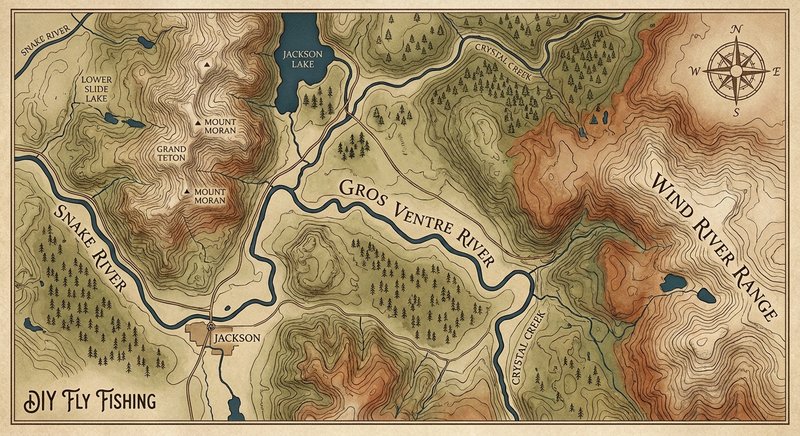
Gros Ventre River
Fly fishing in Wyoming · Intermediate · Best seasons: Summer, Fall
Target Species
Cutthroat Trout, Mountain Whitefish
About This Water
Snake River tributary with cutthroat and whitefish. Flows through elk refuge.
Fishing Recommendations
The Gros Ventre River (pronounced "Grow-Vont") is one of the crown jewels of the Greater Yellowstone Ecosystem. Flowing from the Gros Ventre Wilderness down into the Jackson Hole valley, it is a quintessential freestone river characterized by its stunning red rock canyons, sapphire water, and the dramatic backdrop of the Teton Range.
As your guide, I consider this "the" place for anglers who want to escape the drift boat traffic of the main Snake River and experience classic western wade fishing.
🎣 Location Overview
The Gros Ventre is a dynamic, high-gradient freestone river. It is famous for the "Lower Slide," where a massive 1925 landslide created Lower Slide Lake.
- Upper River: High-alpine meadow water and pocket water above the lake.
- Lower River: Below the lake, the river flows through a spectacular canyon and eventually meanders through cottonwood bottoms before joining the Snake River. What makes it special is the Snake River Fine-Spotted Cutthroat Trout. This specific subspecies is native only to this drainage. The river is wild, rugged, and offers a sense of solitude that is increasingly hard to find in the West.
🐟 Target Species & Behavior
Snake River Fine-Spotted Cutthroat
These are the stars of the show. Unlike the picky rainbows of the Henry’s Fork, these Cutties are famously opportunistic.
- Behavior: They are "surface-oriented" fish. They spend much of the summer looking up for terrestrials and stoneflies.
- Holding Water: They love structure. Look for them in "bucket" pockets behind boulders, along cut banks, and in the soft foam lines (the "seams") between fast and slow water.
- Feeding: They aren't particularly leader-shy, but they do require a natural drift.
Mountain Whitefish
Often overlooked but hard-fighting, Whitefish congregate in the deeper, slower pools.
- Feeding: They are almost exclusively subsurface feeders, keying in on small midge and mayfly nymphs.
📅 Best Times to Fish
Optimal Seasons
- Summer (Mid-July – August): This is the prime window. The river usually stays high and muddy from snowmelt (runoff) until early to mid-July. Once it clears, the "dry fly feast" begins.
- Fall (September – October): My personal favorite time. The cottonwoods turn gold, the crowds vanish, and the fish get aggressive before winter.
Best Times of Day
- Summer: 9:00 AM to 4:00 PM. You don't need to be there at dawn; wait for the sun to hit the water to activate the insects.
- Fall: 11:00 AM to 5:00 PM. The warmest part of the day triggers the best hatches (Mahoganies and Blue Winged Olives).
🪰 Recommended Flies & Techniques
Top Fly Patterns
- Dry Flies:
- Chubby Chernobyl (Size 8-12) in gold, red, or purple.
- Water Walker or Amy's Ant (Terrestrials are huge here).
- Parachute Adams (Size 14-18) for technical hatches.
- Nymphs:
- Pat’s Rubber Legs (Coffee/Black).
- Tactical Jig Pheasant Tails (Size 14-16).
- Zebra Midges (Red or Black) for Whitefish.
- Streamers:
- Gold Sparkle Minnow or Olive Wooly Bugger.
Techniques
- Dry-Dropper (The "Jackson Hole Special"): A large, buoyant foam dry fly (like a Chubby) with a 2-foot dropper to a weighted nymph. This covers both bases and acts as a bobber.
- Pocket Water High-Sticking: Keep as much fly line off the water as possible to avoid drag in the complex currents.
- Streamer Stripping: In the deeper canyon pools, swing a streamer through the tail-outs to find the larger 18"+ Cutthroats.
💡 Pro Tips & Local Knowledge
- The "Foam is Home" Rule: On the Gros Ventre, if you see a line of white bubbles, there is a fish under it. Cast directly into the foam.
- Avoid the "Big Slide" Water if it's Muddy: The red hills of the Gros Ventre are made of highly erosive clay. A small rainstorm can turn the lower river "chocolate milk" in an hour. If the lower river is blown out, head above Slide Lake where the water clears faster.
- Cover Ground: Don't stand in one hole for an hour. These fish are aggressive; if they haven't hit your fly in five good drifts, move 20 feet upstream to the next pocket.
- The "Twitch": When fishing large terrestrials (hoppers/ants), give the fly a tiny twitch just as it enters a soft eddy. It often triggers a violent strike from a Cutthroat.
⚠️ Important Information
Access
- Gros Ventre Road: This road follows the river for miles. There are numerous pull-outs.
- The Canyon Stretch: Requires some hiking and "boulder hopping." It is physically demanding but offers the best fishing.
Regulations & Permits
- License: You need a valid Wyoming Fishing License and a Conservation Stamp.
- Special Rules: The Gros Ventre has specific regulations regarding harvest. Most anglers practice 100% Catch and Release here to protect the native Fine-Spotted Cutthroat. Always check the current WY Game & Fish booklet for seasonal closures.
Special Considerations (Wildlife)
- Bear Safety: You are in Grizzly Bear country. Always carry bear spray, make noise while walking through willows, and never fish alone if possible.
- Moose: The Gros Ventre is prime moose habitat. Give them a wide berth; they are often more dangerous than bears if you get too close.
Guide's Final Word: The Gros Ventre isn't about trophy sizes (though 20-inchers exist); it’s about the beauty of the fish, the wildness of the landscape, and the joy of a trout rising to a dry fly. Enjoy the view—it's world-class.
Bug Hatches & Matching Flies
| Hatch | Type | Peak months | Time of day | Hook sizes | Matching flies |
|---|---|---|---|---|---|
| Salmonfly Pteronarcys californica | stonefly | June, July | Morning/Afternoon | #2-8 | Rogue River Stone #4-6, Pats Rubber Legs #4-8, Soyars Fluttering Stone #6-8 |
| Western Green Drake Drunella doddsii | mayfly | July, August | Afternoon | #10-12 | Hairwing Green Drake #10-12, Drake Emerger #12, 20 Incher Stone #10-12 |
| Golden Stonefly Hesperoperla pacifica | stonefly | July | Morning/Evening | #8-12 | Chubby Chernobyl (Gold) #8-12, Golden 20 Incher #8-12, Norm Wood Special #10-12 |
| Pale Morning Dun Ephemerella excrucians | mayfly | July, August | Morning/Afternoon | #16-18 | Sparkle Dun #16-18, RS2 (PMD Color) #16-18, Pheasant Tail #16-18 |
| Blue Winged Olive Baetis | mayfly | April, May, September, October | Afternoon | #18-22 | BWO Parachute #18-22, CDC Bubble Back BWO #20, JujuBaetis #18-22 |
| Yellow Sally Isoperla | stonefly | July, August | Afternoon/Evening | #14-16 | Yellow Sally Parachute #14-16, Iron Sally #14-16 |
| Spotted Sedge Hydropsyche | caddis | July, August, September | Evening | #14-18 | Elk Hair Caddis #14-18, LaFontaine's Deep Sparkle Pupa #14-16, Iris Caddis #16 |
| Grasshoppers Melanoplus | terrestrial | August, September | Afternoon | #6-12 | Morrish Hopper #8-12, Dave's Hopper #10-12, Parachute Hopper #10-14 |