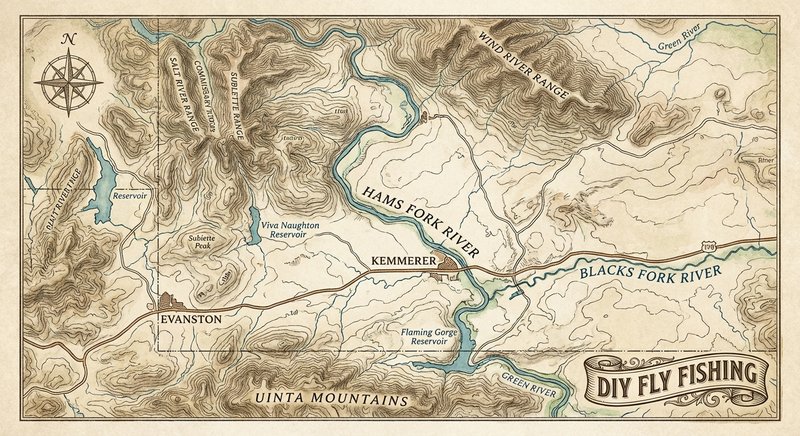
Hams Fork
Fly fishing in Wyoming · Beginner · Best seasons: Summer, Fall
Target Species
Cutthroat Trout, Brown Trout
About This Water
Southwest Wyoming stream with cutthroat and brown trout. Less pressured water.
Fishing Recommendations
Welcome to one of Wyoming’s best-kept secrets. As your guide, I’m excited to walk you through the Hams Fork, a high-desert gem located in Southwestern Wyoming near the town of Kemmerer. This is "big fish, small water" territory at its finest.
🎣 Location Overview
The Hams Fork is a tailwater fishery flowing primarily from the Viva Naughton Reservoir. It meanders through high-desert sagebrush flats and willow-lined meadows. What makes this water special is its character: it is a relatively narrow, intimate stream that holds surprisingly large fish—often referred to by locals as "Kemmerer Monsters."
The water is generally clear and cold, characterized by tight "S-curves," deep undercut banks, and classic riffle-run-pool sequences. Anglers love it because it offers a technical challenge without the overwhelming crowds of the Green or Snake rivers. It feels like classic, wild Wyoming.
🐟 Target Species & Behavior
- Bonneville Cutthroat Trout: This is the native crown jewel of the Hams Fork. They are opportunistic feeders but can be wary in the slower, flatter sections of the river. They are known for their stunning colors and willingness to rise to a well-placed dry fly.
- Brown Trout: The browns here are the "predators" of the system. They lurk in the darkest undercuts and the deepest tail-outs of pools. During the fall, they become highly aggressive as they prepare for the spawn.
Behavior Note: Because the river is narrow, these fish are "bank-oriented." They rely on the overhanging willows for cover and the undercut banks for safety from ospreys and eagles. If you see a deep shadow against a bank, there is a fish there.
📅 Best Times to Fish
Optimal Seasons
- Summer (July – August): This is the peak of the dry fly season. Once the spring runoff (if any, given the dam) subsides and the water stabilizes, the insect activity explodes.
- Fall (September – October): My personal favorite time. The crowds vanish, the Brown Trout start moving, and the "hopper" fishing remains excellent until the first hard freeze.
Best Times of Day
- Summer: Early mornings for trico or midge hatches, and late evenings (the "magic hour") for caddis activity.
- Fall: Mid-day is best. As the water warms slightly between 11:00 AM and 3:00 PM, the fish become most active.
🪰 Recommended Flies & Techniques
Dry Flies
- Chubby Chernobyl (Size 10-14): Gold, Purple, or Red. Use this as your "indicator" fly in a dry-dropper rig.
- PMDs & Yellow Sallies (Size 16-18): Essential for July.
- Hopper Patterns (Size 8-12): Pink or Tan foam hoppers are deadly in August and September.
- Parachute Adams (Size 16-20): The ultimate "searching" pattern for when fish are rising but you can't quite tell what they're taking.
Nymphs
- Zebra Midge (Size 18-22): Red or Black. A tailwater staple.
- Pheasant Tail (Size 16-20): Flashback versions work well in the riffles.
- Pat’s Rubber Legs (Size 10-12): Great for enticing larger fish in the deeper holes.
Streamers
- Gold or Olive Sparkle Minnows: Very effective for the aggressive Browns.
- Woolly Buggers (Size 8-10): Black or Thin Mint.
Presentation Tips
The Hams Fork requires a stealthy approach. Don't march right up to the bank; stay back 5-10 feet and cast from your knees if necessary. Long leaders (9-12 feet) and light tippet (5X or 6X) are often required for the slower pools, while a standard 4X or 5X rig works fine for the riffles.
💡 Pro Tips & Local Knowledge
- The "S-Curve" Strategy: Don't waste too much time in the straight, shallow stretches. Focus your energy on the outside bends where the current has carved out deep troughs.
- The Dry-Dropper is King: This is the most effective way to fish the Hams Fork. Hang a small Zebra Midge or Pheasant Tail 18-24 inches below a buoyant foam hopper.
- Wade Quietly: The substrate is often gravel and silt. If you stumble or kick rocks, the vibrations will spook fish 30 yards downstream.
- Look for "Ledges": There are underwater shelves where the shallow water suddenly drops into a deep emerald green. Fish sit right on that edge waiting for food to drop over.
⚠️ Important Information
Access
Most public fishing occurs on Bureau of Land Management (BLM) land or through Wyoming Game & Fish "Walk-In" areas. The most popular access is immediately below the Viva Naughton Reservoir dam. Be very mindful of private property boundaries; Wyoming law is strict regarding trespassing—stay within the high-water marks or on designated public land.
Regulations & Permits
- A valid Wyoming Fishing License is required.
- An Invasive Species Decal is required if you are using a float tube or any watercraft.
- Check the current Wyoming Game & Fish Department regulations for any seasonal "Hoot Owl" (temperature) restrictions or specific creel limits.
Special Considerations
- Moose Safety: This area is prime moose habitat. They are often found in the thick willows along the river. Give them a wide berth; they can be more dangerous than bears.
- Wind: It’s Wyoming. Be prepared for high-plains winds. A 5-weight rod is standard, but if the wind picks up, a 6-weight will help you punch through the gusts.
Tight lines, and enjoy the solitude of the Hams Fork!
Bug Hatches & Matching Flies
| Hatch | Type | Peak months | Time of day | Hook sizes | Matching flies |
|---|---|---|---|---|---|
| Midges Chironomidae | midge | January, February, March, April | Late Morning/Afternoon | #18-24 | Zebra Midge #18-22, Griffith's Gnat #20-22, Mother's Day Midge #20-24 |
| Blue Winged Olive Baetis | mayfly | April, May, September, October | Late Morning/Afternoon | #16-22 | RS2 #18-22, Parachute Adams #16-20, JujuBaetis #18-22 |
| Pale Morning Dun Ephemerella inermis | mayfly | July, August | Late Morning/Early Afternoon | #14-18 | PMD Sparkle Dun #16-18, Pheasant Tail #14-18, Split Case PMD #16-18 |
| Western Green Drake Drunella doddsii | mayfly | June, July | Afternoon | #10-12 | Hair Wing Green Drake #10-12, 28-Incher #10-12, Quigley Cripple #12 |
| Spotted Sedge Hydropsyche | caddis | June, July, August | Evening | #14-18 | Elk Hair Caddis #14-18, LaFontaine's Sparkle Pupa #14-16, Holy Grail Caddis #14-16 |
| Little Yellow Sally Isoperla | stonefly | July | Afternoon/Evening | #14-16 | Yellow Stimulator #14-16, Iron Lotus #16, Sally Side-Down #14-16 |
| Trico Tricorythodes | mayfly | August, September | Early Morning | #20-24 | Trico Spinner #20-24, Sunken Trico Spinner #22, Drowned Trico #20-22 |
| Grasshoppers Acrididae | terrestrial | August, September | Late Morning/Afternoon | #8-12 | Chubby Chernobyl #8-12, Morrish Hopper #10-12, Parachute Hopper #12 |