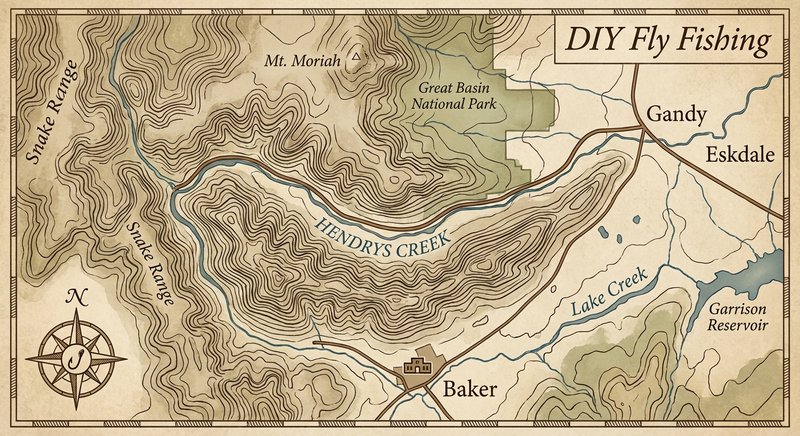
Hendrys Creek
Fly fishing in Nevada · intermediate · Best seasons: summer, fall
Target Species
Bonneville Cutthroat Trout
About This Water
Great Basin National Park stream with Bonneville cutthroat. Native trout restoration.
Fishing Recommendations
Hendrys Creek is one of the hidden gems of the Great Basin. Located on the eastern slopes of the Snake Range in Eastern Nevada, near Great Basin National Park, this is a rugged, high-gradient stream that offers a quintessential "blue-lining" experience. This is not a place for long casts and drift boats; it is a place for hiking boots, short rods, and some of the most beautiful native trout in the American West.
🎣 Location Overview
Hendrys Creek is a remote mountain stream that flows through a dramatic canyon within the Mount Moriah Wilderness. What makes this water special is its isolation and its role as a sanctuary for pure-strain Bonneville Cutthroat Trout.
The water is crystal clear, cold, and fast-moving. The stream character is dominated by "pocket water"—a series of small plunge pools, tight riffles, and undercut banks lined with birch, willow, and wild rose. Anglers love Hendrys because you can spend an entire day on the water without seeing another soul, surrounded by limestone cliffs and high-desert flora.
🐟 Target Species & Behavior
The primary (and prized) target here is the Bonneville Cutthroat Trout (BCT).
- Behavior: These are opportunistic feeders. Because the growing season at high elevations is short and nutrients are scarce, these fish are generally eager to rise to a well-placed dry fly.
- Size: Do not expect monsters. A 10-inch fish is a "trophy" here, with most averaging 6–8 inches. However, what they lack in size, they make up for in striking orange slashes and vivid spotting.
- Holding Spots: Look for the "bubble line." In such fast water, fish hide in the soft spots behind boulders, in the deep dark centers of plunge pools, and right against the brushy banks where terrestrial insects fall in.
📅 Best Times to Fish
Due to its elevation, timing is everything at Hendrys Creek.
- Summer (Late June – August): This is the prime window. Once the spring runoff subsides (usually by late June), the fish become very active. This is the best time for dry fly fishing.
- Fall (September – early October): This is my favorite time. The canyon colors change, the air is crisp, and the trout are feeding aggressively to bulk up for the long winter.
- Time of Day: Unlike lower-elevation rivers, you don't need to be there at the crack of dawn. High mountain water stays cold; wait for the sun to hit the water (10:00 AM – 4:00 PM) to trigger insect activity.
🪰 Recommended Flies & Techniques
The brushy nature of Hendrys Creek dictates your gear. I recommend a 7-foot to 8-foot 2-weight or 3-weight rod. A standard 9-foot rod is often too long for the overhanging canopy.
Top Fly Patterns
- Dry Flies:
- Stimulators (Size 14-16): Orange or Yellow. These mimic adult stoneflies and grasshoppers.
- Elk Hair Caddis (Size 16-18): A staple for any Nevada mountain stream.
- Royal Wulff or Humpy: High-visibility flies that float well in turbulent pocket water.
- Terrestrials:
- Black Ants or Foam Beetles (Size 16-18): Deadly in late summer.
- Nymphs:
- Pheasant Tail or Gold-Ribbed Hare’s Ear (Size 16-20): If they aren't rising, drop one of these 12 inches below your dry fly.
Presentation Tips
- The "Dap": Often, you won't even cast. You’ll poke your rod tip through the willows and drop the fly on the water.
- Short Leashes: Keep your casts under 15 feet. Accuracy is more important than distance.
- One-and-Done: These fish are wild and spooky. If you don't get a strike on the first two clean drifts, move to the next pocket.
💡 Pro Tips & Local Knowledge
- Stealth is Mandatory: The water is skinny and clear. If you stand tall on a rock over a pool, the fish will see your silhouette and head for cover. Wear earthy colors (camo, olive, or tan) and stay low.
- Work Upstream: Always fish facing upstream so you approach the fish from behind their field of vision.
- The "Top of the Pool" Trick: Everyone fishes the deep tail of the pool. Experienced guides know the biggest Cutthroat often sit right at the very head of the pool, where the white water enters, waiting for the first crack at incoming food.
- High Clearance is Key: The road to the Hendrys Creek trailhead can be rough. A high-clearance 4WD vehicle is highly recommended.
⚠️ Important Information
- Access: Access is via the Hendrys Creek Trailhead on the east side of the Snake Range (north of Hwy 6/50). Be prepared for a hike; the best fishing starts a mile or two up the trail from the wilderness boundary.
- Regulations:
- A valid Nevada Fishing License is required.
- Check current NDOW (Nevada Department of Wildlife) regulations for specific bag limits. Many anglers choose to practice 100% Catch and Release here to protect the native BCT population.
- Barbless hooks are highly recommended to minimize stress on these native fish.
- Safety: This is remote country. Cell service is non-existent. Carry plenty of water, bear spray (though encounters are rare, they are present), and be mindful of rattlesnakes at the lower trailhead elevations.
- Leave No Trace: This is a wilderness area. Pack out everything you pack in and keep this pristine habitat beautiful.
Bug Hatches & Matching Flies
| Hatch | Type | Peak months | Time of day | Hook sizes | Matching flies |
|---|---|---|---|---|---|
| Blue Winged Olive Baetis spp. | mayfly | April, May, September, October | Mid-day | #18-22 | BWO Sparkle Dun #18-20, RS2 #20-22, Pheasant Tail #18-20 |
| Pale Morning Dun Ephemerella excrucians | mayfly | June, July | Late Morning/Afternoon | #14-18 | PMD Parachute #16, Hares Ear Nymph #14-16, Quill Gordon #16 |
| Little Yellow Stonefly Isoperla spp. | stonefly | June, July, August | Afternoon/Evening | #14-16 | Yellow Sally Dry #14-16, Iron Lotus #16 |
| Spotted Sedge Hydropsyche spp. | caddis | July, August | Evening | #14-18 | Elk Hair Caddis #14-16, LaFontaine's Deep Sparkle Pupa #16 |
| Golden Stonefly Hesperoperla pacifica | stonefly | June, July | All Day | #8-12 | Pat's Rubber Leg Stone #8-12, Chubby Chernobyl #10-12 |
| Terrestrials Formicidae / Acrididae | terrestrial | July, August, September | Afternoon | #10-16 | Parachute Ant #14-16, Morrish Hopper #10-12, Black Beetle #14 |
| Midges Chironomidae | midge | March, April, November | Mid-day | #20-24 | Zebra Midge #20-22, Griffith's Gnat #20-22 |
| American Grannom Brachycentrus occidentalis | caddis | May | Afternoon | #14-16 | Peacock Caddis #14-16, Caddis Larva #14-16 |