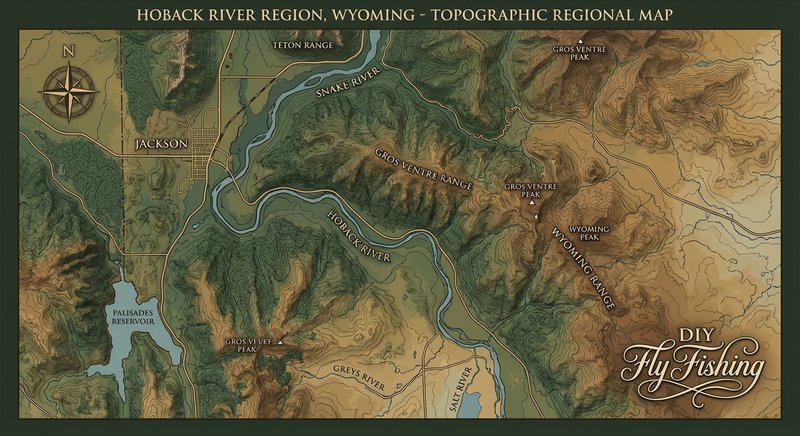
Hoback River
Fly fishing in Wyoming · Intermediate · Best seasons: Summer, Fall
Target Species
Cutthroat Trout, Mountain Whitefish
About This Water
Snake River tributary south of Jackson. Cutthroat and whitefish in canyon water.
Fishing Recommendations
The Hoback River is one of the most scenic and rewarding freestone rivers in the Greater Yellowstone Ecosystem. A major tributary to the Snake River, it offers classic Western fly fishing without the heavy boat traffic found on the main stem. As your guide, here is the lowdown on how to master the Hoback.
🎣 Location Overview
The Hoback River flows through a dramatic landscape, transitioning from the high-altitude willow flats of the Bondurant basin into a rugged, boulder-choked canyon before joining the Snake River at "Hoback Junction."
What makes it special is its wild character. Unlike the dam-controlled rivers in the region, the Hoback is a true freestone stream. It is highly susceptible to spring runoff, which often keeps it unfishable until late June or early July. Once it clears, it becomes a "dry fly paradise." Anglers love it for its accessibility—Highway 191 parallels much of the river—and for the aggressive nature of its resident trout.
🐟 Target Species & Behavior
- Snake River Fine-spotted Cutthroat: This is the star of the show. These fish are native only to this specific drainage. They are famous for their willingness to rise to large attractor dry flies. They are "opportunistic feeders," meaning they don't have the luxury of being picky in the fast-moving water.
- Holding Water: They love "soft" water. Look for them behind large boulders, in the seams between fast and slow water, and tucked tight against the willow banks in the meadow sections.
- Mountain Whitefish: Often underrated, the "Whities" in the Hoback grow large and fight hard.
- Holding Water: They congregate in the deeper, slower pools and tailouts. If you aren't catching Cutthroats but are hook-ups are frequent on the bottom, you’ve found the Whitefish school.
📅 Best Times to Fish
- Summer (July – August): This is prime time. Once the river drops and clears (usually by the first or second week of July), the fish are hungry and looking up. The Golden Stonefly and Yellow Sally hatches in July are legendary.
- Fall (September – October): My personal favorite. The cottonwoods turn gold, the water is low and crystal clear, and the fish are putting on weight for winter. Terrestrial fishing (hoppers) is peak in September.
- Best Time of Day: During mid-summer, the "9 to 5" window is best. There is no need for an alpine start; wait for the sun to hit the water to activate the bugs. In the heat of August, mornings and late evenings are more productive.
🪰 Recommended Flies & Techniques
Top Fly Patterns
- Dry Flies:
- Chubby Chernobyl (Size 8-12, Gold, Purple, or Red): The ultimate searcher pattern.
- Purple Haze (Size 14-16): Works when they are being slightly more selective.
- Stimulators (Size 10-14, Orange or Yellow): Great for mimicking stoneflies.
- Hopper Patterns (Size 8-12, Tan or Pink): Essential for August and September.
- Nymphs:
- Pat’s Rubber Legs (Size 8-12, Coffee/Black): The best stonefly mimic for deeper canyon pockets.
- Prince Nymph or Pheasant Tail (Size 14-16): Classic droppers.
- Streamers:
- Gold Sparkle Minnow or Black Wooly Bugger: Use these in the deep canyon pools or on overcast days.
Techniques
- The Hopper-Dropper: This is the bread and butter of the Hoback. Tie on a buoyant Chubby Chernobyl and hang a weighted nymph (like a Pheasant Tail) 2–3 feet below it. This covers both the surface and the mid-water column.
- Pocket Water Picking: In the canyon stretches, don't spend too much time in one spot. Hit the "pockets" behind rocks with short, accurate casts. If a Cutthroat is there, he will usually hit within the first three drifts.
💡 Pro Tips & Local Knowledge
- The "Granite Creek" Factor: Granite Creek flows into the Hoback about midway through the canyon. After a heavy rain, Granite Creek can "blow out," turning the Hoback chocolate milk below the confluence. If the lower river looks muddy, drive above the Granite Creek confluence; it will likely be crystal clear.
- Bank Tight: In the upper meadow sections (near Bondurant), the Cutthroats will sit literally inches from the grassy banks under the overhanging willows. If your fly isn't within 6 inches of the grass, you're missing fish.
- Wading Safety: The rocks in the Hoback Canyon are notoriously slick and often "tippy." I highly recommend felt-soled boots (where legal) or studs, and a wading staff is a life-saver here.
⚠️ Important Information
- Access: Much of the Hoback Canyon is within the Bridger-Teton National Forest, providing excellent public access with many pull-offs along Highway 191. However, the upper section near Bondurant has significant stretches of private ranch land. Look for WyDOT or Game & Fish signs marking public access points.
- Regulations:
- A valid Wyoming Fishing License is required.
- An Invasive Species Decal is required if you are bringing any watercraft (even a paddleboard or raft).
- Always check the current Wyoming Game & Fish "Area 1" regulations for specific creel limits, though catch-and-release is highly encouraged for wild Cutthroats.
- Bear Safety: This is Grizzly and Black Bear country. Even though you are near the road, you are in a wild corridor. Always carry bear spray on your person (not in your pack) and know how to use it.
Guide’s Final Word: The Hoback is a "happy" river. The fish are beautiful, the scenery is world-class, and the fishing is straightforward. Keep your fly floating high, watch for the "slash" of a Cutthroat, and enjoy the Wyoming air.
Bug Hatches & Matching Flies
| Hatch | Type | Peak months | Time of day | Hook sizes | Matching flies |
|---|---|---|---|---|---|
| Salmonfly Pteronarcys californica | stonefly | June, July | All Day | #4-8 | Chubby Chernobyl (Orange) #6-10, Pat's Rubber Legs (Black/Orange) #4-8, Sofa Pillow #6-8 |
| Golden Stonefly Hesperoperla pacifica | stonefly | June, July | Morning/Afternoon | #8-12 | Rogue River Stone #8-10, Iron Sally #12-14, Yellow Stimulator #10-12 |
| Green Drake Drunella doddsii | mayfly | July, August | Afternoon | #10-12 | Hair Wing Green Drake #10-12, Drake Emerger #12, 20 Incher Stone #10-12 |
| Blue Winged Olive (BWO) Baetis | mayfly | April, May, September, October | Late Morning/Afternoon | #16-20 | Parachute Adams #16-20, Pheasant Tail #18-20, RS2 (Grey/Olive) #18-22 |
| Pale Morning Dun (PMD) Ephemerella | mayfly | July, August | Late Morning/Afternoon | #14-18 | Sparkle Dun #16-18, Frenchie #14-16, Split Case PMD #16 |
| Yellow Sally Isoperla | stonefly | July, August | Afternoon/Evening | #14-16 | Yellow Sally Stimulator #14-16, Copper John (Yellow) #14-16, Little Yellow Sloan #16 |
| Spotted Sedge (Caddis) Hydropsyche | caddis | July, August, September | Evening | #14-18 | Elk Hair Caddis (Tan) #14-18, LaFontaine's Deep Sparkle Pupa #14-16, X-Caddis #16 |
| Terrestrials (Grasshoppers) Orthoptera | terrestrial | August, September | Late Morning/Afternoon | #8-14 | Hopper Juan #10-12, Morrish Hopper #8-12, Black Foam Ant #16-18 |