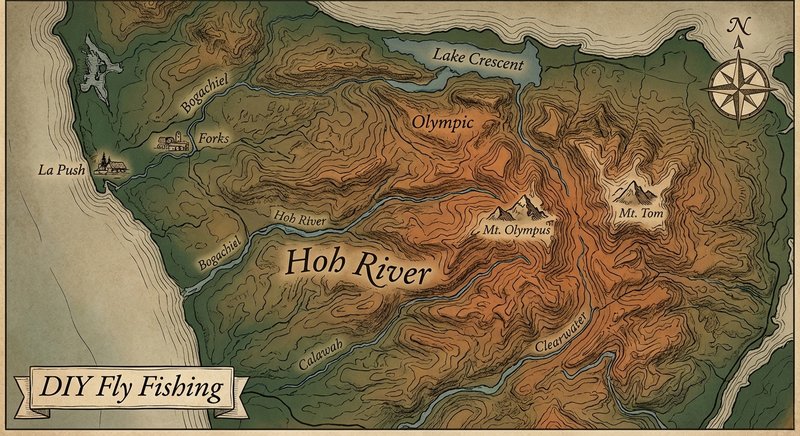
Hoh River
Fly fishing in Washington · Advanced · Best seasons: Fall, Winter, Spring
Target Species
Steelhead, Chinook Salmon
About This Water
Olympic Peninsula rainforest river with world-class winter steelhead. Pristine wilderness fishing in temperate rainforest.
Fishing Recommendations
Welcome to the "Rainforest River." As a guide on the Olympic Peninsula (OP), I can tell you that the Hoh River is the crown jewel of Washington’s coastal waters. It is a place of ancient moss-covered sitka spruce, glacial-fed turquoise water, and some of the largest, hardest-fighting wild salmonids on the planet.
Here is your comprehensive guide to fly fishing the Hoh River.
🎣 Location Overview
The Hoh River originates from the glaciers of Mount Olympus and flows roughly 50 miles to the Pacific Ocean. It is the quintessential Olympic Peninsula river.
What makes it special: The Hoh is one of the few remaining strongholds for wild, legendary "bi-run" steelhead. Because it is glacial-fed, it carries a unique "glacial flour" that gives the water a milky, iridescent turquoise hue. The river is incredibly dynamic; high-flow events constantly shift the gravel bars and rearrange massive logjams, meaning the "honey hole" you fished last year might be a dry bar this year. It is rugged, remote, and offers a true wilderness experience.
🐟 Target Species & Behavior
Wild Winter Steelhead
The stars of the show. These fish are known for their immense size (often exceeding 20 lbs) and chrome-bright strength.
- Behavior: They are "resting" on their way to spawn. They aren't actively feeding, but they are territorial and aggressive.
- Holding Water: They love "walking pace" water—about the speed of a comfortable stroll. Look for tailouts, the soft edges of main currents, and "inside" seams.
Chinook (King) Salmon
Both Spring and Fall runs enter the Hoh. These are the heavyweights of the river.
- Behavior: Hoh Kings are notorious for sitting deep in heavy "bucket" water or at the heads of deep pools.
- Holding Water: Deep slots, under heavy logjams, and in the "gut" of the run where the current is strongest.
📅 Best Times to Fish
- Winter Steelhead (Late December – April): This is the prime season. February and March are the peak months for the largest wild fish.
- Fall Chinook (September – November): The "October Caddis" season coincides with the return of heavy fall Kings.
- Optimal Conditions: The Hoh is notoriously "moody" due to the high rainfall in the Olympic Rainforest. The best fishing occurs when the river is dropping and clearing after a rain event.
- The "Hoh Green": Look for 2 to 4 feet of visibility. If the water looks like "milky jade," you are in the prime window.
🪰 Recommended Flies & Techniques
Swinging Flies (Spey Casting)
This is the traditional and most rewarding way to fish the Hoh.
- The Gear: 7–9 weight Spey rods, 12.5' to 14' long. Skagit heads are essential for throwing heavy sink tips and large flies.
- The Flies:
- Steelhead: Intruders in pink/orange, black/blue, or "Nightshade" (purple/black). Hobo Speys and Prom Dresses are local favorites.
- Chinook: Large, flashy patterns. Comets, Squidros, or anything with heavy lead eyes to get down to the "bucket."
- Technique: Cast 45 degrees downstream, mend to sink the fly, and let it swing through the current. Most strikes occur at the "dangle" when the fly straightens out.
Nymphing / Indicator Fishing
Highly effective for covering specific slots or fishing around heavy wood.
- The Gear: 9 or 10-foot single-hand 8-weight rod.
- The Flies: Large beads (10mm-12mm) in mottled orange or "clown" colors, or heavy stonefly nymphs.
💡 Pro Tips & Local Knowledge
- Respect the Wood: The Hoh is full of massive cedar and spruce root balls. While they eat flies, they also hold the biggest fish. Experienced guides fish "tight to the timber." If you aren't losing a few flies a day, you aren't fishing where the fish are.
- The "Inside" Move: Many anglers over-cast the Hoh. In high, colored water, steelhead will often be resting just 5-10 feet from the bank in the softest water available. Fish your close water before wading in.
- Read the USGS Gauges: Before driving out, check the USGS Hoh River at Highway 101 gauge. If the graph is a vertical line upward, stay home. If it’s a slow downward slope, get your gear ready.
- Cover Water: The Hoh is a "numbers game" regarding steps. Cast, swing, step, repeat. Don't linger in one run for three hours; find the "player" (the aggressive fish) and move on.
⚠️ Important Information
- Regulations: Check the WDFW (Washington Department of Fish & Wildlife) emergency rules frequently. The Hoh is subject to sudden closures to protect wild fish counts.
- Wild Fish Policy: Almost all wild steelhead must remain in the water. Barbless hooks are mandatory.
- Access:
- Upper River: Access through the Olympic National Park (requires a park pass).
- Middle River: Numerous pull-outs along the Upper Hoh Road and the "Oxbow" area.
- Lower River: Access through the Hoh Tribal Reservation (be sure to check for local permits/access rules) or the Oil City road.
- Safety: The Hoh is a powerful, cold river. Wading boots with studs and a wading staff are non-negotiable. If you are floating the river, be extremely wary of "sweepers" (fallen trees) which can be lethal in the heavy current.
Guide’s Final Word: Bring your best rain gear, a thermos of coffee, and a sense of wonder. Even if you don't hook a 20lb chrome steelhead, standing in the mist of the Hoh valley is a spiritual experience for any fly angler.
Bug Hatches & Matching Flies
| Hatch | Type | Peak months | Time of day | Hook sizes | Matching flies |
|---|---|---|---|---|---|
| Western March Brown Rhithrogena morrisoni | mayfly | March, April | Midday to Afternoon | #12-14 | March Brown Emerger #12-14, Parachute March Brown #12-14, Hare's Ear Nymph #12-14 |
| Blue Winged Olive (BWO) Baetis tricaudatus | mayfly | March, April, October, November | Late Morning to Afternoon | #16-20 | RS2 #18-20, Blue Winged Olive Parachute #16-20, Pheasant Tail Nymph #16-20 |
| Golden Stonefly Hesperoperla pacifica | stonefly | June, July | All Day | #6-10 | Pats Rubber Legs (Gold/Brown) #6-10, Chubby Chernobyl (Gold) #8-10, Golden Stone Nymph #8-12 |
| October Caddis Dicosmoecus gilvipes | caddis | September, October | Afternoon to Evening | #8-10 | Orange Stimulator #8-10, Morrish October Caddis #8-10, Peeping Caddis Nymph #8-12 |
| Pale Morning Dun (PMD) Ephemerella excrucians | mayfly | June, July, August | Late Morning to Early Afternoon | #14-18 | PMD Sparkle Dun #16-18, Split Case PMD #14-16, PMD Parachute #14-18 |
| Yellow Sally Isoperla spp. | stonefly | June, July, August | Afternoon to Evening | #14-16 | Yellow Sally Stimulator #14-16, Little Yellow Stone Nymph #14-16, Crystal Sally #14-16 |
| Skwala Stonefly Skwala americana | stonefly | February, March | Midday | #10-12 | Skwala Stone Nymph #10-12, Bullet Skwala #10-12, Olive Stimulator #12 |
| Salmonfly Pteronarcys californica | stonefly | May, June | All Day | #4-8 | Kaufmann's Stone Nymph (Black) #4-8, Clark's Stonefly #6-8, Bitch Creek Nymph #6-8 |
| Spotted Sedge Hydropsyche | caddis | July, August, September | Evening | #14-16 | Elk Hair Caddis (Tan) #14-16, Hydropsyche Larva #14-16, Soft Hackle Hare's Ear #14-16 |